

FAA Caribbean Caution NOTAM Through Feb 2
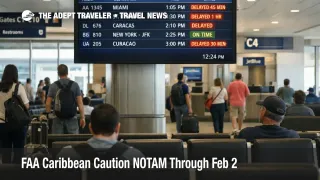
The Federal Aviation Administration is still warning U.S. operators to use caution across key Caribbean airspace, keeping a caution NOTAM in effect through February 2, 2026. That matters for travelers because an advisory can still lead airlines and dispatchers to operate more conservatively, especially on days when schedules are already tight and spare aircraft are limited. If your trip relies on same day arrivals for a cruise embarkation or a fixed resort check in, the practical move is to add buffer, reduce connection complexity, and monitor for day of flight retimes that signal the airline is still smoothing its network.
The caution posture follows an earlier, short lived set of Caribbean flight restrictions tied to the Venezuela escalation in early January. Those prohibitions were lifted on January 4, 2026, but the replacement posture still flags military activity risk, which is why the recovery can look uneven even when many flights have resumed.
The Caribbean FAA caution NOTAM is a reliability problem more than a capacity headline. The advisory remains active through February 2, 2026, and that can keep operations more fragile for travelers who have no slack in their itineraries.
Who Is Affected
Travelers flying into, out of, or through the San Juan Flight Information Region are among the most exposed because it covers Puerto Rico and the U.S. Virgin Islands, and it sits under common routings that feed Eastern Caribbean arrivals and departures. For passengers, this shows up as a greater chance of dispatch driven reroutes, tactical fuel planning, and conservative go, no go decisions when the day starts to drift.
Caribbean itineraries that touch Aruba and Curaçao are also in the higher exposure set because the FAA issued a parallel advisory for the Curaçao Flight Information Region through the same February 2 endpoint. In practice, that can matter even if you never see "airspace" mentioned in an airline alert, because these decisions can manifest as small schedule changes, longer block times, and fewer clean backup options when disruptions stack.
Southern Caribbean routings tied to Trinidad and Tobago can face similar caution posture. The FAA advisory for the Piarco Flight Information Region also runs through February 2, 2026, and it explicitly calls out military activity risk at all altitudes for the covered area. That can ripple into resort traffic flows, regional connections, and cruise positioning days when airlines are trying to keep aircraft and crews in sequence.
Finally, travelers whose routings run close to Venezuelan airspace, or who are booked on carriers that choose wider avoidance buffers, can still see variability because the FAA continues to warn of military activity in or around Venezuela. Even when you are not traveling to Venezuela, this can change how airlines route across the region, which is why two itineraries that look similar on paper can behave differently on the day.
What Travelers Should Do
Start with immediate actions and buffers. If you are traveling for a cruise or an all inclusive changeover, treat same day arrival as optional when you can, and move to an arrival the day before. If you must arrive same day, prefer the earliest flight of the morning, keep transfers simple, and avoid separate tickets that leave you unprotected if the first flight slips.
Use a clear decision threshold for rebooking versus waiting. If missing embarkation, a paid tour start, or a nonrefundable night would create a cascading loss, rebook now to a routing with more slack, even if the itinerary is longer. If your plans are flexible and you have a protected booking with multiple later backups, waiting can be reasonable, but only if you can accept an overnight outcome if recovery turns uneven again.
Monitor the next 24 to 72 hours for signals that the caution posture is still shaping schedules. Watch for repeated retimes on your exact flight number, not just generic travel alerts, because persistent retimes usually mean airlines are building longer routings or more buffer into the plan. Also watch for any extension, replacement, or expansion of the FAA advisories as February 2 approaches, because an extension can keep waiver policies and reaccommodation pressure in play.
How It Works
A caution NOTAM is not the same as a prohibition, but it can still change airline behavior. The FAA's language is effectively a risk flag to U.S. operators, which can push dispatchers toward more conservative routings, higher fuel margins, or avoidance of certain tracks when conditions look uncertain. On a normal day, those adjustments may be invisible to passengers. On a high load day, or on a network that is still rebalancing after earlier cancellations, the same adjustments can become the difference between an on time arrival and a late inbound aircraft that breaks the next departure.
The first order effect is tactical, longer routings, occasional airborne or ground delays, and last minute schedule changes that can reduce the number of clean reaccommodation options later in the day. The second order ripple is network timing. When block times grow or aircraft repositioning becomes less reliable, airlines lose the slack that normally absorbs small disruptions. That is when missed connections rise, standby lists grow, and travelers start competing for the same limited later departures into island airports with fewer daily frequencies.
Cruise and resort systems amplify that fragility. Cruise embarkation is a hard cutoff, and many all inclusive properties effectively behave the same way on transfer days, because a missed arrival can mean a lost night, a missed ground transfer, or a forced rebook into scarce last minute inventory. When flights roll, hub cities and gateway airports can see hotel demand spikes, and ground transportation plans can fail if they were built around a narrow arrival window.
For additional context on how airspace constraints cascade through airline schedules, see Delhi Airspace Closure, Delhi Airport Midday Delays and Lufthansa Tehran Flights Suspended Through March 29. For structural context on how the U.S. air traffic system absorbs stress and why resilience matters when conditions change quickly, see U.S. Air Traffic Control Privatization: Reality Check.
Sources
- Prohibitions, Restrictions and Notices, Federal Aviation Administration
- KICZ A0008/26 Advisory NOTAM, San Juan Flight Information Region (TJZS)
- KICZ A0009/26 Advisory NOTAM, Curacao Flight Information Region (TNCF)
- KICZ A0010/26 Advisory NOTAM, Piarco Flight Information Region (TTZP)
- KICZ A0011/26 Advisory NOTAM, Maiquetia Flight Information Region (SVZM)
- U.S. Military Action in Venezuela Triggers Caribbean Airspace Disruptions, Congressional Research Service
- US lifts Caribbean airspace curbs after attack on Venezuela, Reuters, January 3, 2026
- FAA issues warnings to airlines on Central, South American flights, Reuters, January 16, 2026