

Lufthansa Tehran Flights Suspended Through March 29
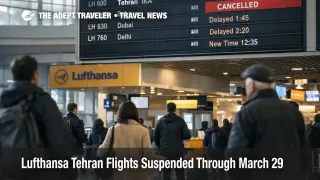
Lufthansa extended its suspension of passenger flights to Tehran, keeping the route offline through March 29, 2026, as the carrier continues to manage regional security risk. Travelers booked to Iran, or connecting through Lufthansa hubs to reach Iran on one ticket, are the most affected because the suspension removes a straightforward nonstop option. The practical move now is to decide quickly whether you can wait for a restart, or whether you should rebook onto an indirect routing with larger connection buffers while seats still exist.
The Lufthansa Tehran flight suspension matters because it pairs a capacity cut with ongoing Iranian airspace avoidance guidance, which keeps longer routings and higher schedule variance in the system even when airports are operating normally.
Who Is Affected
Passengers holding Lufthansa issued tickets that rely on Frankfurt Airport (FRA) to reach Tehran Imam Khomeini International Airport (IKA) are directly impacted, including travelers who chose Lufthansa specifically to minimize connection risk and keep the itinerary protected under one booking. Travelers connecting into Frankfurt from elsewhere in Europe or North America are also exposed because a single canceled long haul segment can break the entire day's sequencing, especially when the best alternates require a hub change and a longer layover.
Middle East and South Asia bound travelers who do not even touch Iran can still see second order impacts. When a large block of carriers detour around Iranian airspace, flight plans often shift east or south, block times grow, and the margin that absorbs small delays shrinks. That is the point where a routine late push or minor air traffic flow constraint becomes a missed bank connection at major hubs, and missed connections concentrate rebooking demand into fewer later departures.
Travelers on separate tickets face the highest financial downside. A reroute driven delay or a last minute cancellation on one booking can still trigger a no show on the other, and once you are forced into a new chain of segments, baggage, border formalities, and minimum connection times become additional failure points. If your trip includes a fixed event, medical appointment, cruise timing, or the last flight of the day to a smaller destination, treat this as a reliability problem, not a normal delay day.
What Travelers Should Do
Start with immediate actions and buffers. Pull your record locator, confirm whether Lufthansa has already reprotected you, then compare any offered itinerary against the hub's minimum connection time and your real tolerance for a misconnect. If the itinerary depends on a tight connection, move to an earlier inbound or a longer layover now, because once disruption queues build, the best remaining options disappear quickly.
Use a clear decision threshold for rebooking versus waiting. If arriving late creates cascading losses, for example a cruise embarkation, a paid tour start, a wedding, or a hard business deadline, reroute to an itinerary that arrives a day earlier or includes an intentional overnight at the hub. If your trip is flexible and all segments are on one ticket, waiting can be reasonable, but only if there are multiple later same day backups and your connection is comfortably above minimum.
Monitor the next 24 to 72 hours for three signals. First, any updated Lufthansa handling language that expands rebooking flexibility or extends the suspension again. Second, any changes to European conflict zone guidance that affect whether EU airlines are expected to keep avoiding Iranian airspace. Third, repeated schedule retimes on your specific flight number and city pair, because persistent retimes usually signal the carrier has accepted longer baseline routings, not a one off disruption. For additional system context, see Iran And Iraq Airspace Avoidance Extends Flight Times and the earlier Tehran specific decision point in Lufthansa Extends Tehran Flight Suspension to Jan 28.
How It Works
A route suspension removes inventory across many days, which changes traveler outcomes differently than a single day delay. The first order effect is straightforward, passengers on the suspended city pair are canceled and must choose between reimbursement and rerouting, depending on what the airline offers and what seats exist. Because the suspension runs through March 29, 2026, the recovery problem is not just today's reaccommodation, it is also future availability across multiple departure banks.
The parallel airspace layer is what keeps detours sticky. European safety guidance has advised EU operators not to operate within Iranian airspace, which pushes airlines into routings that avoid the Tehran flight information region and, in some cases, also reduce exposure to neighboring corridors. The first order operational consequence is longer distance, higher fuel burn, and less schedule slack. The second order ripple is network timing, longer block times push arrivals past connection banks, missed connections then concentrate rebooking demand into fewer later flights, and that scarcity increases overnight stays near hubs.
A third ripple shows up in crew and aircraft legality. When flights run longer, crew duty clocks tighten, aircraft rotations lose recovery margin, and dispatchers sometimes have to choose between adding margin, swapping aircraft, inserting a technical stop, or canceling a flight that can no longer be operated inside planned constraints. For travelers, this is why the safest play is usually not the shortest itinerary on paper, it is the itinerary with protected segments, conservative connection times, and a realistic backup path if the day's routing or airspace posture shifts again.
Sources
- Germany's Lufthansa Won't Fly To Tehran Until March 29, Spokeswoman
- Iran and neighbouring airspace (CZIB 2026-02)
- European regulator warns airlines not to fly in Iranian airspace
- European airlines continue to avoid Iran and Iraq despite airspace reopening
- Iran reopens airspace after temporary closure forced flights to reroute
- Air passenger rights
- Passenger rights
- Refunds