

Belgium Rail Strike Disrupts Airport Trains Jan 25-30
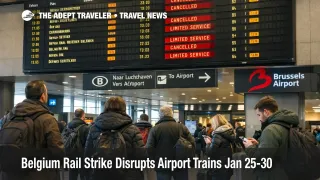
Belgium's national rail network is set to run on a reduced plan during a confirmed labor disruption window, creating a predictable, multi day reliability problem for travelers. SNCB NMBS says train availability will be limited from Sunday, January 25, 2026, at 10:00 p.m. CET through Friday, January 30, 2026, with service ending after the last trains. Travelers are affected because an alternative timetable will be built around staff availability, meaning the network can look normal on paper while specific trains and connections disappear, especially on the most commuter heavy corridors.
The practical move is to treat rail as a constrained resource for the entire window, not a one off bad commute. If you need to reach Brussels Airport (BRU) by train, connect through Brussels Midi, or stitch domestic rail into Eurostar or other international departures, plan around the alternative timetable as the real schedule, and assume fewer fallbacks if something slips.
Who Is Affected
Air travelers using rail to reach Brussels Airport are the first group exposed, because a thinner timetable increases the odds that the next viable train is too late for bag drop or boarding cutoffs. That risk rises further for early departures, for travelers with checked bags, and for anyone relying on a single specific connection rather than a flexible arrival window.
Rail travelers moving through Belgium's main hinge stations are also highly exposed, including Brussels Midi, Antwerp Central, and Liège Guillemins, because those nodes concentrate transfers. When frequency drops, transfer margins collapse, platforms crowd, and small delays become harder to absorb without missing the next leg.
Cross border itineraries face a different failure mode, the domestic feeder problem. Even if an international segment is operating, reduced Belgian domestic service can prevent you from reaching the departure station on time, which is how Eurostar check in windows, ICE departures, and other international rail plans fail. Travelers on separate tickets, including air plus rail combinations, take the biggest financial hit because a missed segment can be treated as a no show.
What Travelers Should Do
Act now if your itinerary is time bound, such as a flight departure, a meeting, a cruise embarkation, or a prepaid tour start. Build slack by moving critical travel earlier in the day, shifting travel outside the strike window where feasible, or adding a hotel night near Brussels Airport or your departure station so a late running connection does not collapse the entire trip.
Use a clear decision threshold for when to switch modes. If losing one or two trains would make you miss check in, break the last practical onward connection, or force a costly overnight, move to a road transfer plan as soon as you see that your preferred rail option is not running in the alternative timetable. If your plans can tolerate delay and you have multiple viable departures, waiting can be reasonable, but only if you are not chaining several tight legs where one cancellation breaks everything.
Over the next 24 to 72 hours, monitor the alternative timetable release and the operator status channels, not social chatter. SNCB NMBS and SNCB International updates are the most actionable signals, and Eurostar's travel updates are the fast check for knock on disruption at Brussels Midi. On the day you travel, recheck your specific train and your station access plan before you leave your lodging, because the reliability risk is highest when travelers assume the regular timetable will reappear.
How It Works
A national rail strike propagates through the travel system in two waves, capacity loss and recovery loss. The first order effect is direct, fewer staffed crews and dispatch resources mean fewer trains, bigger timetable gaps, and more fragile transfers at Brussels Midi, Antwerp, and Liège. That immediately hits airport access because rail is a primary feeder mode into Brussels Airport, and a thinner schedule pushes more travelers into taxis, rideshares, private transfers, and rental cars at the same time.
The second order ripple is where costs and misconnects accelerate. When domestic feeders thin, international rail segments become harder to use even if they are technically operating, because the last mile to the departure station fails. That is why Eurostar and other cross border trips can become unreliable without any single headline cancellation, it is the connection chain that breaks. As travelers switch modes, road corridors and car hire inventory tighten, and airport area hotels reprice as forced overnights rise, particularly for passengers who cannot risk missing a flight the next morning.
If you are trying to judge how fast Brussels area travel can cascade when a key layer fails, two recent patterns are worth keeping in mind. Europe Transport Strike Dates 2026 for Flights and Trains shows how clustered labor actions reduce recovery options across borders, and Brussels Airport Snow Cancellations Disrupt Connections illustrates how quickly Brussels Airport area plans can shift into rebooking pressure, mode shifts, and hotel compression when timing margins disappear.