

EASA Iran Airspace Warning To Lengthen Europe Asia Flights
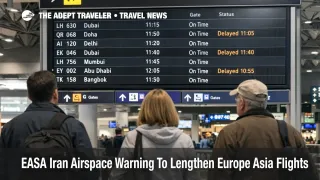
European aviation regulators are telling airlines to stay out of Iranian airspace as regional tensions rise, and as the risk of misidentification increases inside Iran's Tehran Flight Information Region. Travelers on Europe to Gulf, India, and Central Asia routings are the most exposed because many of those tracks normally cross Iran at cruise altitude. The practical move is to assume longer flights and more fragile connections for the next week, then build buffer or reroute early if your itinerary has no slack.
The European Union Aviation Safety Agency issued Conflict Zone Information Bulletin (CZIB) 2026-02 on January 16, 2026, recommending operators do not operate within Iran's Tehran FIR (OIIX) at any altitude or flight level. The bulletin also calls for heightened caution and contingency planning in neighboring airspace, particularly where U.S. military bases are located, and it directs operators to closely monitor regional aeronautical publications and updates. The CZIB is active, and is valid until February 16, 2026, unless reviewed earlier.
For travelers, the immediate effect is not a single airport closure, it is network math. When a large overflight corridor is removed, dispatchers push flights onto longer tracks, flight times grow, and the day's schedule loses slack. That can surface as retimed departures, longer layovers forced by missed arrival banks, occasional cancellations when aircraft and crews cannot stay in sequence, and more overnights in hub cities when the last wave of departures is missed.
Who Is Affected
Passengers routing between Europe and India, Europe and the Gulf, and Europe and Central Asia are the most consistently exposed, because many common great circle routings or preferred tracks normally traverse Iranian airspace. In practice, that includes itineraries that connect through big banks at hubs such as London Heathrow Airport (LHR), Frankfurt Airport (FRA), Istanbul Airport (IST), Dubai International Airport (DXB), Hamad International Airport (DOH), and Indira Gandhi International Airport (DEL), where a modest arrival slip can cascade into missed onward departures.
Travelers booked on European carriers that already route conservatively in the region may still see knock on effects, because avoidance concentrates traffic into fewer corridors and pushes longer block times into aircraft rotations. Reporting around the CZIB indicated multiple European airlines were already avoiding Iran and Iraq around the time of issuance, which is a sign that some schedule padding and tactical reroutes were already in motion before the advisory became the headline.
Itineraries with the highest personal downside are the ones with hard cutoffs. Same day cruise embarkations, escorted tours that do not wait, long haul repositioning flights for weddings or events, and separate ticket builds where the onward leg is not protected can all turn a one hour slip into a lost day. That risk is amplified when the connecting hub has limited later frequencies to your destination, or when your onward segment is the last departure of the day.
Cargo shippers, and travelers whose trips depend on cargo capacity, can also feel second order effects. When passenger flights take longer routes, payload and fuel tradeoffs can reduce available belly space, and when schedules get rebuilt, uplift can shift to different hubs or different departure windows. Industry risk trackers have been highlighting the same dynamic, longer Asia Europe routings and increased uncertainty, as operators avoid Tehran FIR and build broader contingency plans.
What Travelers Should Do
Start with immediate actions and buffers. Recheck your exact flight number in the airline app, not just the booking confirmation, because persistent retimes are the earliest signal that your carrier has rebuilt the route. If you have a connection, treat two hours as a floor for short haul to long haul moves, and three hours as a safer target for long haul to long haul banks at the biggest hubs, especially if you must clear passport control or change terminals.
Use a clear decision threshold for rebooking versus waiting. If a missed connection would force an overnight, break a cruise turn day, or strand you on a separate ticket without protection, rebook now to an itinerary with more slack, even if it is less direct. If your trip is flexible, and you are on a single protected ticket with multiple later backup options, waiting can be reasonable, but only if you can absorb a late arrival without losing prepaid nights or critical appointments.
Monitor the next 24 to 72 hours for the signals that actually predict traveler pain. Watch for repeated schedule changes on your specific route, waiver announcements that reduce change fees, and any extension or replacement of the EASA bulletin as February 16, 2026, approaches. Also watch your hub airport's late day arrival performance, because once the evening wave starts arriving late, reaccommodation desks clog, hotel inventory tightens, and the last departures become the hardest seats to secure.
How It Works
A Flight Information Region is the airspace block where an air navigation service provider provides air traffic control and flight information services. EASA's CZIB is not a universal legal ban for every airline worldwide, but it is a strong safety recommendation for EU regulated operators and EASA authorized third country operators operating to, from, or within the EU, and it usually translates into immediate dispatch and insurance driven routing decisions.
When airlines avoid a large FIR like Tehran (OIIX), reroute patterns usually consolidate into a few alternatives: tracks north via Turkey and the Caucasus, tracks south via the Arabian Peninsula, or longer arcs that thread through whatever neighboring airspace remains operationally acceptable that day. Longer tracks increase block time, and block time is what drives missed connections, crew legality, and aircraft rotation integrity. If an aircraft lands late at a hub, it may miss its next slot, its crew may time out, and the airline may cancel the following leg because there is no spare aircraft available at that station.
Those mechanics spread beyond aviation. Late arrivals raise misconnect rates, which pushes passengers into hub hotels, strains airport ground transport, and forces tour operators and cruise lines to manage late joining, missed embarkations, and reprotected air. That is the same reliability problem travelers have seen in other airspace caution stories, including FAA Caribbean Caution NOTAM Through Feb 2, where advisory posture can still produce conservative operations and uneven recovery when schedules are tight. For a deeper structural view of why the system loses slack quickly when constraints appear, see U.S. Air Traffic Control Privatization: Reality Check.