

Bayonne Odyssey Return Delayed, Royal Caribbean Impact
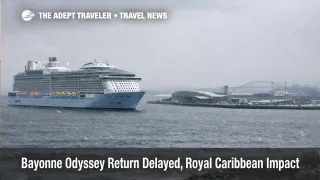
Royal Caribbean delayed Odyssey of the Seas returning to Cape Liberty Cruise Port in Bayonne, New Jersey, by one day as Winter Storm Fern disrupted land based travel and port operations in the U.S. Northeast. For guests onboard who expected to disembark on Monday, January 26, 2026, the change shifts the entire post cruise travel day and can break same day flights, prebooked transfers, hotel checkouts, and car returns. The practical move is to assume your onward plan needs a new Tuesday, January 27, 2026 timeline, then rebook flights and ground plans before storm recovery demand drains remaining inventory.
The Odyssey Bayonne return delay matters because the failure mode is not the ship itself, it is the tight chain after you clear the terminal. When disembarkation slips, airport transfer windows compress, airline change options narrow, and travelers end up competing for the same limited seats and rooms as other storm disrupted passengers.
Who Is Affected
Disembarking guests with Monday flights are the most exposed, especially anyone holding separate tickets, basic economy fares, or nonrefundable add ons that limit same day changes. Even if you can change your flight, the New York area air system may still be in a recovery backlog, which can reduce available seats and push rebooked itineraries into later departures or next day travel.
Travelers with fixed ground commitments are also exposed. That includes hotel stays with a Monday checkout, rental cars with fixed return times, prebooked private transfers timed to a normal morning disembarkation, and rail tickets that assume you can clear the terminal early. This is also a documentation heavy situation, because many reimbursement processes depend on a clear record of what you paid, what changed, and what the operator communicated.
Embarking guests on the next sailing are affected as well, because a late return often shortens the turnaround clock at the pier. That can change when baggage is staged, when check in lines build, and how strictly cutoff times are enforced, even if the ship ultimately sails on the revised plan.
What Travelers Should Do
Act immediately on flights and ground transfers. If your itinerary still shows a Monday departure from Newark Liberty International Airport (EWR), LaGuardia Airport (LGA), or John F. Kennedy International Airport (JFK), treat that as a high risk misconnect unless you have written confirmation of a disembarkation group that reliably supports the transfer. Rebook into later Tuesday departures where possible, and prioritize routings with fewer connections because winter recovery often produces rolling delays and equipment swaps that break tight itineraries.
Use a clear decision threshold for waiting versus rebooking. If you must be home by Tuesday night, or you have a hard work start Wednesday morning, do not gamble on limited standby space, rebook now into a protected seat, even if it costs more. If you have flexibility, a Wednesday flight can be the safer choice because it reduces exposure to same day port congestion and airline backlog.
Over the next 24 to 72 hours, monitor three layers, your ship communications for final debark timing, your airline for schedule changes and reaccommodation options, and local road conditions for the corridor between Bayonne and the airports. For broader system context in the same storm window, see Winter Storm Fern US Travel Disruptions Jan 25 to 26 and, for cruise side knock on patterns, Winter Storm Fern, U.S. Cruise Homeports Disrupted.
How It Works
A delayed cruise return becomes a travel system problem because ports, airports, and ground transport all rely on tightly timed staffing and throughput. At the source, a winter storm can slow or pause shore side operations needed for a safe turnaround, including docking support, baggage handling, customs and inspection staffing, and the basic ability for workers and arriving passengers to reach the terminal area safely. When those inputs are constrained, cruise lines may hold offshore and shift arrivals to protect safety and restore predictable operations.
Second order effects propagate quickly into aviation and lodging. A one day slip pushes thousands of travelers into the same compressed set of Tuesday flights, taxis, rideshares, rental cars, and hotel rooms, while airlines are simultaneously reaccommodating passengers from storm canceled flights elsewhere. That competition is why cruise passengers can face expensive last minute changes even when the ship is physically close to home, because the constraint is not nautical distance, it is the capacity of the land travel system to absorb a surge.
Royal Caribbean's guest guidance for this event indicates disembarkation is planned to begin around 7:00 a.m. on Tuesday, January 27, 2026, and the line outlined compensation and reimbursement pathways tied to the one day change. For travelers, that means the most important operational step is to re anchor your plan to the new morning window, then design buffers around airport transfers, baggage timelines, and airline check in cutoffs.