

Evacuation at Miami International Airport MIA Door 21
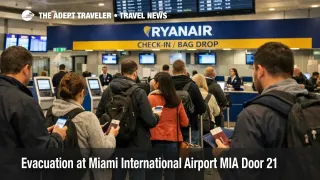
Unattended luggage left at Departures Door 21 triggered a precautionary evacuation at Miami International Airport (MIA) on Sunday, January 25, 2026. The response cleared passengers from parts of the South Terminal, including security checkpoints serving Concourses G, H, and J, after authorities treated the item as a potential threat until it was cleared. For travelers, the practical problem was not just the initial evacuation, it was the two stage disruption, first the abrupt move away from checkpoints and curbside, then the surge and re screening delays when the area reopened.
Authorities reported an all clear in the early evening after the Miami Dade Sheriff's Office bomb squad searched the area and found no threat. Local reporting placed the initial evacuation around 500 p.m., with reopening around 730 p.m., with at least one outlet citing a slightly later all clear time. The airport also warned of continued delays as the affected checkpoints and surrounding areas reopened.
Who Is Affected
Travelers departing from Concourses G, H, and J were the most exposed because checkpoint closures can strand passengers on the wrong side of security with boarding time still ticking. Anyone arriving by car or rideshare faced added risk because evacuations often spill into curbside and roadway management, creating stop and go traffic, lane closures, and confusion about where to be dropped off or picked up.
Connecting passengers were affected in a different way. Even if they were already airside elsewhere in the airport, delays in one terminal can trigger gate holds, missed departure slots, and late aircraft turns that ripple into downstream flights. That risk was higher than usual because the incident landed on a day when winter storm disruptions were already stressing schedules, which reduces the availability of backup flights and increases the odds that a missed departure becomes an overnight.
Travelers were also exposed to crowd dynamics. The Miami Dade Sheriff's Office said misinformation, including a false claim that shots were fired, contributed to confusion and panic during the response. That matters operationally because panic compresses decision time, separates groups, and increases the chance travelers abandon bags or documents, which then compounds delays during re screening.
What Travelers Should Do
If you were at MIA during the closure, assume you may need to re enter security and rebuild your timeline from scratch. Check your airline app for a new boarding time, confirm the departure gate after you regain signal, and screenshot the latest status in case the display changes again while you are in line. If you are still landside, pick the closest open checkpoint for your concourse once the airport directs you, and plan for a restart style delay rather than a quick restart.
Use a clear threshold for rebooking versus waiting. If you are within about 60 to 90 minutes of scheduled departure and you are not yet back through security, treat rebooking as the default, especially for international flights, flights with checked bags already cut off, or any itinerary with a tight connection. If your flight is delayed, your gate is holding, and you can see that security is moving steadily, waiting can be rational, but only if later same day alternatives still exist if you miss the cutoff.
Over the next 24 to 72 hours, monitor three signals: whether the airport reports lingering checkpoint or curbside constraints, whether your airline extends waivers that let you change without a fee, and whether winter storm recovery causes rolling cancellations that shrink your backup options. For broader system pressure that can limit reroute availability, compare conditions in Flight Delays and Airport Impacts: January 25, 2026. If you are flying American and you end up disrupted, the fastest path may be self service recovery through the carrier's tools described in American Airlines App Update Adds Delay Rebooking Tools.
How It Works
Unattended items in a departures area create a security dilemma because responders must treat an unknown object as potentially dangerous until it is cleared. That is why airports repeatedly tell travelers not to leave belongings unattended, and why the response can include evacuating the immediate area, pausing screening, and calling specialized resources such as a bomb squad. Even when the outcome is an all clear, the process creates a temporary capacity collapse at security, which is one of the most fragile choke points in the airport.
The first order effects are straightforward, checkpoints close, passengers are displaced, curbside and roadway flow gets managed for safety, and information spreads unevenly through crowds. The second order ripples are what tend to break itineraries. When screening restarts, passengers surge back at once, which can create a second queue that is longer than the first. Late arriving crews and aircraft then miss planned turns, which can delay later departures even for travelers who were never near the original incident.
Finally, disruption stacks. When a weather event is already driving cancellations nationwide, a local security incident becomes more costly because airlines have fewer spare aircraft, fewer open seats, and less hotel inventory to recover stranded passengers. That combination is why the practical traveler move is to preserve optionality early, and to treat any terminal wide evacuation as a missed flight risk event, not a minor delay.
For a deeper look at how system bottlenecks propagate across hubs even when the original issue is not weather, see U.S. Air Traffic Control Privatization: Reality Check.
Sources
- Partial MIA evacuation over unattended luggage at airport
- Unattended luggage prompts evacuation at Miami International Airport
- MIA gives all clear to resume operations after precautionary evacuation
- No shots fired at MIA during precautionary evacuation: Sheriff
- Operations resume at Miami International Airport after "suspicious item" left at terminal prompts evacuations, authorities say
- MIA Airport Security