

Flight Delays and Airport Impacts: January 25, 2026
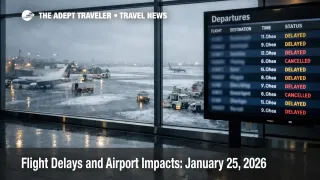
A major winter storm and reduced airport arrival capacity are driving the FAA's plan for broad air traffic disruption across the East Coast, the Midwest, and Texas. Travelers are most exposed if their itineraries rely on connections through the New York area, Washington, Atlanta, Charlotte, Chicago, Detroit, Dallas, Houston, or Boston hubs. The practical move is to assume rebooking will be constrained, and to decide early whether to reroute, shift dates, or switch to a nonstop before you commit to the airport.
The FAA's outlook is explicit that U.S. flight delays January 25 can spike quickly once traffic management initiatives begin metering departures into constrained hubs. The ATCSCC plan lists multiple airports for possible ground stops or delay programs after the morning push, reflecting expected weather driven capacity loss and the need to protect the system from overload.
At the same time, the bigger traveler problem is not just delay minutes, it is option loss. With thousands of cancellations reported as Winter Storm Fern sweeps across a large portion of the country, many flights that would normally serve as same day backups are simply not operating, which raises the stakes on protecting the first workable itinerary you can secure.
Who Is Affected
Travelers connecting through the New York region are in the highest exposure set because the FAA plan calls out ground stop or delay program potential at LaGuardia Airport (LGA) and John F. Kennedy International Airport (JFK), plus Newark Liberty International Airport (EWR) and Philadelphia International Airport (PHL), during the mid day and afternoon Zulu windows. When those hubs are metered, delays often appear first at your departure airport because flights are held on the ground to prevent airborne holding near the destination.
The Washington region is also a high risk connector zone today. The plan flags possible initiatives for Washington Dulles International Airport (IAD), Ronald Reagan Washington National Airport (DCA), and Baltimore Washington International Thurgood Marshall Airport (BWI), and it notes a published staffing trigger at DCA during early morning Zulu hours, a reminder that staffing and weather constraints can stack.
Southern and Texas hubs are not safe harbors in this setup. The plan lists Atlanta's Hartsfield Jackson Atlanta International Airport (ATL) and Charlotte Douglas International Airport (CLT) for possible ground stop or delay programs, and it also lists Houston's George Bush Intercontinental Airport (IAH) and William P. Hobby Airport (HOU), plus Dallas Fort Worth International Airport (DFW) and Dallas Love Field Airport (DAL), for possible ground stops after 1300Z.
Midwest and Great Lakes connectivity is under similar pressure. Chicago O'Hare International Airport (ORD) and Chicago Midway International Airport (MDW) are listed for possible ground stop or delay programs, and Detroit Metropolitan Wayne County Airport (DTW) is listed for a possible ground stop. Ski country travelers should also treat today as fragile because the plan includes possible initiatives for Aspen Pitkin County Airport (ASE) and Eagle County Regional Airport (EGE), and it calls out ski country route structures later in the day.
What Travelers Should Do
Act early, and do not wait for a formal cancellation to protect your trip. If your itinerary involves a connection through New York, Washington, Atlanta, Charlotte, Dallas, Houston, Chicago, Detroit, or Boston, open your airline app now, and price out a nonstop, a different hub, or a date shift while seats still exist. Use Winter Storm Fern US Flights, Waivers Expand Jan 23 to confirm whether your carrier's waiver window still covers your route, and treat waiver eligibility as permission to move earlier, not as reassurance that operations will normalize.
Set a decision threshold for rebooking versus waiting before you leave for the airport. If you have a sub 90 minute connection at the major hubs listed above, or you have a hard arrival deadline such as a cruise embarkation, a medical appointment, or a prepaid pickup, rebooking is usually the better bet once your first segment shows sustained delay growth or once your connection airport enters active flow control. If you are on separate tickets, raise the bar again, because misconnect protection may not extend across bookings, and the storm driven cancellation volume is already compressing recovery options.
Over the next 24 to 72 hours, monitor three things that change fast. First, the FAA ATCSCC updates for whether "possible" initiatives become active ground stops or delay programs, since that is when delays propagate far beyond the weather footprint. Second, your airline's rebooking and waiver updates, since carriers often expand or tighten lists as hubs degrade or recover. Third, the practical recovery layer, hotel availability near hubs, and ground alternatives, because once rebooking inventory is gone, the trip becomes a lodging and transport problem as much as a flying problem. For pattern matching on how a seemingly manageable morning can break later, Flight Delays and Airport Impacts: January 23, 2026 is the closest recent analogue.
If your flight cancels and you decide not to travel, refunds still apply when you decline the alternative trip the airline offers. The U.S. Department of Transportation's refund guidance also covers certain unused fees for ancillary services when they were unavailable due to a cancellation, so do not assume you must accept a voucher if a refund better fits your plan.
Background
The FAA's ATCSCC operations plan is a daily map of where capacity is likely to fail, and how that failure spreads. The first order effect is simple, weather and visibility reduce how many arrivals per hour an airport can safely accept, and deicing increases turn times, which pushes departures later and creates gate conflicts for inbound flights. That is why low ceilings, freezing rain, and snow showers in hub regions translate into missed connections even for travelers whose origin and destination look clear.
The second order effects are what most travelers experience. When a hub is metered, flights are held at their departure airports to prevent unsafe airborne queues near the destination, so delays appear nationwide, not just inside the storm footprint. Aircraft and crews then end up out of position for later segments, duty limits are hit, and the next bank gets canceled to protect tomorrow's schedule. That dynamic also tightens airport hotel inventory and ground transport options because more travelers are forced into overnight recovery, often in the same handful of hub cities.
Today's plan also shows how non weather constraints can amplify a weather day. Runway closures and construction impacts, for example a taxiway closure tied to a United Airlines ramp reconfiguration at Chicago O'Hare, or runway projects at other airports, reduce operational flexibility when conditions are already marginal. In addition, planned space launch windows can trigger route management actions that further narrow the system's routing options during peak periods, which matters more when thunderstorms are also listed as a possibility over Gulf and oceanic routes. For a deeper system level explainer on why capacity and resilience issues keep surfacing during stress days, see U.S. Air Traffic Control Privatization: Reality Check.
Sources
- ATCSCC ADVZY 006 DCC 01/25/2026 OPERATIONS PLAN
- US storm leaves 670,000 without power, forces thousands of flight cancellations
- More than 10,000 flights canceled as massive winter storm sweeps across US
- Nearly 15,000 U.S. flights have been canceled due to the winter storm, and counting
- Refunds
- Airline Cancellation and Delay Dashboard