

Lisbon Airport Pauses EES Border Checks Until March
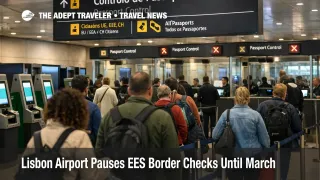
Portugal has temporarily suspended the EU Entry Exit System process at Lisbon Humberto Delgado Airport (LIS), after repeated arrivals hall queues stretched to hours for some non EU passengers. The change primarily affects visa exempt short stay visitors arriving from outside the Schengen Area who would otherwise be routed into biometric enrollment steps. Travelers should still treat Lisbon as a high variance gateway, pad onward connections and timed transfers, and monitor for test reactivations that signal the system is being prepared for a phased return before the pause ends.
The Lisbon Airport EES pause matters because it changes the border processing posture at a single choke point, arrivals passport control, which can swing your end to end arrival timeline even when the inbound flight is on time.
Portugal's government said on December 30, 2025 that it suspended EES "effective immediately" and "for three months," and that it would boost external border control equipment and capacity by about 30 percent while reinforcing staffing, including support from the National Republican Guard (GNR). In practice, that means Lisbon may run more of its pre EES style flow for many arrivals through about March 30, 2026, while airport and border authorities try to stabilize throughput in the arrivals hall.
If you have been following the deterioration in queue performance, this is a formal rollback rather than a one off tactical switch off. For earlier context on how the backlog built, see Lisbon Airport Border Queues Raise Security Concerns. For the wider Schengen pattern that made Lisbon's bottlenecks more likely during scale up, see Schengen EES Airport Delays Worsen With Jan 9 Ramp. If you need a plain language refresher on what EES is supposed to do once fully in place, see EU entry/exit system starts October 12: what to expect.
Who Is Affected
Non EU nationals arriving into Lisbon from outside Schengen remain the core exposure group, especially first time EES eligible travelers who would normally be asked for biometrics and system registration. Travelers on separate tickets or on itineraries with short legal connection times are most at risk because the delay happens after the aircraft doors open, and before you can reach the next gate, train, car pickup, or meeting point.
Families and groups often see amplified delay because the slowest processing step governs the entire party's onward schedule. Cruise passengers arriving same day for embarkation at Lisbon's port, as well as travelers joining escorted tours with hard departure times, should assume that a smooth landing does not guarantee a smooth arrival timeline.
Airlines also feel second order impacts. When large numbers of passengers miss onward flights due to immigration delay, rebooking demand concentrates into the next departure banks, which can create availability gaps, raise same day fares, and push some travelers into overnight stays. Ground transport providers feel it too, because missed pickup windows cause re dispatch costs and no show disputes, and hotels near the airport and central Lisbon see last minute demand when late arrivals miss evening rail or tour departures.
What Travelers Should Do
If you arrive into Lisbon before March 30, 2026, plan your buffer around passport control variability, not around scheduled arrival time. Build extra time for any onward flight, rail connection, or timed pickup, and save offline copies of onward tickets, hotel confirmations, and meeting point instructions in case you exit the arrivals hall later than planned and need to reroute quickly.
If you are deciding whether to rebook, use simple thresholds. If your onward connection is on a separate ticket, or if your onward plan is a hard timed event like a cruise embarkation, a tour departure, or a late evening long distance train, rerouting to add a longer buffer is usually the safer move. If you are on a single airline ticket with protected connections and multiple later options the same day, waiting can be reasonable, but only if your carrier has a realistic same day reaccommodation path.
Over the next 24 to 72 hours, watch for signals that the system is being phased back in. Local reporting has described limited test reactivations intended to validate technical changes, followed by re suspension, which is a sign that authorities are iterating rather than flipping back to full operations at once. Also watch for airline travel advisories about minimum connection guidance, and for any airport or government updates that mention arrivals hall staffing levels, kiosk availability, or revised contingency measures.
How It Works
EES is designed to replace manual passport stamping for most non EU short stay visitors, recording passport data, biometric identifiers, and the time and place of entry and exit across 29 participating European countries. The European Commission describes EES as an automated IT system that registers travel document data, fingerprints, facial images, and entry and exit events, and it says the system is being introduced gradually from October 12, 2025, with manual stamping replaced as of April 10, 2026.
At airports, the operational problem is throughput. Each additional step at the desk or kiosk adds seconds or minutes per passenger, and those increments compound into long queues when multiple arrivals feed the same immigration hall in a tight window. When kiosks are partially deployed, when automated gates cannot be used for EES processing, or when the system experiences outages, queue length becomes unpredictable, and airports have to manage crowding in circulation areas that were not designed for long dwell times.
Portugal's three month suspension at Lisbon is a classic contingency response to a choke point failure. The government framed the decision as being taken under relevant European regulations due to worsening bottlenecks in the arrivals area, while also increasing equipment capacity by about 30 percent and reinforcing staffing, including GNR support. The short term traveler benefit is fewer EES enrollment transactions in the arrivals flow, but the second order reality is that predictability still depends on staffing, lane management, flight bank timing, and whether technical work during the pause actually improves the underlying systems enough to support a stable ramp up later.
Sources
- Contingency measures strengthened at Humberto Delgado airport
- Governo reforça medidas de contingência no Aeroporto Humberto Delgado
- Security flaws at Humberto Delgado Airport already led to the EES rollout being suspended last month
- Sistema europeu de controlo de fronteiras volta a ser testado no Aeroporto de Lisboa
- Entry/Exit System (EES), European Commission
- Review of Schengen Entry-Exit System urgently needed to avoid systemic disruptions impacting passengers (ACI EUROPE PDF)