

Storm Chandra UK Travel Disruption for Flights and Ferries
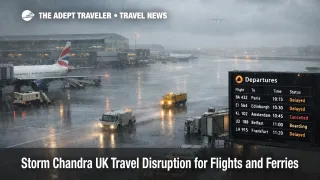
Storm Chandra is disrupting travel across the United Kingdom and Ireland with a same day mix of heavy rain, strong winds, and wintry hazards that is knocking out multiple transport layers at once. Travelers most affected are those trying to connect between flights, rail, ferries, and road transfers, especially where airport access depends on exposed bridges, low lying roads, or timed rail links. If you have any tight connections today, the safest move is to slow your itinerary down, confirm each segment directly with the operator, and add time and an overnight option before you leave for the terminal.
The practical shift today is that the disruption is not limited to a single mode, it is a system problem. The Met Office flagged multiple warnings tied to Storm Chandra, including the risk of snow or sleet where heavy rain meets colder air, plus unusually disruptive wind direction for some areas. In Ireland, Met Éireann described strong winds and heavy rain pushing into the country from late January 26 into January 27, which lines up with the travel day crunch for early departures and morning ferry schedules.
Who Is Affected
Same day flyers are at highest risk when surface transport is the weak link. Even if your flight out of London Heathrow Airport (LHR) or Dublin Airport (DUB) shows as operating, flooded approaches, tree fall, or bridge restrictions can turn a normal airport run into a missed check in window. News coverage in the UK has highlighted severe flooding impacts in the South West, and official flood warnings have been active, including a severe flood warning for the River Otter at Ottery St. Mary updated early on January 27, 2026.
Ferry travelers are facing a cleaner, more binary failure mode: cancellations. Irish Ferries posted cancellations on the Dublin to Holyhead corridor for January 27, 2026 due to adverse weather, and Irish media reporting also described cancellations affecting Irish Sea routes. In Scotland, CalMac published weather driven timetable changes on the Troon to Brodick route spanning January 27 to January 31, 2026, a reminder that island links may operate on amended patterns even when not fully cancelled. If your plan depends on a ferry plus a same day flight, treat the flight as the fragile leg, because ferry rebooking tends to cascade into missed airport slots and limited hotel inventory near the port.
Rail travelers are being squeezed by both infrastructure limits and safety restrictions. National Rail has issued operator specific disruption notices tied to Storm Chandra conditions, including Great Western Railway speed restrictions and service impacts that can undermine airport transfer timing in the South West and Wales corridors. The compounding risk is that slower rail and fewer buses push more people into taxis and car hire, which then run into the same flooded or wind affected roads.
For additional context on how recent UK storms have already been stressing transport reliability, see Storm Ingrid UK Rail Disruption Hits Southwest and Storm Goretti UK Ferries And Airports Disrupted Jan 9.
What Travelers Should Do
If you are traveling today, start by de coupling connections. Move any same day flight plus ferry plan into an overnight buffer, or swap to a single mode itinerary where possible. Download boarding passes and rail tickets, screenshot confirmations, and save customer service numbers, because app outages and overloaded help lines are common during multi mode weather events. If you must travel, assume road time will be unpredictable, and build extra time for airport and port access, not just for the flight or sailing itself.
Use clear decision thresholds for rebooking versus waiting. If your ferry leg is cancelled, or your rail operator posts speed restrictions and line blockages on your corridor, rebook immediately rather than hoping to improvise at the terminal, because the alternatives will sell out as more people are forced onto the same limited capacity. If your flight is delayed but still operating, waiting can be rational only if you have a protected connection or a flexible ticket, and you can physically reach the airport without relying on a flood prone drive or a single rail link. Otherwise, rebook to the next day and protect your accommodation and ground transport first.
Over the next 24 to 72 hours, monitor three things: flood warnings on your specific river basin or town, ferry operator sailing updates for your exact route and date, and rail disruption notices for your corridor, because secondary impacts often linger after the strongest winds ease. Also watch for overnight temperature drops that can turn wet surfaces into ice on untreated roads and station approaches, which can extend disruption into the morning peak even after rainfall tapers. If you are rerouting into the UK from elsewhere, and you may need to extend your stay or change your entry plan, keep this reference handy: UK Entry Requirements For Tourists In 2026.
Background
Named storms like Chandra create travel chaos when they trigger simultaneous constraints across the network. At the source, high winds and heavy rain reduce the operational envelope for airports and ports, and they force rail operators into speed restrictions and precautionary line closures when trees, debris, or flooding threaten safe running. The second order effects are usually bigger than the first: cancelled ferries strand passengers in port towns, which increases demand for last minute hotel rooms and alternative sailings, while rail slowdowns cause missed airport check in windows and push more travelers onto roads that may already be closed or unsafe.
A key traveler trap is assuming that because a flight is operating, the trip is safe to attempt. In a storm pattern with active flood warnings and widespread surface disruption, the limiting factor is often access, not the runway. That is why the best mitigation is itinerary slack: fewer same day dependencies, earlier departures, and a planned overnight option at the connection point.
Sources
- Week ahead: An unsettled start with Storm Chandra bringing rain and wind, Met Office
- Storm Chandra Impacting Ireland on Tuesday, 27th January 2026, Met Éireann
- Severe flood warning for River Otter (Lower) at Ottery St. Mary, GOV.UK Check for Flooding
- Poor weather may affect your journey in England, Scotland and Wales, National Rail
- Poor weather may affect Great Western Railway services until the end of the day, National Rail
- Dublin Holyhead, Latest sailing updates, Irish Ferries
- Troon Brodick 27 to 31 January 2026, Service Changes, CalMac
- River flooding and road closures as Storm Chandra hits, RTÉ News