

Verona VRN ATC Strike Delays Likely January 31, 2026
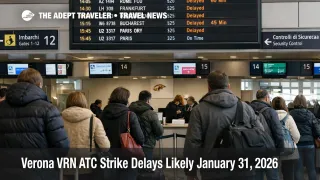
A scheduled air traffic control labor action is set to reduce capacity at Verona Villafranca Airport (VRN) in Villafranca di Verona, Italy. ENAV, Italy's air navigation service provider, says the local strike is planned for Saturday, January 31, 2026, from 100 p.m. to 500 p.m. CET, and that minimum essential services will still be provided under the rules.
Travelers are most exposed if they are booked on Verona departures or arrivals that fall in the afternoon bank, or if they are relying on a tight chain like flight plus same day rail, car rental, or ski transfer. The practical next step is to move to an early flight if you have flexibility, and if you cannot, treat every downstream commitment as likely to start later than planned.
The Verona ATC strike may slow the pace of arrivals and departures at VRN on January 31, 2026, increasing the odds of retimes, missed connections, and late ground transfers for travelers who fly in the mid day peak.
Who Is Affected
The first group is anyone scheduled to depart Verona during the four hour window, because reduced tower or approach capacity typically shows up as longer departure metering, gate holds, and runway queues that are hard to "make up" later in the day. The second group is inbound passengers landing in the same period, especially those with pre booked shuttles, timed rail connections, or car pickups, because even modest airborne holding can translate into missed handoffs on the ground.
A third group is travelers not obviously "in the window" whose aircraft rotation depends on Verona earlier in the day. If an inbound aircraft arrives late, the outbound flight you are on can depart late even if it is scheduled outside the strike period, and the risk is highest on thinner schedules where there is limited spare equipment to swap in.
If you are trying to protect a larger Italy itinerary that connects onward through another hub, the second order risk is that local delay at Verona pushes you into misconnect territory downstream, then reaccommodation demand spikes, and you get fewer good options at the exact moment you need them. For nearby context on how Italy strike days can stack across modes, see Italy Transport Strike Jan 20, Trains and Metros Hit and Italy Aviation Strike Feb 16 Disrupts Flights.
What Travelers Should Do
If you are flying to or from Verona on January 31, 2026, act early and bias toward removing the afternoon single point of failure. If your ticket allows changes, shifting to a morning flight reduces exposure and leaves more recovery time if the day still runs behind. If you must keep an afternoon itinerary, add buffer to airport arrival, and save your boarding pass offline so you are not dependent on last minute app access or weak terminal connectivity when queues build.
Use a clear decision threshold for rebooking versus waiting. If a two to four hour delay would force an overnight, cause you to miss the last practical onward train, or break a paid commitment such as a tour start or a hotel with strict late arrival policies, rebook proactively into a different time band or day rather than betting on day of recovery. If your plans are flexible and you can tolerate arriving several hours late, you can wait longer, but only if you have a backup ground plan that does not rely on one tight connection.
Over the next 24 to 72 hours, monitor three signals in parallel. First, watch airline notifications for retimes, pre cancellations, and change offers, because carriers often reshape schedules ahead of a known constraint. Second, check ENAC's guidance on protected time bands and guaranteed flights, which often shapes what airlines try to preserve, and can shift crowds into narrower periods even when the strike itself is short. Third, track your inbound aircraft positioning earlier in the day, because a late inbound is often the earliest warning that your flight will depart behind schedule even if the strike ends on time.
Background
Air traffic control, ATC, is a capacity gate for the entire flight schedule, not just a tower detail. When staffing actions or work rules reduce available ATC service at one airport, the safest operational response is to space aircraft farther apart, meter departures, and slow arrival rates, which creates queues that take time to unwind after normal capacity returns.
That first order slowdown propagates quickly through the travel system. Airline rotations are time sensitive, so a delayed arrival into Verona can push the same aircraft's next leg late, then cascade into later sectors that never touch Verona. Crew duty limits can turn what begins as a manageable delay into a cancellation later in the day if the schedule loses enough slack. On the traveler side, arrivals that bunch after a constraint can overload curbside pickup, car rental counters, and taxi supply, and that creates last mile timing failures that show up as missed hotel check ins, rebooked transfers, and extra night costs.
For a deeper explainer on why capacity constraints cascade into missed connections and recovery limits, see U.S. Air Traffic Control Privatization: Reality Check.