

Italy Transport Strike Jan 20, Trains and Metros Hit
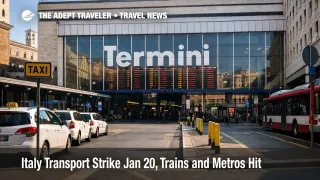
Italy is facing a broader transport disruption picture that travelers should treat as a system wide reliability problem, not just a rail story. Reporting around the January 20, 2026 action describes a 23 hour strike window affecting rail operations, and rail freight, with knock on effects that show up as cancellations, retimes, and uneven service by corridor. For visitors, the practical change is that the plan you built around a "simple" train day can fail at the edges, meaning the metro ride to the main station, the regional feeder that connects into high speed rail, or the airport rail link you assumed would be running.
The strike day also changes how quickly the network can recover. When fewer trains operate, there is less spare capacity to absorb late arrivals, late crews, and displaced passengers. That compression pushes more people onto the same limited departures, which is why the hardest part of the day is often not the first cancellation, it is the second step, trying to find a workable replacement before your hotel, tour, or flight window closes. Trade coverage has framed January 20 as a key national transport disruption date, and mainstream outlets have separately flagged the rail protest risk for the same day.
For deeper corridor level context on the rail portion of the disruption, see Italy Rail Strike Disrupts Trains January 20, 2026. If your week also includes flights in northern Italy, see Verona ENAV Strike May Delay VRN Flights Jan 31 for a separate, later aviation constraint that can compound trip timing decisions.
Who Is Affected
The first group is travelers moving between cities on fixed timelines, especially anyone chaining multiple segments in one day. If you are doing Milan to Florence to Rome, or Rome to Naples and onward, the risk is not only that one train cancels, it is that the remaining departures become crowded, and the next workable option can be hours later. This is where split tickets and tight station change times become fragile, because one missed feeder can cause you to lose a reserved long distance seat, and the system may not have enough inventory to repair your plan quickly.
The second group is travelers whose itinerary depends on urban transit to make the day work. When local metros and buses run reduced schedules, tourists lose the "last mile" reliability that normally protects them. A hotel that felt walkable on a map can become a longer, slower transfer when the metro headway stretches, or when a bus route is suspended. That is the moment when the strike stops being a rail headline and becomes a day wide mobility constraint.
The third group is airport bound travelers, including anyone with an international departure the same day. Rail disruption can affect the train links and timed connections many travelers use to reach Rome Fiumicino Leonardo da Vinci Airport (FCO) and Milan Malpensa Airport (MXP), and it can also affect the upstream local service that gets you to the airport rail origin in the first place. Even if your flight operates normally, the ground access layer can be the reason you miss it, particularly when taxi demand spikes and curbside pickup times stretch.
What Travelers Should Do
If you have a must arrive commitment, shift the travel day off Tuesday, January 20, 2026, and re lock tickets now while seats are still reasonable. If you must travel on the strike day, remove single points of failure by traveling earlier than you normally would, avoiding last departures, and adding a hotel buffer the night before any flight, cruise embarkation, or timed event. Your goal is to avoid a scenario where one cancellation forces a same day rescue that the reduced network cannot support.
Use a clear decision threshold for rebooking versus waiting. If missing arrival triggers real penalties, for example a long haul flight, a paid tour, a medical appointment, or a non refundable hotel night, treat "not explicitly guaranteed" as "not safe enough," and rebook to a guaranteed departure, a different day, or a different mode. If your plan is flexible and you can tolerate arriving several hours late, you can wait longer, but only if you have a viable backup that does not rely on multiple connections.
Over the next 24 to 72 hours, monitor three signals in parallel. First, the strike status and the exact time window being referenced by your operator and by the official calendars. Second, the guaranteed service information, because minimum service exists, but it is limited, and it is not the same as a normal timetable. Third, the day of operations updates, because service can change before the start and after the end as trains and crews fall out of rotation. Trenitalia's strike guidance also reinforces the central planning rule for visitors, rely on listed guaranteed trains, and do not assume frequency will be "close enough."
Background
Italy's transport system propagates strike disruption quickly because the layers depend on each other. The first order effect begins at the source, fewer available crews and operational staffing, which shows up as cancelled trains, retimed departures, and uneven regional coverage across the rail network. A widely cited planning detail for the January 20 action is the 23 hour duration being referenced across multiple reports, which is long enough to affect both morning departures and late evening recovery.
Second order effects hit at least two additional layers. Connections are the first, because high speed rail can look "mostly running" while regional feeders and station access break, causing missed reserved seats and forcing travelers into long rebooking lines. Urban mobility is the second, because reduced metros and buses make it harder to reach the stations that still have limited service, which pushes more travelers onto taxis and private transfers at the same time, tightening supply and increasing delays. That last mile squeeze is also why airport transfers become disproportionately risky on strike days, even when airports themselves are not the striking entity.
Finally, some travelers will see aviation adjacent pressure elsewhere on the calendar. Italy's official transport strike portal is also where later airport related labor actions are posted, which matters if your Italy trip spans multiple dates and you are trying to choose the least risky day to fly versus ride the rails.
Sources
- Scioperi dei trasporti a gennaio 2026: il calendario completo
- Scioperi: dai treni agli aerei, ecco chi si ferma in gennaio
- Gennaio all'insegna degli scioperi: trasporti pubblici, treni, aerei e scuola fermi
- Servizi minimi garantiti in caso di sciopero
- Servizi minimi garantiti in caso di sciopero, treni garantiti
- Scioperi (MIT) | Portale Scioperi