

Italo Rail Works Rome Naples Cut Trains Into Feb
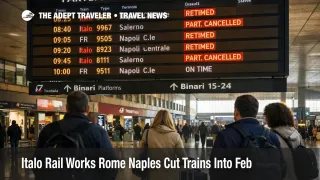
Infrastructure works are disrupting some high speed rail options on Italy's Rome, Italy to Naples, Italy, and Rome to Salerno, Italy corridors, with Italo warning of timetable changes and partial cancellations tied to Rete Ferroviaria Italiana, RFI, work programs. Travelers using these routes to reach Naples, Pompeii, the Amalfi Coast, and southbound connections should plan for fewer usable departure choices on some days, plus departure time shifts that can break tight arrival plans. The simplest move is to verify your exact train number and time the day before travel, then add buffer for last mile transfers if you are chaining tickets or timed activities.
The operational change is clearest in Italo's corridor notices. Italo says Rome to Salerno line works run from January 7 through January 28, 2026, and that multiple Italo services see schedule variations, including earlier departures, plus partial cancellations. The same notice flags that, on some days, additional measures can be applied for works at other points on the line, which is why the "right" timetable is the one in your booking channel close to departure.
For the Rome to Naples corridor, Italo reports that RFI works run from January 10, 2026 through February 13, 2026, and that Italo 8923 has a schedule variation, with the same warning that further day specific measures can apply. A linked Italo PDF shows date scoped adjustments for train 8923, including that the measures apply across the stated window except on January 24 and January 25, 2026.
If you are trying to understand whether your specific Rome, Naples, or Salerno plan is affected, focus on train numbers rather than city pairs. In the Rome to Salerno notice, Italo lists impacted services including 8191, 9903, 9907, 9967, 8111, 9971, 9998, 9975, and others, and the linked PDF expands those measures by date, with some trains cancelled on specific days and some not running over certain segments.
Who Is Affected
The most exposed travelers are the ones using high speed rail as the backbone for a timed day in Campania, Italy, especially day trips where one missed departure turns into lost entry slots or missed guided tour starts. That includes travelers heading from Rome into Naples for museums, food tours, and onward metro moves, and travelers continuing south toward Salerno as the rail gateway for the Amalfi Coast and the wider Salerno province.
Connection builders are the second high risk group. When RFI works reduce or shift train paths, the first order impact is fewer seats at the exact times you wanted. The second order ripple is that delays bunch arrivals into narrower windows, which stresses station change times, taxi availability, and pre booked transfers. If your plan relies on a single tight link, for example Rome rail arrival into a tour pickup in Naples, or a same afternoon transfer onward from Salerno, the practical risk is not just a slower ride, it is losing the entire chain.
Air travelers can also get caught even when flights operate normally, because airport access plans often assume the "standard" timetable. This matters most when you are linking rail into Rome Fiumicino Leonardo da Vinci Airport (FCO) or Naples International Airport (NAP) on separate tickets, where a retimed departure can move you out of your planned margin. Once that margin is gone, the backup mode is usually road based, and road based backups reprice fast during disruption.
What Travelers Should Do
Start by validating the exact itinerary that will operate, not the one you remember booking. Check your Italo train number in the Italo app or your original sales channel about 24 hours before departure, then check again on the morning of travel for any further day specific measures. If you have a must arrive commitment, consider shifting to an earlier departure that leaves you at least one additional backup option the same day, or buying a changeable fallback on an alternate operator.
Use a clear decision threshold for rebooking versus waiting. If a delay of 60 to 90 minutes would cause you to miss a timed attraction entry, a ferry, a flight, or a paid driver pickup, rebook proactively rather than hoping your specific train holds. If your plan is flexible, you can wait longer, but only if you have enough slack to accept the next available train, and only if you are not chaining multiple segments where one miss collapses the rest.
Over the next 24 to 72 hours, monitor three things: the operator notice for your corridor, the live status of your exact train number, and the state of your last mile plan. If rail options thin out, pre price alternates like Trenitalia high speed services, an intercity plus regional split, or a coach, and be realistic about transfer time in Naples and Salerno when arrivals bunch. If you pivot to a car hire backup, book earlier than you normally would, because station and airport inventory tightens quickly when rail reliability drops.
Background
Planned infrastructure works create disruption because high speed rail corridors run on tightly allocated "paths" that must be shared among multiple services and maintenance windows. When RFI schedules track, signalling, or line works, the immediate effect is fewer usable slots through the affected segment, which forces operators to retime departures, skip stops, or cancel partial legs to keep rolling stock and crews in position for later runs.
Those first order changes then ripple outward. A single retimed train can arrive outside a station's planned platform rhythm, which increases dwell time, causes knock on lateness for following services, and reduces the amount of spare recovery time later in the day. That is why RFI work programs can create unreliable outcomes even for travelers who are not directly riding through the worksite, because the network has less slack to absorb small delays. Italo's corridor notices explicitly warn that, on some days, further measures may be added for works at other points, which is a practical signal that travelers should treat the published timetable as provisional until close to departure.
For Italy travel planning, it also matters that rail disruption stacks. Maintenance works, weather, and periodic labor actions can land close together on the calendar, and each reduces recovery capacity for the next. If your trip mixes multiple cities and fixed start commitments, it is worth checking broader Italy and Europe disruption calendars as part of the same planning pass, not as a separate last minute task, and if you are already in a high risk week, consider adding a hotel buffer night before the most time sensitive leg. For related Italy rail reliability context, see Italy Rail Strike Disrupts Trains January 20, 2026 and Europe Transport Strike Dates 2026 for Flights and Trains.
Sources
- LINEA ROMA-SALERNO: Lavori RFI dal 7 al 28 gennaio 2026 (Italo Informa)
- LINEA ROMA-NAPOLI: Lavori RFI dal 10 gennaio 2026 al 13 febbraio 2026 (Italo Informa)
- Avviso ai Viaggiatori, Roma Salerno Line, 7 to 28 January 2026 (Italo PDF)
- Avviso ai Viaggiatori, Roma Napoli Line, 10 January to 13 February 2026 (Italo PDF)
- Avviso ai viaggiatori lavori tra Villa Literno e Minturno Scauri (RFI)