

Italy Rail Strike Disrupts Trains January 20, 2026
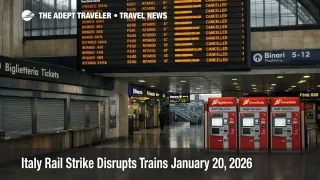
A nationwide rail and rail freight strike is scheduled in Italy for Tuesday, January 20, 2026, with a published 23 hour action window that can sharply reduce passenger train service. Travelers should plan for cancellations, shorter consists, and timetable changes that are often uneven by region and time of day, even on headline intercity routes. If you have a fixed arrival, the safest move is to shift the rail day to Monday, January 19, 2026, or Wednesday, January 21, 2026, or to switch to a flight or coach where that is practical.
The travel facing consequence is straightforward. Italy rail strike January 20, 2026 means fewer dependable departures across the national network, less recovery capacity when something slips, and a higher chance that one late or cancelled segment breaks a full day plan, especially when you are chaining regional feeders into long distance trains.
Who Is Affected
Travelers using long distance corridors are the obvious first group, particularly those relying on high speed links between Milan, Italy and Rome, Italy, and onward to Florence, Italy, Bologna, Italy, and Naples, Italy. Even when some trains run, reduced frequency compresses demand into fewer departures, which makes same day rebooking harder and raises the odds that the next available option is hours later rather than the next slot.
Regional and commuter riders are often the most operationally exposed because regional trains are the glue that makes intercity days work. When a feeder is cancelled or pushed outside its slot, you can miss a reserved seat long distance departure and lose the price and schedule advantage you built your day around. This matters most for travelers on split tickets, or anyone trying to connect through major stations with tight change times.
Airport bound travelers should treat January 20, 2026 as a high risk ground access day. Rail strikes can disrupt the train links and timed connections many travelers use to reach Milan Malpensa Airport (MXP) and Rome Fiumicino Leonardo da Vinci Airport (FCO), turning what is normally a predictable station to terminal move into a taxi, rideshare, coach, or hotel staging decision. The strike risk is not only the direct airport train, it is also the upstream regional service that gets you to the airport rail origin in the first place.
What Travelers Should Do
If you can still change plans, move any must arrive rail travel off Tuesday, January 20, 2026, and lock the new ticket today while inventory is still reasonable. If you must travel on the strike day, build buffers that remove single points of failure, such as traveling earlier than you normally would, avoiding last departures, and adding a one night hotel buffer before a flight, a cruise embarkation, or an event.
Use clear decision thresholds for rebooking versus waiting. If missing arrival has a real penalty, such as an international flight, a medical appointment, a paid tour, or a meeting, rebook now rather than hoping your original train survives. If your plan is flexible and you can tolerate arriving several hours late, you can wait longer, but only if you have a viable same day alternative, and you are not depending on a chain of connections where one cancellation collapses the whole plan.
Over the next 24 to 72 hours, monitor three things: the strike status and window, the guaranteed train information for your operator, and the live status of your specific train on the morning of travel. Trenitalia notes that essential services for local transport are planned in peak time bands, and it also publishes lists of guaranteed trains, but you should assume that only trains explicitly listed as guaranteed are safe enough to build a tight day around. If you are combining rail with cross border rail this week, keep an eye on broader European rail disruption patterns, including Eurostar Disruption London Paris Trains Late January, because rail to rail backups can vanish quickly when multiple networks are constrained.
Background
Italy's passenger rail system is built around tightly scheduled paths, shared infrastructure, and rolling stock rotations that link early morning departures to afternoon returns. A strike disrupts that chain at the source by reducing available crew and operational staffing, which immediately shows up as cancelled trains, retimed departures, and short notice platform changes. Trenitalia also describes a common operating rule during strikes, trains already in motion may reach their destination if it is reachable within about an hour from the strike start, otherwise they can be terminated early, which can strand travelers short of their intended arrival even when the train initially departs.
Second order effects ripple across the network because fewer trains means less spare capacity to recover. When one trainset is out of place, later services can be affected, and when a large block of demand is forced into fewer departures, station crowding and rebooking friction increase. That is why the practical risk is often highest in the middle of the day, when missed connections compound and when the next workable option may already be full.
The strike also propagates into other travel layers that are not rail. Airport access is the most visible, because travelers who would normally arrive by train shift to taxis, rideshares, and buses, which can raise prices and reduce availability, especially around major hubs. Hotels can see last minute demand spikes when a day trip turns into an overnight, and car rentals can tighten in stations and airport markets when rail becomes unreliable for one day. Freight rail actions also matter indirectly, not because travelers are booking freight, but because they can add pressure on network operations and staffing at the same time passenger services are trying to run a reduced plan.