

Storm Chandra UK Flood Warnings Disrupt Roads, Rail
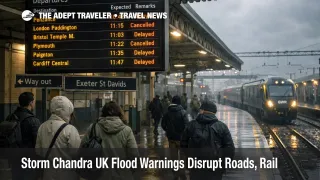
Flood and wind impacts are continuing across parts of the United Kingdom and Ireland after Storm Chandra, with saturated ground conditions keeping disruption active beyond the storm peak. Travelers are still running into road closures, rail restrictions, and intermittent ferry and flight impacts in the most affected areas, even when terminals and stations look open at first glance. The practical risk on January 28, 2026 is that surface access fails late, which is when missed check in cutoffs, missed departures, and unplanned hotel nights tend to happen.
The Storm Chandra UK flood warnings situation has shifted from peak weather to persistence, where flood risk remains elevated as water moves through river systems and low lying areas.
Who Is Affected
Travelers are most exposed when their itinerary depends on the last mile, meaning the drive to a station, an airport, or a ferry terminal that passes through low lying roads, bridge crossings, or known flood pinch points. Official flood messaging continues to emphasize saturated catchments and ongoing high river levels, which is the exact setup where a road can go from slow to impassable with little notice, and where rail operators can impose speed restrictions or short turn services to protect safety and infrastructure. The Environment Agency's live flood information has continued to flag elevated risk in specific river basins, and Somerset's incident posture underscores that the flood story is not over just because the strongest winds ease.
Southwest England remains a key risk zone for travel logistics because flooding and debris do not just block one road, they compress all remaining options at once. A closure on a main corridor can push more traffic onto smaller alternates that are also vulnerable, which slows transfers into regional hubs and increases the chance of missing timed departures. In parallel, rail becomes less resilient when line speeds drop or when a segment is constrained, because missed connections compound quickly when frequencies are thin. National Rail's disruption guidance for poor weather indicates impacts can continue through the week, and that matters most for travelers trying to make tight same day chains involving rail plus onward travel.
Northern Ireland travelers face a similar pattern where wind and rain create rolling constraints rather than a single clean shutdown. Authorities have warned that roads and bridges may require closures or temporary restrictions, and the Strangford Lough ferry service was reported as canceled until conditions allow safe operations. That kind of localized interruption can strand travelers on the wrong side of a connection point, then cascade into missed rail, coach, or flight segments later in the day. The same dynamic applies to Irish Sea travel, where operators have posted adverse weather cancellations on key corridors during the storm window, and recovery depends on sea state, port sequencing, and vessel positioning rather than on a single forecast improvement.
For travelers who need the earlier, same day snapshot of the storm's multi mode disruption, see Storm Chandra UK Travel Disruption for Flights and Ferries. For added context on how repeated storms have been stressing rail resilience in the southwest corridor, see Storm Ingrid UK Rail Disruption Hits Southwest.
What Travelers Should Do
Start with a surface access check before you commit to the trip. That means confirming your rail operator status and National Rail disruption notes, checking live flood status for your specific basin, and validating your road route with official local updates where possible, because a generic map route can look normal right up until a closure point. If you are already in a lodging location near affected corridors, leave earlier than you think you need, and keep a same day backup plan that does not rely on a single bridge, a single low water crossing, or a single feeder rail segment.
Use a hard decision threshold for rebooking versus waiting, and base it on the first cutoff you cannot miss. If a flood warning, a major incident posture, or an operator disruption notice suggests your route could become unreliable during your transfer window, rebook to a later departure or to the next day while inventory still exists, rather than arriving at a station or terminal hoping the last mile holds. Waiting is only rational when you have flexibility, you have protection on the ticket, and you can physically reach the departure point using more than one viable route.
Over the next 24 to 72 hours, watch for the persistence signals that extend disruption after the storm peak. Flood warnings and alerts can remain active as water drains through the system, and additional rain or overnight temperature drops can create new hazards on already stressed roads and station approaches. National Rail disruption pages, flood basin status pages, and regional authority updates are the best way to spot whether conditions are stabilizing, or whether secondary impacts, such as sinkholes, washouts, or precautionary closures, are still propagating through travel corridors.
Background
Storm disruption becomes a travel problem in layers, and the second layer is often the one that breaks itineraries. At the source, heavy rain and strong winds constrain operations directly, reducing safe road speeds, forcing rail speed restrictions, and triggering ferry cancellations when sea state exceeds limits. In the Chandra aftermath, the persistence mechanism is saturated ground and elevated river levels, which keeps closures and restrictions in play even after the worst weather passes. Somerset's decision to declare a major incident reflects that flood risk can remain high while water continues moving through low lying systems such as the Somerset Levels and Moors.
The ripple effects spread beyond the flooded street or the closed bridge. When roads close, travelers compress onto fewer viable corridors, which increases travel time variability and makes timed check in cutoffs harder to meet. When rail corridors slow or partially close, the system loses redundancy, missed connections become more common, and displaced travelers shift to taxis and car hire, which then run into the same constrained road network. Ferry cancellations can strand passengers in port towns, which increases last minute lodging demand and pushes more travelers toward rail or air alternates that may already be capacity constrained. That is why the day after a named storm can be more dangerous for tight itineraries than the peak wind hour, the service may technically run, but the access chain is what fails.
Sources
- Week ahead: An unsettled start with Storm Chandra bringing rain and wind, Met Office
- Major incident declared in response to heavy rain and flooding, Somerset Council
- Poor weather may impact your journey in England until Friday 30 January, National Rail
- Flood warning for Upper Frome from Maiden Newton to Dorchester, GOV.UK Check for Flooding
- Flood alert for Rivers Otter and Sid, and Exmouth area, GOV.UK Check for Flooding
- Storm Chandra, Multi-Agency Update, Department for Infrastructure Northern Ireland
- Flooding Outlook, Monday 26 January 2026, SEPA
- Storm Chandra Impacting Ireland on Tuesday, 27th January 2026, Met Éireann
- Dublin Holyhead, Latest sailing updates, Irish Ferries
- Sailing Updates, Stena Line