

Winter Storm Fern DFW Disruptions, American Waiver
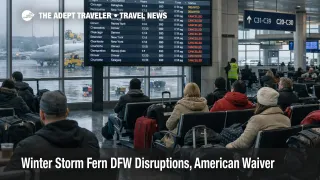
American Airlines is telling customers it has moved to an "all hands on deck" posture as Winter Storm Fern continues to disrupt the U.S. air travel system, with the carrier's hub network taking an outsized hit. Travelers are most exposed on itineraries that connect through American hubs, especially Dallas Fort Worth International Airport (DFW), where the airline said storm conditions and staffing constraints have slowed recovery. The practical move is to treat late January travel as irregular operations, use waiver flexibility early, and add buffer time for both connections and airport access.
The scale at DFW has been severe even after the storm's peak moved east. FlightAware's airport specific totals show 622 delays and 643 cancellations at DFW on January 27, 2026, which helps explain why rebooking inventory and same day options tightened quickly for American passengers. On January 28, 2026, FlightAware still showed meaningful disruption at DFW, though totals were lower than the prior day, a sign that recovery is underway but not complete.
American's message also makes clear why the system can keep failing after the worst precipitation ends. The carrier pointed to storm impacts in places that do not routinely handle snow and ice, which can turn into staffing shortfalls when employees and vendor partners cannot safely commute, and when ramp work slows for deicing and safety.
Who Is Affected
The most affected travelers are those whose itinerary touches American's hub complex, because hub disruption does not stay local. When DFW slows, flights across the network can be held at their origin to avoid arriving into a constrained airport, and aircraft that would normally rotate to other cities end up out of position for later departures. That is how a Texas ice day becomes a missed connection in another region, even if the weather at your origin looks fine.
Connecting passengers are the first group to feel the impact. A single inbound delay can collapse a planned connection, and during a recovery phase, later same day alternatives can sell out fast because airlines are using cancellations to rebuild workable aircraft and crew sequences. Travelers on separate tickets are especially exposed, because protection does not always carry across bookings when a misconnect occurs.
There is also a second order travel layer beyond the airport. When cancellations spike, hotel demand near hubs and key spokes rises, rental cars drift out of balance, and rideshare supply can thin if roads remain hazardous. Those ground system constraints matter because they turn a flight cancellation into a full itinerary failure, especially for cruise embarkations, prepaid tours, and events with fixed start times.
What Travelers Should Do
Act immediately on what you can control. Confirm your flight status in the American Airlines app, check your inbound aircraft where available, and decide whether you can shift to an earlier departure or a nonstop routing that avoids a stressed hub. If you might be forced into an overnight, keep essential items and medications in your personal item, and assume checked bag delivery can lag during ramp recovery.
Use a decision threshold for rebooking versus waiting that matches your deadline. If your itinerary depends on a tight connection through Dallas Fort Worth, or another hub still seeing heavy cancellations, rebooking earlier is usually safer than trying to thread a narrow connection window through a network that is still rebuilding. If you must arrive the same day, prioritize fewer legs, earlier departures, and longer connections, even if the itinerary looks less convenient.
Monitor the next 24 to 72 hours with an eye on waiver rules and the recovery curve at DFW. American's Winter Storm Fern travel alerts waive change fees for eligible tickets, but they include specific purchase deadlines, travel date windows, and rebooking deadlines, and those details can differ by region. Check whether your ticket qualifies before you commit to waiting, because the best alternate seats often disappear first.
How It Works
Winter storms break airline networks in two phases, capacity loss during the event, then fragility during recovery. At the source, snow, ice, low visibility, and cold reduce how many arrivals and departures an airport can safely handle, and deicing adds minutes to each departure, which compounds into gate congestion as banks stack up. If ramp conditions are unsafe, baggage, fueling, catering, and pushbacks slow down, even when runways reopen.
Recovery is harder when the storm footprint hits multiple hubs and regions that lack routine winter operations. Aircraft end up in the wrong place, crews time out under duty limits, and airlines cancel additional flights to rebuild rotations rather than keep running a broken schedule. Staffing is part of the constraint, because road ice and cold can prevent airport employees, vendors, and federal partners from reaching work reliably, which slows everything from security lines to baggage delivery.
For broader operational context on the nationwide recovery day dynamics, see Winter Storm Fern US Flight Delays January 27 and Flight Delays and Airport Impacts: January 27, 2026.
Sources
- A note to customers from Heather Garboden, American's Chief Customer Officer
- Travel alerts, Travel information, American Airlines
- FlightAware cancellations and delays, yesterday at Dallas-Fort Worth Intl
- FlightAware cancellations and delays, today at Dallas-Fort Worth Intl
- Winter storm snarls US travel, forces mass flight cancellations