

Flight Delays and Airport Impacts: January 27, 2026
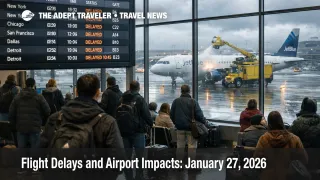
FAA planning for January 27, 2026, points to a recovery day that can still produce meaningful delays at several major hubs. Gusty winds are the primary trigger in the Northeast and the Bay Area, while light snow and high winds can slow runway and ramp cycles in the Midwest. Travelers should treat this as a day when disruption is less about one big shutdown and more about uneven restart friction, especially deicing throughput, surface snow and ice constraints, and intermittent traffic management initiatives that hold flights at their origin to protect constrained destinations.
The U.S. flight delays January 27 outlook is that Boston Logan International Airport (BOS), Newark Liberty International Airport (EWR), and San Francisco International Airport (SFO) are the most prominent wind flagged risk points, while Chicago O'Hare International Airport (ORD), Chicago Midway International Airport (MDW), and Detroit Metropolitan Wayne County Airport (DTW) sit in the snow plus wind risk bucket. Even when local conditions look flyable, the system can still meter arrivals and departures to keep queues from building in the air, which is why delays can appear first at your departure airport.
Who Is Affected
Travelers connecting through the Northeast corridor are the first group exposed because a constrained arrival rate at Boston Logan or Newark Liberty can push departure holds across wide parts of the country. That risk increases if you are on separate tickets, since a single inbound delay can break an onward leg without protected reaccommodation. If your day includes an international connection, the stakes are higher because missed long haul departures can mean a full day slip, not just a later same day option.
Midwest itineraries are also sensitive today, not because every flight will be disrupted, but because even modest snow plus high winds can reduce taxi speeds, slow deicing cycles, and extend turnaround times. When block times creep up, crews time out faster, gates stay occupied longer, and aircraft rotations fall behind. The visible symptom for travelers is a departure that keeps sliding, then an aircraft swap, then a cancellation that arrives late in the game when seat inventory is already thin.
North Texas and the New York City area add a second layer of exposure through possible traffic management initiatives later in the day. The FAA Command Center plan for January 27 included a JetBlue Airways (JBU) only ground stop at Boston earlier in the morning window, and it flagged the potential for initiatives after late morning and early afternoon time blocks at Newark Liberty and Teterboro Airport (TEB), Dallas Fort Worth International Airport (DFW), LaGuardia Airport (LGA), and San Francisco International. For travelers, those planned possible initiatives matter because they often coincide with peak banks and can turn localized weather or surface constraints into nationwide departure metering.
If you are still unwinding Winter Storm Fern impacts, the traveler profile that remains most vulnerable is anyone with a hard arrival deadline. Cruise embarkations, prepaid tours, medical appointments, and same day meetings do not absorb a rolling series of two hour slips well, and recovery days are exactly when option loss happens fast. For broader context on how Fern shaped the current recovery posture, see Winter Storm Fern US Flights, Delays Linger Jan 26.
What Travelers Should Do
Check your flight status before you leave for the airport, and again once you are in transit, because wind and deicing constraints can change departure times quickly. If you are flying through Boston Logan, Newark Liberty, San Francisco International, Chicago O'Hare, Chicago Midway, or Detroit Metropolitan, build extra time for slower gate turns and for surface constraints that can stretch taxi out and taxi in. Keep essentials in your personal item, and assume checked bag delivery can lag if ramp pacing slows for safety.
Set a decision threshold for rebooking versus waiting that matches your actual risk. If your connection time drops under about 90 minutes at a large hub, or if your destination hub enters a ground stop or a ground delay program window, rebooking usually beats hoping the sequence clears in time. If you must arrive on January 27, 2026, prioritize nonstops first, then routings with fewer hubs and longer connection windows, even if that looks less convenient on paper, because recovery days punish complexity.
Over the next 24 to 72 hours, monitor three layers, the FAA Command Center outlook, your airline's waiver coverage and rebooking rules, and local weather changes that can preserve ice and reduce ramp efficiency even after snowfall ends. Watch for whether possible initiatives become active programs at Newark Liberty, LaGuardia, Dallas Fort Worth, or San Francisco International, since that is the point when delays propagate well beyond the local weather footprint. If you have flexibility, shifting to an earlier departure or moving travel off the most constrained day can be cheaper than absorbing an unplanned hotel night during a compressed recovery window.
How It Works
FAA air traffic flow management is designed to keep demand from exceeding what airports and airspace can safely handle. When wind, snow, ice, low visibility, or surface constraints reduce arrival and departure rates, the system often responds by holding flights on the ground at their origin airports through programs like ground stops and ground delay programs, rather than letting aircraft stack in the air near a constrained destination. That is why you can be delayed in clear conditions, because the constraint is at the hub you are flying into, not at the runway you are departing from.
Those first order controls create predictable second order ripples. When flights are held at origin, connection banks break, misconnects rise, and aircraft and crews end up out of position. Longer taxi times and longer turn times then compound the problem by increasing block times, which pressures crew legality and pushes later flights into delay or cancellation. Once cancellations begin, hotel demand near hubs spikes, remaining flights sell out, and rebooking queues lengthen, making the next 12 to 36 hours feel worse than the local weather alone would suggest.