

Winter Storm Fern US Flight Delays January 27
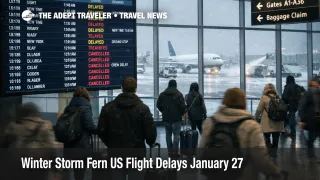
Winter Storm Fern recovery is still disrupting U.S. air travel, even as outright cancellations ease. Travelers flying on Tuesday are most exposed if they are connecting through large hubs, or relying on a tight same day chain that leaves no room for irregular operations. The practical move is to treat January 27, 2026 as a recovery day, confirm whether your airline waiver still applies, and widen buffers for check in, connections, and airport arrival timing.
Winter Storm Fern US flight delays are now being driven less by peak snowfall, and more by restart friction, including deicing throughput, surface snow and ice constraints, wind, and aircraft and crew repositioning.
The FAA's daily air traffic outlook for Tuesday highlighted gusty winds affecting Boston Logan International Airport (BOS), Newark Liberty International Airport (EWR), and San Francisco International Airport (SFO), plus light snow with high winds affecting Chicago Midway International Airport (MDW), Chicago O Hare International Airport (ORD), and Detroit Metropolitan Wayne County Airport (DTW). Those conditions matter on a recovery day because they slow ramp work and runway throughput, which can turn a late morning arrival cap into missed connections and delayed departures well outside the storm footprint.
FAA system planning also showed that recovery risk remained dynamic on Tuesday. The FAA operations plan advisory cited surface snow and ice constraints and wind as factors, and it listed the possibility of ground stop or delay program activity later in the day at Newark and Teterboro, Dallas Fort Worth International Airport (DFW), LaGuardia Airport (LGA), and San Francisco. Even when these initiatives are only "possible," they are a useful signal that you should expect metering, held departures at origin airports, and a higher chance of rolling delays as the day develops.
Who Is Affected
Travelers with connections are the first group exposed, especially those connecting through Northeast airspace complexes where surface constraints and wind can reduce arrival rates and cascade into upstream holds. On recovery days, a flight that looks fine at the origin can still sit at the gate because the destination complex is metering arrivals, or because the aircraft is waiting on a crew that timed out on a previous segment.
Travelers on multi leg itineraries, separate tickets, and basic economy style fares tend to absorb more pain, because reaccommodation options can be limited when the network is rebuilding. If you are traveling for a fixed deadline, including medical appointments, weddings, or same day meetings, the "we will get you there later" promise can fail when the last workable banks fill up.
Cruise embarkation and post cruise fly home plans remain a special risk case, because a one day slip in inbound air travel can misalign hotel check outs, transfers, and final boarding windows. Even when the ship still sails, the traveler's problem becomes ground logistics, baggage timing, and the availability of last minute hotel rooms near the port or the airport.
What Travelers Should Do
Act immediately on information you can control. Check your airline app for your inbound aircraft, and not just your departure time, confirm whether a Winter Storm Fern waiver still covers your city pair, and move sooner if you have flexibility. If your trip involves checked bags, assume delivery can lag during recovery, and keep essentials in your personal item so you can survive an overnight without access to your suitcase.
Use clear decision thresholds for rebooking versus waiting. If your first flight delay compresses your connection below roughly 90 minutes at a hub, or if the FAA outlook and planning signals show ongoing surface constraints at your connection airport, rebooking is usually safer than trying to thread a tight connection through a fragile network. If you must arrive the same day, prioritize fewer legs, earlier departures, and longer connection windows, even if it costs more, because the cost delta is often smaller than a forced overnight plus rebooking.
Monitor the next 24 to 72 hours in layers, not just one feed. Watch your airline's waiver page for extensions or narrowed airport lists, watch FAA planning and daily outlook notes for where the system is still capped, and watch local road and weather conditions because staffing and airport access can remain impaired after the last flakes fall. If you are traveling to a cruise, tour, or event, set a hard cutover time to book a hotel and shift to next day arrival rather than gambling on an end of day scramble.
How It Works
Winter storms disrupt aviation in two phases, capacity loss during the event, then network fragility during recovery. At the source, snow and ice reduce the number of arrivals an airport can safely accept per hour because braking action, visibility, and approach spacing become more conservative, while deicing adds minutes per departure and those minutes compound into gate congestion when multiple banks try to push at once.
Fern's recovery phase is snarled by where the storm hit and what it left behind. When surface snow and ice constraints persist at hubs, airlines cannot simply "turn the schedule back on," because aircraft sit out of position, crews hit duty time limits, and maintenance and catering rhythms break. Airlines often cancel additional flights to rebuild workable rotations, which lowers the cancellation count over time, but can keep delays and misconnect risk high.
Those first order aviation impacts produce second order ripples across hotels, cruises, tours, and ground transport. When passengers misconnect, airport hotel demand spikes and last minute inventory gets tight, rental cars drift out of balance, and rideshare supply can thin, particularly if roads remain hazardous. For continuity with earlier phases of this event, see Winter Storm Fern US Flights, Delays Linger Jan 26 and Winter Storm Fern US Flights, Waivers Expand Jan 23, and for deeper context on how FAA flow management interacts with system wide recovery, see U.S. Air Traffic Control Privatization: Reality Check.
Sources
- FAA Daily Air Traffic Report, Tuesday, January 27, 2026
- Current Operations Plan Advisory
- Winter Storm Fern Update: Northeast hubs facing weather related challenges | Delta News Hub
- American teams working around the clock after Winter Storm Fern | American Airlines Newsroom
- Travel Advisories and Alerts | Southwest Airlines
- Flight cancellation numbers are dropping as travel starts to recover after Storm Fern | Business Insider
- US airlines issue travel waivers as winter storm Fern threatens widespread disruptions | Reuters