

Grand Turk Canceled, Carnival Sunshine Returns To Norfolk
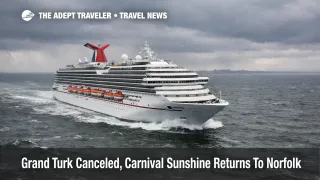
Carnival Sunshine is skipping its planned call at Grand Turk in Turks and Caicos and accelerating back to Norfolk, Virginia, to get ahead of a developing East Coast winter storm. Guests on the current sailing are the direct impact group, especially anyone who built shore plans around the Grand Turk day or who arranged tight, same day travel after the cruise. The practical next step is to treat the early return as both a port cancellation and a weather driven arrival risk, then adjust flights, transfers, and documentation before you lose cancellation flexibility.
The Carnival Sunshine Grand Turk cancellation changes the end of the sailing by removing the Grand Turk call and moving the ship's Norfolk arrival up to the morning of Saturday, January 31, 2026, with guests given options on when to leave the ship.
Who Is Affected
Passengers who booked Carnival shore excursions for Grand Turk will see the most straightforward unwind because those products are controlled by the cruise line, and they typically refund automatically when a port is dropped. The higher friction group is guests who booked independently, including third party tours, private drivers, and beach club reservations, because those refunds usually depend on each operator's terms and the proof you can provide that the ship did not call.
The second group is anyone who planned a tight post cruise departure from Norfolk International Airport (ORF), Richmond International Airport (RIC), or Newport News Williamsburg International Airport (PHF). An early docking can sound like "more time," but weather is the real constraint. If winter storm conditions degrade roads, curb access, or flight operations, the early arrival can still translate into longer terminal holds, slower baggage delivery, and a narrower window to make a flight you booked with minimal buffer.
A third group is the next set of embarking guests, because the ship arriving early does not automatically mean the next sailing starts early. Carnival has indicated embarkation remains scheduled for Sunday, February 1, 2026, but the storm forecast means terminal throughput and arrival timing could become more sensitive than normal.
What Travelers Should Do
Start with a fast inventory of what breaks because Grand Turk is off the table. Cancel or rebook any third party excursions immediately, save screenshots of your original itinerary and the updated notice, and keep every receipt tied to the canceled port day because those documents matter for chargebacks and insurance claims.
Use a decision threshold for flights rather than hoping conditions cooperate. If your flight is on Saturday, January 31, 2026, consider moving to a later departure or adding a buffer night if change fees are tolerable, especially if your ground plan depends on rideshare or a long drive. If you cannot move the flight, plan to clear the ship and reach the airport earlier than you normally would for Norfolk, and assume check in, security, and de icing delays are all plausible.
Over the next 24 to 72 hours, monitor three feeds, Carnival's onboard and app messaging about debarkation flow, the cruise terminal's instructions on processing, and National Weather Service updates for the Norfolk area. A Winter Storm Watch and marine storm messaging can be as important as snowfall totals because high winds and poor visibility can disrupt bridge and tunnel traffic, port approaches, and flight schedules.
Background
This change is a classic example of how weather risk propagates through the cruise system. At the source, a ship has two competing problems, itinerary integrity in the Caribbean, and safe, on time access to a homeport that sits inside a storm forecast cone. When fleet operations decides to "sail ahead of the storm," the first order effect is usually a dropped port call and more sea time, because the ship needs schedule margin to reach the pilot station, secure a berth, and complete customs and passenger processing before conditions worsen.
The second order ripple lands on everything that depends on a stable arrival clock. Shore excursions are the obvious casualty, but the bigger traveler cost often comes from downstream connections. Guests who booked flights, rail, or long drives based on an assumed all ashore time can suddenly face uncertainty, not because the ship is late, but because terminal processing can bunch into a narrower window, and storm conditions can disrupt the surface transport that gets you from the pier to the airport.
There is also a capacity ripple on land. When a cruise returns early and some guests choose to depart immediately, local hotels see different demand patterns, rideshare and taxi supply gets stressed in bursts, and rental car availability can tighten, especially if many travelers make the same "leave early" decision at once. Finally, the next sailing becomes a weather exposure point. Even if the ship is physically in port, embarkation still depends on staffing, gangway safety, terminal operations, and the ability of arriving passengers to reach Norfolk on time.
For a broader example of how weather driven port constraints can quietly break cruise timing even when airports appear normal, see Western Mediterranean Port Closures Disrupt Cruises. For a recent non weather itinerary disruption that still created similar downstream timing and refund problems, see Freedom of the Seas Port Swap After PortMiami Evac.