

Gibraltar Port Work Suspension Delays Strait Ferries
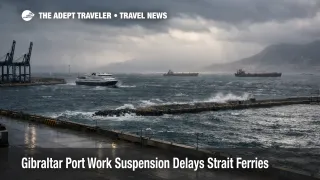
Port operations at Gibraltar were suspended after severe weather brought gale force winds and heavy swell into the Strait of Gibraltar region, halting port work such as bunkering and terminal activity and slowing vessel movements. For travelers, the immediate effect is that ferry and port area timelines become unstable, and a delay at one node can quickly spill into nearby ports and crossings as ships wait for clearance, pilots, and safe berthing conditions.
The practical point is that even when you are not boarding in Gibraltar itself, a Gibraltar port closure can still affect the wider Strait system. When ports pause movements, schedules lose their spacing, then restart in clumps. That is when terminals feel crowded, boarding windows shift, and ground transport demand surges at the same time.
Who Is Affected
Travelers crossing between southern Spain and North Africa are the most exposed, particularly those routing through Algeciras, Spain or Tarifa, Spain toward Ceuta, Spain and Tangier, Morocco. When wind and sea state trigger suspensions, operators may cancel blocks of departures, then run limited service when conditions briefly ease, which can leave long gaps followed by sudden boarding calls.
Gibraltar visitors are also affected even without a ferry ticket. Day trips that rely on tight timing, such as morning arrival with an afternoon return, are higher risk when the port area is operating under weather restrictions or recovering from a full stop. The same is true for travelers chaining multiple legs, for example a ferry plus a train, or a ferry plus a flight out of Málaga Costa del Sol Airport (AGP). Once the ferry leg slips, every downstream step, road transfers, rail check in, airport bag drops, becomes harder to hit.
Cruise passengers can see a different failure mode. Rough conditions can force ships to hold offshore or reshuffle port calls, and even when a ship still calls, arrival and departure times can drift enough to break excursions with fixed departure times and to raise misconnect risk for same day flights. Related regional context is covered in Western Mediterranean Port Closures Disrupt Cruises.
What Travelers Should Do
Treat any Strait crossing tied to a fixed appointment as time critical travel, not a flexible local hop. Before you leave for the terminal, verify your sailing on the operator channel you booked through, and then recheck close to departure, because weather driven schedules can change quickly as safety limits are crossed. If you are driving to the port, plan for slower approaches, and for holding patterns when truck or passenger flows are restricted after earlier cancellations.
Use clear decision thresholds for rebooking versus waiting. If your crossing is already canceled, or if earlier sailings on your route are being pulled, waiting at the terminal rarely improves your odds, and it often increases your costs when you miss rail or hotel deadlines. If you have a flight the same day, set a cutoff time where you move to a later departure or to an overnight plan, because once the system restarts, queues, security checks, and boarding controls can consume the buffer you thought you had.
Over the next 24 to 72 hours, watch three signals that matter more than general weather chatter. First, official wind and marine advisories, because those define the operating envelope for fast ferries and port movements. Second, port advisories indicating whether movements are fully restored or still restricted. Third, whether your operator is running multiple consecutive departure blocks on time, which is the best indicator that the backlog is clearing rather than re forming. For broader storm driven disruption mechanics on the Iberian side, see Storm Kristin Portugal Spain Travel Disruption.
Background
A Strait weather shutdown propagates through the travel system in layers. The first order effect starts at the waterline, high winds and heavy swell make it unsafe to berth, run pilotage, fuel ships, or operate high speed craft reliably, so ports pause movements and ferries cancel. The next layer is scheduling, once vessels and crews are out of sequence, operators must rebuild the lineup, and ports may meter departures to manage safety and traffic inside terminals.
Second order ripples show up away from the pier. When sailings bunch after a restart, taxi and rideshare demand spikes at the same time on both ends, and road access near terminals can slow, especially around Algeciras when freight backlogs accumulate. Hotels also become part of the system, because a missed crossing often turns into an unplanned overnight, and availability can tighten fast in peak corridors when many travelers make the same decision at once.
Finally, the disruption can persist after conditions "improve" because recovery is not a single event. It depends on sea state staying within limits long enough to clear the backlog and to re establish spacing between departures. That is why a complete suspension notice dated January 28, 2026 can still matter on January 29, 2026 and beyond, even if you see some sailings resume.
Sources
- Gibraltar Port Operations Suspended Due to Severe Weather
- Severe weather alert
- El puerto de Algeciras retoma sus conexiones marítimas y Tarifa las mantiene canceladas
- El Puerto de Algeciras, abarrotado con más de 2.800 camiones en su interior
- Storm Kristin batters the Rock; severe weather warning in place
- Severe weather causes disruption across Gibraltar as winds reach gale force
- Severe Weather Warning for Severe Gale Force Winds