

Malta Sicily Fast Ferry Cuts Virtu Schedule Jan 29
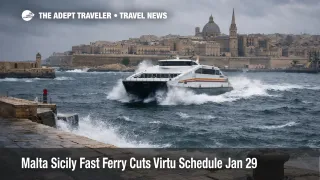
The Malta Sicily fast ferry schedule between Valletta, Malta, and Pozzallo, Italy was cut on January 29, 2026 after Virtu Ferries posted a date specific revision tied to unfavorable sea conditions. Travelers using the fast crossing for same day transfers, day trips, or onward connections should expect less flexibility, because multiple sailings were cancelled and two departures were shifted to new times. The simplest move is to verify the operating sailing before you head to the terminal, then protect any fixed commitments with either an earlier transfer buffer or a backup overnight plan.
Virtu Ferries' posted update shows the morning Malta departure moving earlier to 500 a.m. local time, and the late Pozzallo departure moving later to 1100 p.m. local time, while the 600 p.m. departure from Malta and the 730 p.m. departure from Pozzallo were cancelled. That pattern matters because it concentrates demand into fewer departure blocks, which is when standby space disappears quickly and rebooking becomes a capacity problem rather than a timing inconvenience.
Who Is Affected
Foot passengers, car travelers, and groups relying on the fast ferry as a positioning leg are the most exposed, especially when the ferry is paired with separate ticket flights, pre booked transfers, or non refundable hotel nights. The highest risk itineraries are the ones that assume a specific arrival hour in Pozzallo for onward driving to Syracuse, Italy, Noto, Italy, or Catania, Italy, or that assume an evening return to Malta for a next morning departure from Malta International Airport (MLA). When the evening sailings are removed, the day loses its recovery margin, and missed check ins become more likely if seas stay rough into the afternoon.
Weather driven suspensions also tend to ripple beyond the terminal. First, the cancellation reduces the number of available seats and vehicle slots, and that pushes more travelers into the same limited alternatives, such as the next operating sailing or a flight routing. Second, the knock on effect shows up in hotel and transport availability near staging points, because stranded passengers often shift to overnight stays close to the harbor to preserve an early departure window the next day. This is the same operational pattern travelers have seen elsewhere in the region during marine disruptions, where restarts can be uneven and backlogs take multiple cycles to clear. See Tangier Tarifa Ferry Suspensions During Morocco Storms and Western Mediterranean Port Closures Disrupt Cruises for the broader restart and backlog dynamics.
What Travelers Should Do
Start with immediate actions that prevent wasted transfers. Check Virtu Ferries' latest voyage update before you leave lodging, and treat any ambiguity as a reason to delay your arrival at the terminal until you see a confirmed operating sailing that matches your booking. If you are traveling with a vehicle, assume the remaining sailings can fill faster than foot passenger space, and plan for a longer wait at customer service if you need a same day change.
Set a decision threshold for rebooking versus waiting. If you must be in Sicily by a fixed hour for a tour pickup, a family event, or a hotel that closes check in early, moving to the earliest viable option is usually safer than hoping for a late day weather window that may not materialize. If your trip is flexible and you can tolerate arriving later, waiting can be reasonable, but only if you have a realistic overnight plan in Malta or Sicily and you are not chaining the ferry to a time sensitive flight connection.
Over the next 24 to 72 hours, monitor the sea state signals that drive ferry go or no go decisions, not just rain or general forecasts. The Malta International Airport meteorological office mariners forecast is a useful reference for wind force and sea conditions, and Virtu Ferries' own voyage updates will show whether the operator is attempting limited windows or returning to a normal pattern. If conditions remain rough, the most reliable alternative routing is usually to pivot to a flight based plan rather than waiting at the terminal, especially for travelers with fixed onward reservations.
How It Works
Fast ferry crossings between Malta and Sicily operate within tighter wind, swell, and berthing limits than many travelers expect. The disruption usually begins with safety and operability constraints, not convenience, because a vessel that can depart still needs to dock reliably, and ports need safe conditions for approaches, mooring, and passenger handling. That is why operators often cancel specific departure blocks and amend other times, aiming to run in the safest part of the day and to avoid loading passengers onto sailings that may not be able to complete normally.
Once multiple sailings are removed, the system shifts from a schedule problem into a capacity problem. First order effects show up immediately at the terminals, with fewer departures available for rebooking and a higher chance that the next operating sailing sells out. Second order ripples spread into transfers, hotels, and tours as arrival windows slip and ground transport demand surges in narrower time bands. In weather cycles affecting the central and western Mediterranean, these maritime disruptions can persist in rolling form until several consecutive departures operate on time and the backlog clears, even after conditions begin to ease.