

Manchester Airport Rail Disruption Hits TPE Routes
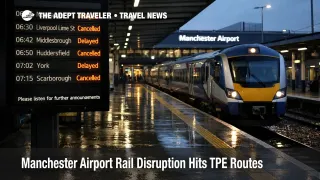
Rail travel across Northern England was disrupted overnight after major issues between Huddersfield and Manchester Victoria triggered widespread TransPennine Express service impacts across multiple route families. Travelers were most exposed on services that either run through Manchester Victoria, or rely on cross Pennine pathing to position trains and crews for later airport and city center departures. If a morning flight or a timed connection depends on arriving by rail, the practical move is to verify your exact train in live trackers, then be ready to switch to Manchester alternates, or a road transfer, before you are committed mid journey.
The Manchester Airport rail disruption affected TransPennine Express planning across the North by constraining a key corridor, which raises cancellation and delay risk even on trains that start far from the incident area.
Who Is Affected
Passengers traveling to Manchester Airport (MAN) by rail are the priority audience, especially anyone coming from West Yorkshire and North Yorkshire where cross Pennine services normally funnel into Manchester for the final leg to the airport. National Rail's incident summary listed multiple TransPennine Express route groups as affected, including services between Newcastle and Liverpool Lime Street via Manchester Airport, services between Saltburn or Redcar Central and Manchester Victoria, services between York or Huddersfield and Manchester Victoria, services between York or Huddersfield and Manchester Piccadilly, services between Hull and Liverpool Lime Street, and services between Wakefield Kirkgate and Manchester Piccadilly. In practice, that footprint covers a lot of first trains of the day, plus the late evening inbound trips travelers use to position for early departures.
Even if your exact itinerary does not pass through Huddersfield, cross Pennine disruption can still land on your trip through equipment and crew displacement. When a corridor blocks, operators often short turn trains, swap formations, and re sequence diagrams to restart service. That recovery phase is where journey planners can look normal, but individual trains still disappear, arrive short of destination, or run with altered calling patterns, which is how airport bound travelers get trapped with a plan that fails late.
What Travelers Should Do
For flights departing the morning of January 29, 2026, build your plan around the last hard cutoff you cannot miss, then work backward with extra buffer. If the live tracker shows cancellations, or repeated delay minutes stacking on your corridor, treat that as an early warning that recovery is not yet clean. The safest play is to switch before you are committed to a station with limited alternates, for example by taking an earlier train into Manchester, or by moving to a direct road transfer while availability still exists.
Use a clear decision threshold for rebooking versus waiting. If the next available rail option would put you inside a narrow window to clear bag drop, security, and the walk from the station into the terminal, waiting is not a rational gamble. When the rail plan no longer leaves room for a missed train, a platform change, or a short notice cancellation, switch to a backup, even if it costs more, because the failure mode is missing the flight and paying for a same day replacement.
Over the next 24 to 72 hours, monitor whether the corridor stays stable, or whether follow on constraints appear. Watch for repeat incident notes tied to the same cross Pennine segment, plus signs of crowding and capacity reduction, such as short formed trains, which can strand travelers even when the timetable is technically running. If you had disruption today, save screenshots of the live status and your booked itinerary, then use the operator's compensation process if you arrive late, or have to abandon the rail leg.
Background
The Huddersfield to Manchester corridor is a structural hinge for rail travel across the Pennines, so a failure there does not stay local. First order effects begin at the source, trains cannot pass a constrained segment, which forces cancellations, turnbacks, and service gaps on the lines that normally carry airport, commuter, and intercity passengers into Manchester. Second order ripples spread into the broader travel system because Manchester is also a connection point, missed trains become missed onward trains, and missed rail arrivals become missed flight check in windows for travelers using Manchester Airport rail access.
As recovery begins, the system remains fragile. Even when infrastructure reopens, operators still have to rebuild the pattern, reposition trainsets, and restore crew rotations. That is why early morning departures can remain unreliable after an overnight incident, and why the knock on impact is not limited to one station pair. If this disruption overlaps other UK weather and infrastructure stress, it stacks, and the reliability of every substitute mode, taxis, rideshares, local trams, and hotel inventory, tends to drop at the same time. For additional UK ground transport disruption context, see Storm Ingrid UK Rail Disruption Hits Southwest and Storm Chandra UK Flood Warnings Disrupt Roads, Rail.