

Messina Taormina Rail Link Cut, Bus Replacements Ongoing
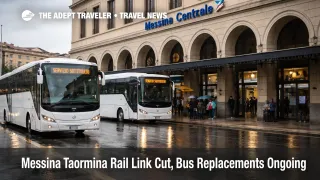
Rail travel on Sicily's east coast remains disrupted because train service is still suspended between Messina and Taormina after weather damage, with replacement buses operating on affected segments. Trenitalia's infomobility update for Thursday, January 29, 2026 confirms the suspension is ongoing, notes that substitute bus schedules can vary with road traffic, and lists Intercity changes that include cancellations and trains starting or ending at Messina instead of running through the blocked section. For travelers, the practical consequence is that a plan that looks like a simple rail hop can turn into a road transfer with wider arrival variance, especially during peak road periods or in additional rain.
The disruption matters most because this stretch is the hinge between Messina connections, including arrivals from mainland Italy, and Taormina area stays, day trips, and onward rail moves toward Catania and Siracusa. Even when buses are running, the trip behaves differently than rail, boarding points can be outside the station forecourt rather than at a platform, luggage handling is slower, and missed connections are more likely when your itinerary depends on tight station change times.
Who Is Affected
Travelers staying in Taormina and the surrounding coastal belt are the first group affected, particularly anyone arriving via Messina Centrale and trying to reach Taormina Giardini, Letojanni, or nearby stops for hotels and tour pickups. Bus substitution reduces timetable certainty, so a "late but acceptable" delay can still break a timed excursion departure, a restaurant reservation that is hard to move, or a prepaid transfer window.
Long distance rail passengers are the second group, because the Messina area is a gateway point for Intercity and overnight trains that connect Sicily to the mainland network. Trenitalia's update lists multiple Intercity services impacted on January 29 and January 30, including cancelled trains and trains that terminate or originate at Messina, with bus links used to bridge the gap for some itineraries. If you are building a cross Italy day on separate tickets, a bus delay here can cascade into losing a reserved seat departure later.
Air travelers are also indirectly exposed, not because the rail cut is at an airport station, but because it can change the reliability of the rail backbone that many itineraries use to reach Catania Fontanarossa Airport (CTA) from resort areas. When the rail network is constrained, more people shift to taxis, rideshares, and private transfers, which can raise prices and reduce availability on short notice.
What Travelers Should Do
Start by treating the replacement bus as a different mode, not a one for one train swap. Recheck your itinerary in your booking channel and in operator updates before you leave lodging, then arrive earlier than you normally would for a regional train, because boarding points can be outside the station and bus loading is slower when multiple trains are substituted at once. Build extra slack into hotel check ins and any timed entries on the day you cross the Messina to Taormina corridor.
Use a clear decision threshold for rebooking versus waiting. If missing arrival would create a real penalty, for example a flight, a cruise embarkation, a prepaid tour pickup, or an event ticket with a fixed start, shift to an earlier departure that leaves you at least one additional same day backup option, or switch the corridor to a private transfer where road conditions allow. If your plan is flexible and you can accept arriving an hour or two later, waiting can be reasonable, but only if you are not stacking multiple tight connections on separate tickets.
Over the next 24 to 72 hours, monitor three things, the operator's infomobility updates, the specific "program" notice for the day you travel, and local road and weather conditions on the coastal route that buses must use. Trenitalia explicitly warns that bus schedules may vary with road traffic, which is your cue to treat published times as best case rather than guaranteed. If your stop is one of the locations without a replacement bus, plan a last mile fallback now, rather than discovering the gap at the station.
Background
This disruption is a good example of how a localized infrastructure failure propagates through a travel system. The first order effect is straightforward, the rail line is not usable on the Messina to Taormina segment, so trains are cancelled or truncated, and buses are substituted to preserve minimum connectivity. That substitution immediately changes performance characteristics because rail travel time is decoupled from road travel time, and road travel is sensitive to congestion, weather, and incident response.
Second order effects show up across at least two additional layers. Connections become fragile because bus arrivals do not align as tightly with platform to platform change times, which increases missed onward trains toward Catania and Siracusa, and increases the likelihood of unplanned overnight stays when the last workable departure is missed. At the same time, demand shifts from rail into taxis and private transfers, which can cause price spikes and availability shortages in Taormina and Messina pickup markets during disruption windows.
Operational details matter here, because "bus substitution" is not uniform by station. Trenitalia's daily operating plan indicates that buses generally stop in the station forecourt, but it also lists exceptions and several stops where bus service is not provided, which can force travelers to bridge short gaps by local transit or taxi. If you want a broader Italy reliability lens while planning, it can help to keep an eye on other rail constraints and calendars, such as Italy Rail Strike Disrupts Trains January 20, 2026 and Italo Rail Works Rome Naples Cut Trains Into Feb, and to ground your planning in the destination context at Italy.