

Air NZ Auckland Widebody Cabin Action Feb 11 to 13
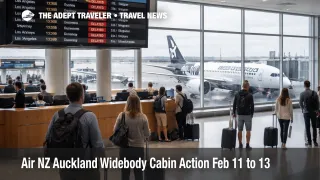
Air New Zealand has flagged potential disruption to its international widebody operation after it said it was notified of industrial action by cabin crew unions E tū and the Flight Attendants' Association of New Zealand (FAANZ). The airline's travel alert names February 11, February 12, and February 13 as the affected dates, and it frames the risk around cabin crew who operate the international widebody fleet. Air New Zealand also says flights are currently operating as scheduled, which means the practical risk for travelers is late schedule changes, not an already published cancellation wave.
For long haul passengers, the widebody scope matters more than the calendar notice itself. Widebody rotations are fewer, fuller, and harder to replace than short haul sectors, and a single cancellation can strand hundreds of travelers while simultaneously removing the aircraft that was meant to operate later legs. RNZ reported the planned action as a stop work strike affecting cabin crew working on Boeing 777 and Boeing 787 long range aircraft, which aligns with the aircraft families most travelers will see on Air New Zealand's long haul routes.
Air New Zealand says that if industrial action proceeds, it plans to contact impacted customers directly with next steps and rebook them on alternative flights where possible. The airline also says it will provide support such as meals during waits and accommodation and transport if an overnight is required, while noting that peak period availability can be limited and that reimbursement may depend on itemized receipts.
Who Is Affected
The most exposed group is anyone ticketed on Air New Zealand international services operated by the Boeing 777 or Boeing 787 during the February 11 to 13 window, especially passengers transiting Auckland International Airport (AKL). Auckland is the carrier's primary long haul hub, so disruptions there tend to propagate across multiple regions at once, including North America, Asia, Australia, and the South Pacific, even when your final destination is not New Zealand.
The next most exposed group is travelers building "tight chains," for example, a long haul arrival into Auckland followed by a short connection to Sydney, Australia, Melbourne, Australia, or a Pacific island flight that only runs once or twice per day. When a widebody arrival retimes, the onward flight usually departs on schedule, and the recovery option is often the next day. That is where the real cost shows up, hotels, transfers, missed events, and disrupted tour starts.
Interline and alliance connections reduce, but do not eliminate, the risk. If the trip is on one ticket, the airline is responsible for rerouting you to the destination under its conditions of carriage, but the quality of that reroute depends on seat inventory and partner availability at the moment the disruption hits. If the trip is split across separate tickets, the risk is much sharper, because the onward carrier can treat you as a no show, and last minute replacement fares can be punishing.
Travelers who should pay extra attention include anyone with cruise embarkations, prepaid lodges, weddings, conferences, or timed rail and ferry links that cannot slide by a day. For these trips, the correct plan is not to hope for "minor" disruption, it is to decide now what would trigger a proactive change.
What Travelers Should Do
Start with immediate protection moves. Confirm that your phone number and email are correct on the booking, and in any Airpoints profile tied to the reservation, because Air New Zealand says it will contact impacted customers directly if schedules change. If you are connecting in Auckland, add surface time on both ends, earlier airport arrival for departures, and a longer connection buffer for same day onward flights, because the first visible symptom is often a retime that collapses your planned connection.
Set decision thresholds before the day of travel. If missing the flight would force an overnight, jeopardize a cruise or tour start, or break a separate ticket, treat that as a rebooking trigger and move to an earlier departure, a different routing, or a different travel day while seats are still available. If your itinerary is flexible and you have multiple later same day alternatives, waiting can be reasonable, but only if you are comfortable with the possibility that reaccommodation lands you a day later.
Monitor the right signals over the next 24 to 72 hours. Watch for Air New Zealand to publish any waivers, flexible change options, or day of operational updates in its travel alerts, and track whether specific flight numbers start showing rolling retimes. Also monitor whether aircraft swaps appear on your route, because a widebody swap can change seat counts and lead to offloads even when a flight still operates.
How It Works
Industrial action in aviation rarely stays neatly inside the hours of the action. A widebody flight is a long, multi crew duty with fixed rest and safety requirements, so even a short stop work period can break the rotation in a way that is hard to "catch up" on the same day. Once one long haul departure cancels, the arriving aircraft that would have fed the next departure is not where it needs to be, and crews can run out of legal duty time, which converts a single cancellation into a rolling schedule problem.
Auckland amplifies this effect because it concentrates long haul arrivals and departures into banks that connect to Australia and the Pacific. If a Boeing 777 or Boeing 787 departure cancels, rebooking pressure spikes on limited capacity routes, and travelers can get spread across multiple later flights, sometimes on different routings. That reshuffle then collides with hotel availability near the airport, plus ground transport surges when large groups are reaccommodated at once.
Air New Zealand's own alert language also hints at the practical traveler constraint during peak periods. The airline says it will provide support if overnights are required, but it warns that accommodation availability can be extremely limited, and it offers guideline reimbursement figures that depend on reasonable expenses and itemized tax invoice receipts. That combination is a signal to travelers to keep documentation, to keep booking records, and to think through backup lodging options near the airport if a same day recovery is mission critical.
For travelers comparing disruption patterns, two recent labor action examples on Adept Traveler show how timing and hub dependence change outcomes. Italy easyJet Strike To Disrupt Flights Jan 31 Afternoon illustrates how a defined window can still cascade into missed connections and next day recovery. Nairobi Airport Strike Ultimatum Risks Flight Disruption shows how hub focused labor risk quickly becomes a hotel, transfer, and tour timing problem, not just a flight status problem.