

NYC Ferry Ice Suspension, Tourist Boats Canceled
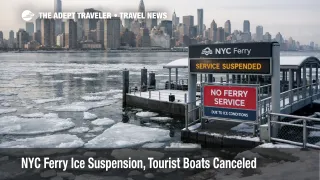
Ice buildup on the Hudson River, the East River, and New York Harbor has shut down or constrained multiple waterborne routes used by both visitors and daily commuters. NYC Ferry says service remains suspended across all routes because of continued ice, and operators continue to monitor conditions while preparing to restart when waterways are safe for normal maneuvering and docking. At the same time, other operators have trimmed service, substituted buses, or paused sightseeing products, turning what many travelers treat as a scenic shortcut into a reliability risk that can break timed plans.
Visitors are most affected when an itinerary depends on a ferry leg to bridge neighborhoods fast, for example, using waterfront routes to avoid subway transfers, or pairing a ferry ride with a fixed time ticket at an attraction. Commuters are most affected when a normal morning routine depends on a specific landing that is now offline, which pushes riders into chokepoints at a smaller number of terminals and onto already busy rail corridors. The practical next step is to treat the waterfront as a road and subway trip for now, then rebuild your day around longer, more redundant transfers rather than waiting for a same day ferry restart that may not come.
Who Is Affected
NYC Ferry riders across the system are the most directly affected because the suspension is system wide rather than confined to one line or landing. Travelers staying in waterfront heavy neighborhoods, including parts of Brooklyn, Queens, and Manhattan's river edges, are likely to feel the disruption first because the ferry often functions as the simplest one seat link between neighborhoods that otherwise require multi transfer subway routing.
New Jersey side travelers using NY Waterway are also affected in a very specific way. Edgewater service has been shifted to Port Imperial, and riders are being moved by bus between Edgewater and Port Imperial until further notice due to icing at the Edgewater ferry landing. That change matters for visitors staying along the Hudson in Edgewater or nearby, and for anyone who planned a ferry into Midtown or Lower Manhattan as the anchor of an airport or rail connection.
Sightseeing passengers are the other major group. Local reporting lists Circle Line sightseeing cruises as canceled from January 29 through February 8 due to ice, which removes a common Statue of Liberty and skyline viewing option during a peak winter visit period. Even travelers who were not planning a boat tour can still be impacted because canceled departures push more people into observation decks, museums, and indoor attractions, tightening timed entry availability and increasing lines.
What Travelers Should Do
Start by rebuilding your transfers as if no ferry options will operate today. If you had a ferry leg embedded inside an airport to hotel plan, price and time a fully land based route now, then decide whether the risk of waiting is worth it. For Manhattan, that usually means choosing a subway heavy transfer if you can manage stairs and luggage, or prebooking a car if you have multiple travelers, heavy bags, or a hard check in or event deadline.
Use clear decision thresholds for rebooking tours and shifting day plans. If your boat product is canceled, move quickly to an alternative experience that still delivers the same goal, such as an observation deck slot, a museum block, or a neighborhood food plan, because other displaced travelers will do the same. If your itinerary depends on a single tight connection, for example, hotel check in plus a Broadway curtain time, or a last admission window at a timed venue, treat the loss of the ferry as a reason to add at least 30 to 60 minutes of buffer beyond what mapping apps suggest, because surface congestion and platform crowding can add unpredictable delay.
Over the next 24 to 72 hours, monitor three signals rather than relying on hopeful headlines. First, watch the operator channels for each service you planned to use, because resumption often happens in phases, and one landing can reopen while another remains constrained. Second, track whether icebreaking and channel clearance is being reported as improving, because that is the operational prerequisite for reliable docking and schedule integrity. Third, if you are flying into the region, also watch broader winter weather driven capacity strain, because storm after effects can stack, and local surface access can remain fragile even when the sky looks clear. For related planning on East Coast aviation disruption windows, see Winter Storm Gianna East Coast Flight Waivers Jan 30 Feb 2. For network recovery stress that can complicate inbound flights and crew positioning, see Storm Fern American Airlines Recovery Strains Crews.
Background
River ice disrupts passenger vessel operations in a way that is different from wind or rain. At the source layer, ice floes force slower speeds, reduce maneuvering margins near docks, and can make landings unsafe if the vessel cannot hold position or if ice compresses against the pier. Even when a route is technically navigable, schedules become unreliable because crews must adjust speed, wait for assistance, or abort a landing if conditions change faster than safe operations allow.
The second layer is terminal concentration and knock on crowding. When a multi landing network goes offline, riders shift to a smaller set of land transport nodes, which intensifies pressure on specific subway lines and bus corridors that serve the waterfront. That crowding then amplifies travel time variance, especially during commuter peaks, and it increases the odds of missed timed plans for visitors who built their day around a predictable ferry cadence.
The third layer is cost and itinerary friction. When ferries and tourist boats pause together, demand moves onto taxis, rideshares, and private transfers at the same moments that road capacity can be reduced by winter conditions. Meanwhile, disrupted operators sometimes substitute buses, as in the Edgewater to Port Imperial shift, which adds a transfer step and introduces road traffic risk into what used to be a water first trip. For travelers, the key is that ice does not just cancel a boat ride, it reshapes the entire timing math of a day in New York City.
Sources
- Service Alerts, NYC Ferry
- NYC Ferry on Instagram
- All New York Waterway ferries will be departing and arriving at Port Imperial until further notice, Borough of Edgewater
- NYC, NJ ferry services disrupted by ice on Hudson River, ABC7 New York
- Ferries disrupted, icebreakers at work in New York, WorkBoat
- Hudson River ice suspends NYC ferry service as deep freeze grips the Northeast, AccuWeather