

Orlando Airport Ground Stop After Tower Sprinkler
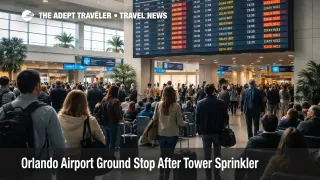
A temporary ground stop disrupted flights at Orlando International Airport (MCO) on February 1, 2026 after a fire alarm response triggered a precautionary evacuation at the airport's air traffic control (ATC) tower. The Federal Aviation Administration (FAA) issued a Command Center ground stop under a "fire alarm, safety" condition while the tower cleared the event. Travelers flying in or out of Orlando, Florida, including those connecting onward the same day, saw abrupt departure holds and arrival sequencing that did not instantly normalize once the stop lifted. The practical next step is to verify whether you are delayed by an FAA flow program or by your airline's local recovery plan, then rebook early if your connection margin is collapsing.
The FAA's advisory window shows why the disruption can feel larger than the on paper duration. The ground stop ran roughly 312 p.m. to 415 p.m. ET, and the advisory's delay snapshot listed 313 total delays, with a maximum of 57 minutes and an average of 39 minutes at the time of issuance. Orlando airport operations later resumed, but the stop's after effects can linger into the evening as aircraft, crews, and gate assignments work back into sequence.
Who Is Affected
The most exposed travelers are those departing Orlando during the late afternoon and early evening push on February 1, 2026, because a ground stop pauses the system at the source and creates a departure queue that must be worked down flight by flight. Even if your flight shows "boarding" or "on time," a late arriving aircraft or a gate conflict can turn into a last minute slip once the airport restacks departures.
Arriving passengers are also affected, especially if they are scheduled near the restart window. During a tower event, arrivals may be metered, slowed, or sequenced to match safe staffing and procedures, which can push touchdown times late enough to break rental car pickup windows, hotel check in cutoffs, or prepaid transfers. If you are traveling on separate tickets, the risk is sharper because a missed onward segment may not be protected by the airline, even when the root cause is an FAA initiative.
A third group to watch is anyone whose February 2 itinerary depends on an aircraft and crew that should have overnighted in Orlando. When a hub or high volume leisure airport takes a sudden operational hit, aircraft may end the day in the wrong city, or crews may time out before completing their rotation. That displacement can degrade next day schedules even after the immediate incident is over, particularly for the first wave of departures.
What Travelers Should Do
Start with fast verification and a buffer mindset. Check your airline app for your flight status, then cross check FAA system status and the FAA Command Center advisory feed to see if an ATC flow program is attached to Orlando. If your airline offers self service changes, use them early, because rebooking inventory evaporates quickly once a stop creates a pileup of displaced passengers. Keep essentials in your personal item, and delay heading to the terminal until your airline posts a credible new departure time, since restart periods often include long gate holds.
Use a clear decision threshold for rebooking versus waiting. If your first delay compresses a connection below about 90 minutes, or if your onward leg is the last flight of the day, moving to an earlier departure on February 2, or to a routing with a longer layover, is usually safer than hoping the recovery clears in time. If you have a hard arrival deadline, prioritize nonstop options first, then one stop itineraries with slack, even if they look less convenient on paper.
Over the next 24 to 72 hours, monitor three signals that indicate whether recovery is truly complete. First, watch whether cancellations stop and shift to delays, since that typically means airlines have aircraft and crews back in rotation. Second, watch whether your airline's on time performance into Orlando stabilizes, not just the single flight you are on, because inbound reliability drives the entire turn schedule. Third, keep an eye on FAA flow advisories and airport updates during the overnight and early morning windows, since a cold snap related facilities issue can reappear if conditions persist.
How It Works
A ground stop is one of the FAA Command Center's strongest traffic management initiatives. It pauses certain departures, often across many origin airports, to prevent an unsafe surge into a constrained destination or to protect a facility that cannot safely provide normal services. In this case, the FAA advisory listed an operational constraint tied to a tower fire alarm and safety response, and the airport later indicated a cold weather sprinkler activation inside the tower drove the alarm and evacuation response.
The disruption propagates through the travel system in layers. First order effects are immediate at the airport, departures are held, arrivals are metered, and gate plans become unstable because aircraft are not arriving and leaving on schedule. Second order effects hit the network, an aircraft that was supposed to arrive, turn, and depart again may miss that turn, shifting delays and misconnects into other cities as airlines protect their downstream schedules. Third order effects are crews and legality, where a delay late in the day can trigger a cancellation if the crew runs out of legal duty time before the last segment completes, which then forces repositioning and can degrade the next morning's first departures.
For context on how a short ground stop can still create a long delay tail, see Atlanta ATL Fog Ground Stop Delays Flights Jan 5 and Palm Springs PSP Ground Stop Delays Weekend Flights. For deeper structural context on why facility resilience and staffing remain binding constraints in U.S. air traffic control, reference U.S. Air Traffic Control Privatization: Reality Check.
Sources
- ATCSCC Advisory 044 MCO/ZJX 02/01/2026 CDM Ground Stop
- Orlando International Airport (MCO) FAA System Status
- Ground stop lifted after cold weather triggers sprinkler inside Orlando International Airport tower
- Temporary ground stop at MCO caused by sprinklers
- Ground Stop At MCO After Fire Alarm In Control Tower