

Balloon Incursions Vilnius Airport Disrupt Flights
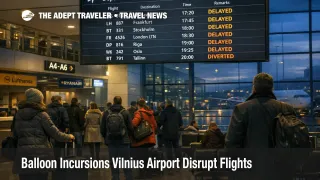
Flights at International Vilnius Čiurlionis Airport (VNO) have been paused repeatedly because suspected balloons drift into aviation hazard zones from the Belarus direction, forcing short notice airspace restrictions. The latest widely reported halt on January 27, 2026 stopped movements for about an hour, yet it reinforced that this is a recurring operational risk rather than an isolated event. For travelers, the practical change is that even clear weather days can still produce abrupt ground holds, diversions, and missed connections if a closure lands in the wrong part of the schedule.
Put simply, balloon incursions Vilnius Airport means your departure or arrival can be frozen with little warning, so itineraries need slack and a backup entry plan.
Who Is Affected
Passengers departing in the late afternoon and evening are often the most exposed because a short suspension can collide with airline cutoff times, crew duty limits, and the final wave of departures that has fewer recovery options. Arrivals are also at risk because inbound aircraft may divert when controllers cannot guarantee clear approach corridors, which can strand travelers at an alternate airport and turn a routine arrival into a ground transport problem.
Connecting travelers, especially those stitching together separate tickets or planning tight rail, bus, or meeting timings after landing, face the highest consequences from a disruption that looks small on paper. Business travelers and corporate travel managers should treat this as a duty of care scenario with a predictable failure mode, a same day trip can become an overnight stay if the closure hits the evening bank and inventory tightens. If you want deeper context on how this pattern first solidified as a repeat winter risk, see Vilnius Balloon Closures Disrupt Flights At Main Airport and Vilnius Airport Balloon Closures Hit Baltic Flights.
What Travelers Should Do
Build buffer into both the air and ground sides of your plan. For departures, arrive earlier than you normally would, and avoid stacking a critical meeting or onward connection immediately after a scheduled arrival at Vilnius. If you are traveling in the evening, consider holding a cancellable hotel option or at least mapping where you would stay if you slide to the next day, because brief closures can still compress late inventory when passengers roll forward.
Use a clear decision threshold for rebooking versus waiting. If your flight is on the edge of the last viable departure wave, or if a closure pushes your delay far enough that you will miss the last onward train, bus, or same day meeting, rebooking proactively is usually safer than hoping the operation snaps back cleanly. If you still have ample slack and the airport has reopened, waiting can be rational, but only if you are not depending on a separate ticket connection that will not be protected.
Monitor the right signals over the next 24 to 72 hours. Watch your exact flight number for repeated retimes, monitor the airport's live arrivals and departures view, and keep airline app notifications enabled so you see diversions and gate changes first. If the pattern persists into your travel window, consider rerouting into Riga International Airport (RIX) or Kaunas Airport (KUN), then completing the final leg by ground transport, which can reduce the odds that one short airspace restriction breaks your entire trip.
How It Works
Air traffic control treats unidentified objects near approach and departure corridors as a serious hazard until they are confirmed clear, especially when objects are hard to track and may appear in clusters. In the Vilnius case, reporting and regional briefings have linked many of these balloon events to cigarette smuggling from Belarus, and Lithuanian officials have framed the incursions as a hybrid pressure tactic because the effect on civil aviation is immediate even when the underlying payload is criminal contraband.
The travel system ripple is larger than the closure window itself. First order effects show up at the airport as halted departures, holding inbound aircraft, and diversions that physically move passengers away from their intended endpoint. Second order effects spread through airline rotations, a diverted aircraft arrives late or out of position, crews time out, and a thin schedule has fewer spare aircraft to restore the plan, which can push disruption into later flights and even the next morning. Past coverage also notes that civilian detection can be challenging, shifting monitoring and response onto military capabilities, which can affect how quickly authorities can confidently reopen corridors. On the passenger side, diversions create immediate demand spikes for buses, taxis, and last minute rooms in Vilnius and at alternates such as Warsaw Chopin Airport (WAW), especially when multiple flights are displaced at once.
Capacity constraints can make reaccommodation slower even for short disruptions because there may be fewer open seats later in the day, particularly in peak periods. For a broader explanation of why recovery can be seat constrained, even when an incident is brief, see FAA Delays on Boeing 737 MAX 10 Hit Airline Capacity.
Sources
- Vilnius Airport halts flights again after suspected Belarus balloon incursion
- Belarusian balloons full of cigarettes pose NATO's latest security threat
- Lithuania's Vilnius airport reopens after balloon incident
- Chronology of contraband balloon 'hybrid attack': here's what you should know
- International Vilnius Čiurlionis Airport
- Lithuania shuts airports, Belarus border crossings after balloon sightings