

Charlotte Airport Snow Cancellations Disrupt CLT
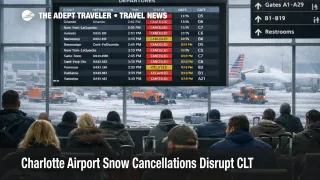
Mass flight cancellations hit Charlotte Douglas International Airport (CLT) after heavy snow disrupted airfield operations and forced airlines, led by American and its regional operators, to cut large portions of the schedule on February 1. Connecting travelers were the most exposed because Charlotte is a major hub where missed inbound flights quickly break downstream departures. The practical next step is to treat February 2 as a recovery day, rebook early if you must travel, and reduce dependence on tight same day connections through Charlotte.
The Charlotte airport snow cancellations matter because the event shifted from a short traffic management action into a broad reset of aircraft and crews, which can take multiple flight banks to unwind. The airport reported 11 inches of snow at CLT, and said it began a gradual return to operations with runways reopening, while warning that airline schedules would still be constrained as crews and aircraft reposition.
Who Is Affected
Travelers connecting on American through Charlotte sit at the center of the risk because the hub concentrates many short haul feeders into specific departure banks, and those banks were the first targets for cancellation when runway, deicing, and turnaround times stretched. Local reporting tied the heaviest cancellation volumes to American and its regional carriers, which matters if your itinerary includes branded regional flights that may be easier for the airline to trim while it protects long haul segments and limited frequency routes.
Passengers on separate tickets are the next highest risk group. If you are flying into Charlotte and then continuing on a separately booked cruise, rail trip, or event anchored reservation, a single cancellation can convert a same day plan into an unplanned overnight with limited protection from the downstream supplier. This is also where the second order ripples show up, hotel rooms near the airport tighten, rental cars sell through, and rideshare pickup times and prices can spike when many travelers try to move at once.
Business travelers and families returning home can also be affected even if they are not touching North Carolina. When a hub loses flights, aircraft and crews end up out of position across the airline network, and the airline often cancels additional flights to protect the next day schedule rather than operate broken rotations. That can produce delays and cancellations at outstations that have clear weather, simply because the inbound plane or crew never arrived.
What Travelers Should Do
Start with immediate actions that reduce exposure to the rebooking queue. Check your airline app, refresh flight status frequently, and if your flight is already canceled, prioritize rebooking into the earliest workable departure rather than waiting for your original time slot to recover. If you are eligible for a waiver, use it while inventory still exists, and consider shifting to a nonstop or a routing that avoids Charlotte for one day. For the waiver mechanics and timing mindset, use Winter Storm Gianna US Flight Waivers For Weekend Travel.
Use decision thresholds for rebooking versus waiting. If you have a connection under about two hours at Charlotte, if you are traveling on separate tickets, or if missing your first leg would strand you until the next day, rebooking through another hub is usually the rational move as long as you can confirm seats. If you have a flexible arrival window, a nonstop, and backup lodging, waiting can be reasonable, but only if you accept that recovery can be uneven and that late day flights can still be cut if crews time out or aircraft rotations do not reset cleanly. For context on how multi day recoveries behave at a large American hub, see Storm Fern DFW Flight Delays, American Recovery Lags.
Monitor the next 24 to 72 hours like an operator, not like a passenger hoping the schedule holds. Watch for repeated schedule trims, aircraft swaps, and gate holds, those often precede another cancellation wave when airlines protect the next bank. Keep an eye on FAA traffic management actions for Charlotte and your reroute hubs, because ground stops and flow programs can reappear as conditions change or as demand outstrips runway capacity. If you do travel, carry essentials, chargers, and medications in a personal item, and save screenshots of notices and receipts to support reimbursement or trip insurance claims.
How It Works
Snow driven disruptions propagate in layers, and Charlotte is a textbook case because the airport is both a local origin and a connecting engine for American's network. The first order impact is at the source, snow accumulation slows runway clearing, deicing demand extends turnaround times, taxi times grow, and gate availability tightens as inbound flights arrive late or not at all. Local reporting also referenced a ground stop for American flights on January 31, which is the kind of traffic management move that protects the airfield and arrival rate in the moment but can strand aircraft and crews on the wrong side of the network.
The second order ripple is the hub bank problem. Airlines build schedules in banks so that many inbound flights connect into many outbound flights in a short window, maximizing connection options with minimal aircraft idle time. When snow breaks that timing, the airline can lose an entire bank, and then crews run into duty and rest limits, aircraft rotations snap, and cancellations expand beyond the storm footprint because the next segment in the chain has no airplane or no legal crew. The Charlotte airport snow cancellations therefore create delays in places that were never snowy, because the system is trying to rebuild a coherent sequence, not just operate the next flight.
The third layer is traveler behavior and inventory compression. When thousands of people are rebooked into the next available flights, alternative routings fill quickly, hotel rooms near the hub compress, and prices rise because displaced passengers and airline crews compete for the same limited supply. This is also where broader capacity constraints matter, because airlines have less spare aircraft and fewer empty seats to absorb shocks, which can make recovery feel slower than travelers expect. For background on why seat availability can be structurally tight even outside a storm weekend, see FAA Delays on Boeing 737 MAX 10 Hit Airline Capacity.
Sources
- Snow Moves Out, Operations Move Forward
- Air Traffic Control System Command Center Advisory, CLT Ground Stop
- Over 800 flights canceled at Charlotte airport on Sunday following snowstorm
- Nearly 900 flights canceled at Charlotte Douglas airport amid heavy snow
- More than 1,000 flights canceled at Charlotte airport from snow storm
- In North Carolina, more winter weather leads to heavy snow