

Federal Aviation Administration SAFO 26001 Warns U.S. Flights of Rocket Debris
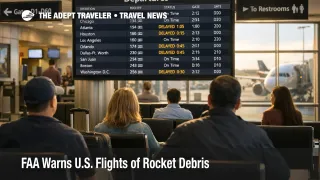
The FAA issued Safety Alert for Operators (SAFO) 26001 to flag a growing, practical risk for airline operations, space launch and reentry activity can trigger sudden airspace restrictions, and, in rare failure cases, falling debris hazards. U.S. flights are the most directly affected when trajectories, hazard areas, and contingency zones overlap busy corridors, especially around Florida and the Caribbean. The immediate traveler takeaway is to plan for occasional short notice reroutes or holds on affected days, and to protect tight connections with extra buffer.
The change in plain language is that FAA SAFO 26001 U.S. flights should treat space launch and reentry windows as another source of irregular operations, similar to convective weather or pop up ATC flow programs, with the added wrinkle that a debris response can be activated quickly after a mishap.
SAFO 26001 is guidance, not a new regulation, but it spells out how air traffic control can manage risk. The FAA describes Airspace Management Plans that depict Temporary Flight Restrictions, Aircraft Hazard Areas, and Debris Response Areas. The alert notes that the FAA activates a Debris Response Area in U.S. airspace via NOTAM during an unplanned catastrophic event involving falling debris, and controllers will reroute aircraft to avoid the area while broadcasting alerts to affected flights.
One line matters for long haul planning, the FAA states that Debris Response Areas are not issued in non radar or oceanic airspace, and it also notes that current DRAs do not extend into procedural oceanic airspace. That means crews can still receive operational updates and routing changes, but the debris specific alerting tool described in the SAFO is not available everywhere your flight might be.
Who Is Affected
Travelers are most exposed when their itineraries rely on peak hour departure banks, tight connections, or limited frequency routes that do not have easy same day recovery options. In practice, that includes many Florida gateway itineraries, Caribbean connections, and transatlantic or Latin America flights that route near the region when certain hazard areas are active.
The risk is not that debris will strike an airliner, it is that the airspace management response to keep aircraft separated from a potential hazard can slow traffic, close a slice of airspace, or force reroutes that add time. A real world example was the March 6, 2025 Starship failure by SpaceX, which prompted temporary ground stops at Miami International Airport, Fort Lauderdale Hollywood International Airport, Orlando International Airport, and Palm Beach International Airport, along with diversions and airborne holding as aircraft avoided the debris area.
The broader pressure is scale. The FAA's commercial space forecast reports 148 licensed launch and reentry operations in FY 2024, and projects a range of 174 to 183 operations in FY 2025 rising to a range of 259 to 566 by FY 2034, depending on the scenario. More operations mean more planned hazard areas, more coordination, and more chances that a disruption overlaps a busy traffic push.
What Travelers Should Do
If you are traveling on a day when a launch or reentry window could affect your route, treat your schedule like a moderate disruption risk day. Choose earlier departures when possible, avoid the last connection of the day on separate tickets, and keep your arrival buffer healthy for cruises, events, and onward ground transport. If you are connecting through Florida gateways or the Caribbean, add extra cushion because delay programs there often propagate quickly into missed banks.
Use a clear threshold for action. If your itinerary has a connection under 90 minutes in a hub that is already capacity constrained, or your trip has a hard arrival requirement, rebook to a more conservative routing as soon as waiver options appear, rather than waiting at the gate for day of surprises. If your connection is two hours or more, and your airline has multiple later options, it is often reasonable to wait while monitoring ATC initiatives and your flight's estimated departure time.
Over the next 24 to 72 hours, monitor three things, airline travel alerts for your specific flight number, launch related NOTAMs that define hazard areas, and ATC flow initiatives that show up as ground delay programs or reroutes. For a practical primer on how airspace constraints reshape routings and connection math, Iran Airspace Closure Reroutes Europe Gulf Flights is a useful parallel case, and for an example of an FAA issued advisory changing reliability in a region, FAA Caribbean Caution NOTAM Through Feb 2 maps well to the same monitor, buffer, and rebooking decision cycle.
How It Works
Space launches and reentries do not happen "above" aviation in a way that keeps the systems separate. They share the same National Airspace System, but at different times and with different hazard models. When a launch is scheduled, the FAA can publish hazard areas and airspace restrictions in advance, then manage flows around them. When a mishap occurs, the FAA can activate a Debris Response Area in U.S. airspace via NOTAM, broadcast alerts to nearby aircraft, and reroute traffic away from where debris is expected or observed.
The first order effect for travelers is time. Reroutes increase flight time and burn more fuel, holding programs delay departures and arrivals, and ground stops can pause departures entirely for a short window. The second order ripple is network math, an aircraft that arrives late does not turn on time for its next leg, crews can time out under duty rules, and gate plans can unravel at hubs with little slack. Those delays then propagate outward as missed connections, reaccommodation lines, and hotel inventory pressure near airports when large groups roll to the next day.
SAFO 26001's recommended actions are aimed at keeping that first order disruption from becoming a safety issue or a cascading operational collapse. It explicitly calls out reviewing launch hazard NOTAMs and Airspace Management Plans during flight planning, anticipating delays, ensuring adequate holding fuel under Part 121 requirements, identifying alternates in case a Debris Response Area activates, recognizing debris may extend beyond the designated area, and consulting the FAA operational information tools for real time updates. For travelers, the practical implication is that FAA SAFO 26001 U.S. flights may build more buffer into planning on affected days, which can show up as longer routings or more conservative dispatch decisions that trade a little time for resilience.
For deeper context on why even short airspace initiatives can cascade into system wide delays, U.S. Air Traffic Control Privatization: Reality Check explains the broader constraints that make the network less forgiving when new classes of airspace users scale up.
Sources
- SAFO 26001: Airspace Management Considerations for Space Launch Activities
- FAA Aerospace Forecast Fiscal Years 2025-2045, Commercial Space Transportation
- US FAA says 240 flights disrupted by explosion of Musk's SpaceX Starship
- SpaceX Starship failure prompts diversions, Florida airports ground stops
- FAA Warns Airlines About Safety Risks from Rocket Launches and Reentries