

Charlotte Airport Recovery Delays Keep Misconnect Risk
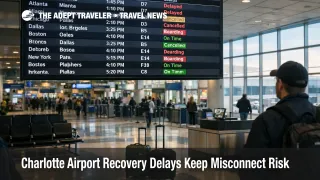
Charlotte airport recovery delays at Charlotte Douglas International Airport are improving after the weekend snow, but February 3, 2026 remains a high risk day for missed connections as schedules and crews reset. Connecting passengers and anyone with timed ground transfers are the most exposed, because a single late inbound can still break an onward bank even when the airport is broadly reopening. The practical next step is to treat today like a stabilization window, add buffer, and be ready to reroute early if your first leg starts slipping.
The improvement is real, local reporting showed cancellations and delays tapering by February 2 compared with the peak weekend impact, but "better" is not the same as "normal." In a recovery pattern, airlines continue trimming specific flights to rebuild tomorrow's schedule, and those trims often land hardest on short haul feeders and regional rotations that carry large numbers of connecting travelers.
Who Is Affected
Travelers connecting on American Airlines through Charlotte sit at the center of the risk because the hub concentrates many inbound flights into narrow connection windows. When a hub is resetting after winter ops, it is common to see departure times move repeatedly, gate holds that look like "only" a delay until they become a misconnect, and rebooking queues that spike when multiple banks compress into the same hour.
Passengers on regional branded segments are also disproportionately exposed, even if the headline cancellations are easing. Regional aircraft and crews cycle quickly, and a single broken rotation can ripple across multiple cities in one day, which is why you can see Charlotte related impacts in clear weather markets that never saw snow. This is also the point where second order friction shows up off the airfield, hotel rooms near the airport tighten, rental cars sell through, and pickup times stretch as displaced travelers choose to wait out the reset instead of gambling on a tight same day connection.
If you are traveling on separate tickets, treat that as a different risk category. A delay that is merely annoying on a single ticket can become a full trip failure if the second provider, like a cruise line, a rail operator, or a hotel with a hard check in cutoff, does not recognize your airline disruption. Families returning home and business travelers heading to fixed meetings face the same structural problem, recovery days are when variability is highest, not when the weather headline is loudest.
What Travelers Should Do
Start with immediate actions and buffers. Confirm your flight status in your airline app before you leave, then again when you are en route, and again when you arrive, because recovery day departure boards can change fast. Pack essentials, chargers, and medications in a personal item, and keep a screenshot trail of alerts and receipts in case you need reimbursement, an insurance claim, or a hotel exception. If you are driving in, expect slower curb flow and longer rental car lines than you would see on a normal Tuesday.
Use a clear decision threshold for rebooking versus waiting. If your connection is under about two hours, if your first leg is already delayed, or if you are on separate tickets, the rational move is to price and reserve alternatives early, even if you hope your original routing works. The reason is inventory, once the recovery wave rebooks into the next available departures, "later" often becomes "tomorrow," especially on hub to hub flights. If you have a nonstop, a long connection, or flexible arrival timing, waiting can be reasonable, but only if you accept that late day flights are the first to be cut when crews time out or when the airline protects the following morning.
Monitor the next 24 to 72 hours like an operator, not like a passenger hoping the schedule holds. Watch airport wide cancellation totals and delay counts on FlightAware, and track whether your aircraft is swapped, because tail changes are a common sign that the airline is still stitching the network back together. Also monitor Federal Aviation Administration traffic management notes for Charlotte and your alternate hubs, because a "ground stop or delay program possible" note can turn into gate holds that erase your buffer, even after the weather event itself has moved on.
If you want a local baseline for how the weekend disruption set up this recovery window, see Charlotte Airport Snow Cancellations Disrupt CLT. For a broader read on how FAA metering and hub acceptance rate cuts propagate into gate holds at your origin, see Flight Delays and Airport Impacts: February 2, 2026.
How It Works
Recovery day disruptions propagate in layers, and Charlotte is a textbook case because it is both a local origin airport and a high throughput connection engine. The first order impact is at the source, winter ops slows taxi and turns, deicing demand stretches gate occupancy, and the airport can be physically open while the airline schedule is still constrained by where aircraft and crews ended up overnight. The airport has emphasized that schedules are set by airline partners and that delays and cancellations can persist as repositioning continues, even with runways open.
The second order ripple is the hub bank problem. Airlines build "banks" so many inbound flights connect into many outbound flights in a short window. When the inbound bank arrives late, you do not just lose one flight, you lose the connection structure that makes the bank work, then crews run into duty and rest limits, aircraft rotations snap, and the airline cancels additional segments to protect the next day's schedule. That is why misconnect risk can stay elevated even as cancellation totals fall, the system is optimizing for tomorrow's coherence, not your single itinerary.
The third layer is traffic management and traveler behavior. When demand exceeds arrival capacity, the FAA can meter flights with initiatives like ground delay programs, which hold aircraft at departure airports to avoid overload at the destination. Those programs are operationally rational, but they can produce long gate holds at your origin, and they can erase connection buffers before you ever take off. If you want deeper context on why these constraints keep showing up system wide, and what is realistically fixable, U.S. Air Traffic Control Privatization: Reality Check lays out the structural drivers.