

Delta San Antonio Engine Fire Landing Delays
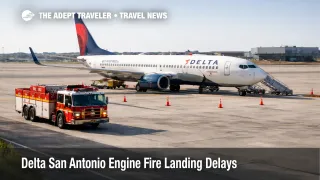
A Delta Air Lines flight bound for Hartsfield-Jackson Atlanta International Airport (ATL) returned to San Antonio International Airport (SAT) on February 3, 2026, after an indication of a potential engine issue and an initial report of smoke or an engine fire. Local emergency response was activated, and the aircraft landed safely with no reported injuries. For travelers, the immediate issue is not only the single disrupted flight, it is the downstream schedule impact when an aircraft is pulled for inspection and the airline has to rebuild the day's plan around an equipment swap.
Delta identified the flight as Delta Flight 1676 and said it returned shortly after takeoff so the crew could receive priority handling and the aircraft could be evaluated by maintenance. San Antonio airport officials told local media the initial call referenced an engine fire, but responders did not find an indication of fire after the aircraft arrived, and airport operations were not reported as materially affected.
Who Is Affected
The most directly affected group is anyone who was booked on Delta Flight 1676 on February 3, 2026, plus travelers holding separate tickets that depended on that flight arriving on time into Atlanta. Even when an airline rebooks quickly, same day seat availability can be thin on heavily traveled domestic routes, and later flights can fill up fast when dozens or hundreds of passengers are pushed into the same pool of alternates.
The next ring is travelers on later Delta flights that were supposed to use the same aircraft and crew sequence. Public flight tracking for DL1676 shows that the February 3 entry is flagged as diverted back to SAT, which is consistent with an aircraft coming out of rotation for inspection, and that is the moment when knock on delays start to appear across unrelated cities later in the day.
A third group is anyone with hard arrival requirements, including cruise embarkation, medical appointments, court dates, or prepaid tours. These trips are sensitive to even a single missed connection because the recovery path may require an overnight, and that can cascade into hotel costs, lost reservations, and missed ground transfers.
What Travelers Should Do
If you were on Delta Flight 1676, anchor on confirmation, not assumptions. Make sure your rebooked itinerary is ticketed, shows a confirmed seat assignment, and matches what the agent or app promised, then screenshot it. If you checked bags, verify the bag status in the airline app after rebooking, because a last minute aircraft return can leave bags staged for the original departure until ramp teams reconcile the new plan.
If you are not on that specific flight but are traveling through SAT or ATL on February 3, 2026, treat the afternoon and evening banks as the higher risk window for secondary effects. When one aircraft comes out of service unexpectedly, the airline can cover the hole with a swap, but swaps are not free, they displace another tail, tighten turn times, and reduce slack, which is how a clean looking morning can become scattered delays later. Use Flight Delays and Airport Impacts: February 3, 2026 as a system level baseline while you watch your specific flight status.
Set a decision threshold for rebooking versus waiting over the next 24 to 72 hours. If your itinerary has a connection under 90 minutes in Atlanta, or you are booked on the last practical flight to your destination, rebooking earlier is usually smarter than waiting for the gate to resolve it, because seats are the scarce resource once reaccommodation begins. If your trip is flexible and you have multiple later options, waiting can be rational, but only if you have an overnight plan and you can absorb a miss without cascading losses. If you end up canceling the trip instead of rebooking, understand the difference between refunds and extra compensation in the U.S. system, which is largely policy driven rather than automatic cash payouts, as covered in U.S. Backs Off Airline Delay Compensation.
How It Works
A reported engine fire or smoke event triggers a conservative operational playbook even when the aircraft lands normally and responders do not observe active fire on arrival. The airline will typically pull that aircraft for inspection, and that single decision is what creates most of the traveler disruption: the aircraft that was supposed to fly the next segment is no longer available, and the schedule has to be rebuilt around whatever spare aircraft, spare crew, and spare gates exist.
The first order effect is immediate, a flight returns, passengers need reaccommodation, and the airline must reposition a replacement aircraft to cover later segments. The second order ripple is network wide timing pressure. When a replacement aircraft is swapped in, it often arrives from another city late, compressing turn times, and increasing the odds that a later departure misses its slot, pushes into a ground delay, or runs into crew duty limits. That is how a single mechanical event can produce scattered cancellations later, not because the problem is spreading mechanically, but because slack has been removed from the day's plan.
The third order ripple is traveler behavior and local inventory. If misconnects rise late in the day, airport area hotels and rental cars can tighten quickly, especially for passengers who need to stay near the airport to catch the first flight out. That is why your best leverage is early: confirm your reaccommodation, move to earlier departures when possible, and decide quickly whether you are protecting the trip or abandoning it.