

Flight Delays and Airport Impacts: February 3, 2026
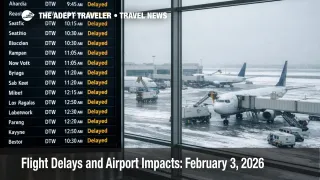
Flight delays and airport impacts are expected to stay mostly manageable across the United States on February 3, 2026, but the FAA is flagging localized constraint risk from snow around Detroit Metropolitan Wayne County Airport (DTW) and low ceilings around Seattle-Tacoma International Airport (SEA) and San Diego International Airport (SAN). Connecting travelers and anyone with a tight same day chain, especially those relying on a single hub to make an onward flight, are the most exposed group even when nationwide averages look calm. The practical next step is to treat today as a monitor and buffer day, check status early, protect connections with extra time, and be ready to pivot if flow programs appear later.
The Flight Delays and Airport Impacts story today is that conditions can look quiet in the national snapshot while a few high leverage airports and airspace constraints still have the ability to create late day disruption.
The FAA's current plan describes an overall quiet day, but it puts three specific terminal constraints on the board, snow at DTW, and low ceilings or low visibility at SEA and SAN. Even a small reduction in arrival acceptance rates at a hub tends to show up as gate holds at your origin, because the system slows departures upstream to avoid stacking aircraft in holding patterns over the destination. That upstream metering is why a traveler in a clear weather city can still see a departure delay, the constraint is not local, it is downstream.
Beyond weather, today's plan includes operational friction that can matter for itinerary reliability. Miami International Airport (MIA) is implementing Terminal Flight Data Manager (TFDM), and the FAA notes that the change can require increased metering and timing adjustments as the new surface management program is introduced. Military activity and special use airspace in Florida related centers can also influence routings and add minutes, which then tightens aircraft turns and increases the odds that a late inbound becomes a late outbound.
If you are coming off yesterday's disruption footprint, treat this as a continuity problem, not a clean slate. Aircraft and crews that were displaced by earlier winter operations can still be out of position, which means the first wave of flights can be more fragile than the weather map suggests. For a baseline on how "watch list" conditions can translate into hub driven delays, reference Flight Delays and Airport Impacts: February 2, 2026. If your itinerary touches Charlotte Douglas International Airport (CLT), note that recovery dynamics after a snow event can linger across multiple banks, as covered in Charlotte Airport Snow Cancellations Disrupt CLT.
Who Is Affected
Travelers with tight connections through DTW, SEA, or SAN are the most exposed, because those airports can shift from normal rates to reduced rates quickly when snow, ceilings, or visibility tighten. The risk is not only an airport delay, it is the cascade, a late inbound breaks a connection, rebooking pushes passengers into later departures, and the later departures then operate with heavier loads and less slack.
Florida bound and Florida originating travelers should also pay attention even if their departure airport looks normal. When military activity or published route structure changes affect Jacksonville and Miami area airspace, flights can be rerouted or stretched, which increases block times and compresses turnaround plans at high volume airports. That compression matters most for late afternoon and evening departures, when there is less spare time left in the day to recover, and when crews are closer to duty limits.
Passengers flying into or out of airports with runway and taxiway constraints face a more subtle risk: slower recovery once anything goes off schedule. The FAA planning notes include runway closures at Harry Reid International Airport (LAS) during specific daytime windows, and extended runway work at Tampa International Airport (TPA), plus ongoing construction and operational adjustments at multiple large airports including LaGuardia Airport (LGA), Chicago O'Hare International Airport (ORD), Orlando International Airport (MCO), and Ronald Reagan Washington National Airport (DCA). These are rarely the headline cause of a bad travel day, but they remove options when the system needs flexibility.
What Travelers Should Do
Start with immediate actions that reduce exposure to surprise holds. Check your airline app, then cross check the FAA airport status snapshot before you leave for the airport, because a ground delay program or a destination acceptance rate reduction often appears there first. If you are connecting, protect the connection by choosing the earlier of two similar flights, and avoid stacking a short layover with a separately booked hotel, cruise, rail, or event commitment.
Use a clear decision threshold for rebooking versus waiting. If your connection margin drops under about 90 minutes at a hub already flagged for snow or low ceilings, or if you are on the last reasonable departure of the day, rebooking to a nonstop or a routing through a different hub is usually the safer move while seats still exist. If your trip is flexible and your delay is still in the "minutes not hours" range, waiting can be rational, but only if you have a backup plan for an overnight and you are not relying on a single must make segment.
Over the next 24 to 72 hours, monitor signals that show whether a localized issue is becoming a system issue. Watch whether delay minutes begin clustering at DTW, SEA, or SAN in repeated waves, and whether Miami starts showing more surface sequencing as TFDM settles in. Also watch for reroute messaging on Florida flows and any late day volume management, because those are the patterns that turn a calm morning into a messy evening.
How It Works
The FAA's Command Center planning process is designed to manage demand to match capacity across airports and airspace. When a terminal constraint appears, such as snow at DTW or low ceilings at SEA, the constraint typically reduces how many arrivals can be handled per hour, and traffic managers respond by metering departures headed to that destination. That metering can be formal, such as a ground delay program, or informal, such as miles in trail restrictions that space aircraft out along a route.
The disruption then propagates through layers of the travel system. First order effects are local to the constrained airport, arrivals slow, gates fill, taxi times rise, and departures slip. Second order effects hit connections and aircraft rotations, a delayed inbound misses the outbound bank, and the aircraft that should have moved to the next city is now late, which forces downstream gate changes, missed connections, and rebooking surges. Third order effects are crew flow and passenger services, late day delays can trigger cancellations when crews time out, and that is when hotels, rental cars, and rideshare demand spike around the affected hub.
TFDM fits into this picture as a surface management and information sharing program in FAA towers, intended to improve how departures are sequenced and how surface demand is managed. During implementation, the practical traveler impact can be additional metering or adjusted push timing at the affected airport, especially during peak banks, which can feel like "the gate will not release us" delays even when weather is fine.