

Disney Adventure Panama Canal Transit Sets Record
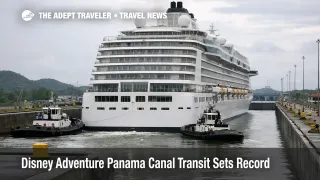
Disney Cruise Line's Disney Adventure completed a record setting Panama Canal transit on February 2, 2026, becoming the largest passenger vessel by both capacity and gross tonnage to cross the waterway. The milestone matters most to cruise travelers on repositioning sailings and canal itineraries because "largest ship" transits are the ones most sensitive to lock choreography, tug support, and traffic sequencing. If you are traveling on a cruise that includes a canal day, or meeting a ship on a same day flight connection, plan for schedule drift by keeping buffers around port arrival times and by avoiding tightly timed, nonrefundable add ons.
The canal authority said the ship measures about 208,000 gross tons and more than 342 meters in length, and that the passage required coordinated work by Panama Canal pilots, tug crews, and operations teams. Canal Administrator Ricaurte Vásquez Morales presented a commemorative plaque recognizing the ship's inaugural transit, a detail that typically accompanies first time passages and signals the operator and the canal are treating the move as a notable benchmark, not a routine slot.
Who Is Affected
Cruise travelers are the direct audience for this record because it frames how the expanded canal infrastructure is being used by today's largest passenger ships, and how that usage can influence itinerary timing. Record transits do not automatically mean disruption, but they do underline that the canal runs on precise operating windows, with safety margins that can tighten when traffic is heavy, when weather reduces visibility, or when tug availability becomes a pacing factor. On a canal itinerary, that shows up as a canal day that runs long, a port call that starts later than planned, or a change in the time you are cleared to go ashore.
Travel advisors and travelers building complex, multi leg trips are also affected because canal positioning voyages often sit inside bigger deployment shifts. When ships move between regions, the cruise line may also update embarkation day hotel guidance, transfer timing, and check in windows, and those small changes are where missed flights and missed transfers actually happen. If you are meeting the ship after an overnight flight, or if you are leaving the ship and connecting onward the same day, assume the cruise line will protect its own transfers first, and treat independent tickets as the fragile layer of the plan.
Finally, this is relevant to travelers watching the 2026 cruise calendar because Panama Canal officials have pointed to a higher volume of Neopanamax cruise ship transits, more than 40 in fiscal year 2026. More big ship passages do not guarantee delays, but it does raise the likelihood of minor timing adjustments when multiple large vessels cluster into the same day, especially during popular repositioning periods.
What Travelers Should Do
If your itinerary includes a Panama Canal day, build immediate buffers into anything that depends on a specific hour. Keep shore excursions booked through the cruise line when the activity is close to the ship's all aboard time, and avoid privately arranged tours that require long road transfers unless you have a clear fallback plan. If you must book independently, choose vendors with flexible start times and explicit refund policies tied to ship schedule changes.
Set a decision threshold for rebooking versus waiting if you are connecting to or from the ship on the same day. If your flight, rail, or onward cruise connection leaves within a tight window after the published arrival time, treat that as a trigger to move to an earlier departure, add a hotel night, or book protected transfers offered by the cruise line. The goal is not to predict a problem, it is to remove the single point of failure that turns a small timing slip into a missed trip.
Over the next 24 to 72 hours before you sail, monitor the signals that actually change outcomes. Watch for updated port arrival times inside the cruise line app, and watch for official canal statements or operational advisories that can affect traffic pacing. If you see your ship assigned an earlier muster, or if you see a revised all aboard time, take that as the real schedule, and update tours, transfers, and dining accordingly.
How It Works
The Panama Canal's expanded locks, including the Agua Clara Locks on the Atlantic side, were built to handle larger vessels that cannot fit the original lock chambers. For cruise travelers, the practical point is that a "big ship" transit is not just about fitting, it is about choreography. Pilots board to guide the vessel, tugs and mooring systems manage positioning and speed, and the canal sequences traffic in a way that balances safety, water use, and throughput.
That structure creates first order and second order travel effects. The first order effect is timing variability on the canal day itself, especially when the canal is managing multiple large vessel movements, or when conditions require slower approaches. The second order ripples show up outside the canal, in ports and in traveler logistics. A ship that arrives later can compress shore time, shift excursion return waves, and push congestion into the peak tender or gangway period, which is when missed meet up points and long lines become most likely. For travelers flying in or out, it can also change the practical value of a same day connection, because a minor slip can erase the buffer you assumed you had.
The Disney Adventure record also matters as a benchmark against prior "largest passenger vessel" moments. Panama Canal communications in 2018 highlighted Norwegian Bliss as the then largest passenger vessel to transit the canal, and canal officials now frame Disney Adventure as surpassing that earlier record. For travelers, those milestones are best used as planning signals, the canal is being used by increasingly large cruise ships, and schedules should be treated as operational targets with built in slack, not as fixed appointments.
An adjacent reality is that itinerary change risk is now a normal part of cruise planning, even when the cause is unrelated to the canal. If you have not built a process for handling changes, use examples like Labadee Haiti Port Calls Pulled From Royal 2026 as a reminder to keep independent add ons flexible, and to price travel insurance based on what you would actually lose if times shift.