

IndiGo Copenhagen Flights Suspended, UK Cuts Feb 2026
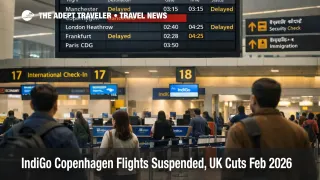
IndiGo is pulling back on a small but meaningful slice of its new Europe and UK flying, citing operational strain from longer routings around restricted airspace and persistent congestion at key airports. The airline said it will suspend its Copenhagen Airport (CPH) route starting February 17, 2026, and it will reduce frequencies on services from Indira Gandhi International Airport (DEL) to Manchester Airport (MAN) and London Heathrow Airport (LHR). If your trip depends on one of those specific weekly departures, you should verify the new operating day now and decide quickly whether to rebook to a different date, a different carrier, or a different hub before remaining seats tighten.
The IndiGo Copenhagen flights suspended change matters because it removes capacity on a corridor where reaccommodation can be limited, and because the UK frequency reductions shrink the "next best option" ladder that usually saves tight connections.
Who Is Affected
Travelers booked on IndiGo between Delhi and Copenhagen, Denmark are the most directly affected because the route is being suspended rather than trimmed, and the practical outcome is a forced alternative, not just a schedule tweak. Anyone connecting into Delhi for those flights, especially from shorter domestic sectors, carries added exposure because a single misconnect can become an overnight when there is no replacement IndiGo departure the next day.
On the UK side, travelers using Delhi to Manchester and Delhi to Heathrow are affected in a more surgical way, but it can still break itineraries that were built around specific days of the week. IndiGo said Delhi to Manchester reduces from five weekly flights to four starting February 7, 2026, then to three starting February 19, 2026. Delhi to Heathrow reduces from five weekly flights to four starting February 9, 2026.
The highest risk group is travelers with hard arrival deadlines, such as cruise embarkations, weddings, tours with fixed start times, or same day rail and air connections, because reduced frequencies mean fewer protected rebooking paths. Separate ticket travelers face the steepest downside because the onward provider may not treat an airline schedule change as a protected disruption.
What Travelers Should Do
Start with immediate actions and buffers. Pull up your booking for the exact flight number and operating date, then confirm whether your departure day changed, or whether you were moved to a different flight entirely. If you connect through Delhi, increase your buffer, and avoid "bare minimum" connections, because longer routings and congestion reduce the schedule's recovery margin when something slips.
Use decision thresholds for rebooking versus waiting. If you were moved off the Copenhagen route, or if your new UK timing creates a tight onward connection, treat that as a rebook trigger, not a wait and see. If you can tolerate a later arrival and you remain on a single ticket, waiting for the airline's proposed alternative can be reasonable, but only if the new routing still gives you realistic connection time and you have a viable backup flight the next day.
Over the next 24 to 72 hours, monitor the signals that predict whether your day will unravel. Watch for additional timetable adjustments, increasing block times, or repeated delays on the same route, because those are often the first hints that the network is still operating near its limit. If you must travel during this period, price check competing carriers early, since spillover demand can move fast once a weekly frequency disappears.
How It Works
Airspace restrictions tied to geopolitical tensions can force flights to take longer routings, which increases block time, fuel burn, and the likelihood that an aircraft and crew arrive late for the next planned departure. When a long haul rotation loses schedule slack, a delay is less likely to be absorbed, and more likely to cascade into a missed departure bank, a swapped aircraft, or a crew legality issue that forces a cancellation instead of "just" a late takeoff.
That interacts directly with airport congestion. Even if the weather is fine, congested hubs can add holding, gate waits, and slower turn times, which turns a tight long haul schedule into a fragile one. Airlines often respond by reducing frequencies to rebuild recovery time into the plan, basically trading fewer flights for higher odds that the remaining flights run as scheduled.
If you want a useful mental model for how these constraints propagate, think in layers. First order effects show up on the route itself, fewer seats, fewer weekly departures, and more rebooking friction. Second order effects ripple into connections and onward plans, because when you lose one frequency, you also lose the "escape hatch" that saves misconnected travelers, which can push more passengers into overnight stays, longer routings through alternate hubs, and heavier demand on competing carriers.
For related context on how a network behaves when it is running without recovery margin, see Winter Storm Fern US Airline Recovery Risk at Hubs. For a Delhi specific example of how airspace constraints translate into traveler disruption windows, see Delhi Airspace Closure, Delhi Airport Midday Delays. For the broader capacity angle, where fewer aircraft or fewer usable rotations can tighten seats across markets, see FAA Delays on Boeing 737 MAX 10 Hit Airline Capacity.