

Flight Delays and Airport Impacts: February 5, 2026
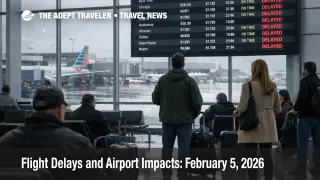
Light snow, low visibility, and low cloud ceilings are the main operational watch items for U.S. flying on February 5, 2026, with the Federal Aviation Administration highlighting elevated delay risk at Charlotte Douglas International Airport (CLT) and continued visibility risk around Seattle Tacoma International Airport (SEA). Travelers connecting through Charlotte are the most exposed, because even a modest drop in arrival capacity can quickly force gate holds and missed connections across the wider network. The practical next step is to protect the first departure, avoid razor thin connection times, and keep monitoring FAA flow planning signals through the mid day and evening banks.
The Charlotte flight delays February 5 setup is mostly a capacity story driven by ceilings and visibility, not a nationwide shutdown. The FAA Command Center outlook flags CLT for low visibility and low ceilings, and keeps SEA on the terminal constraint list for broken ceilings and low visibility, while also noting that Seattle is not expected to require initiatives for low ceilings at this time.
Who Is Affected
The most exposed group is anyone whose itinerary depends on a connection at Charlotte. When ceilings drop, the airport can accept fewer arrivals per hour, and traffic managers protect safety and spacing by metering departures headed to that hub. That is why travelers can see a departure delay at an origin airport with clear weather, the constraint is downstream, and the delay is created upstream to prevent airborne congestion and missed spacing requirements as the hub's arrival rate tightens.
Travelers flying into or out of Seattle should treat the day as condition dependent rather than assuming a clean, predictable disruption window. Visibility and ceiling issues often translate into intermittent flow management, where flights can look fine, then degrade as arrival rates tighten, especially if fog timing shifts. The risk is not only a late arrival, it is the cascade into missed connections, rebookings into later banks, and fewer remaining seats if the day compresses.
There are also secondary groups that can feel the effects without being in the immediate weather footprint. The FAA operations plan references multiple en route constraints and flow items that can add minutes or complexity, including military activity, event volume monitoring, and published route structures on specific flows. Those minutes matter most later in the day, when aircraft turns get tighter, and a slightly late inbound becomes a late outbound that pushes a whole rotation behind schedule.
What Travelers Should Do
Start with immediate actions that reduce exposure to surprise holds. Check your airline app before you leave for the airport, then monitor FAA Command Center planning signals if you are headed to Charlotte or Seattle, because the earliest sign of trouble is often a destination acceptance rate tightening that triggers upstream metering. If you are traveling on separate tickets, treat today as higher risk than it looks on a local weather map, because you do not have protected rebooking if the first delay breaks the chain.
Use a clear decision threshold for rebooking versus waiting. If your connection through Charlotte is tight enough that a modest arrival delay breaks it, or if you are booked on the last reasonable departure bank of the day, moving to a nonstop, shifting to an earlier routing, or choosing a different hub is usually the safer trade while seats still exist. If your delay is still measured in minutes, and you have multiple later options on the same ticket, waiting can be rational, but only if you can tolerate an overnight without blowing a cruise embarkation, a medical appointment, or a time fixed event.
Over the next 24 to 72 hours, monitor whether the ceiling and visibility forecast verifies and whether minor constraints start repeating across multiple arrival banks. Watch for patterns like repeated gate holds to Charlotte, rising average delays into Seattle, and airline notifications that open flexible change options, which often signals the carrier expects continued irregular operations. For additional context on how these FAA planning signals tend to translate into traveler impacts, see Flight Delays and Airport Impacts: February 4, 2026 and Flight Delays and Airport Impacts: February 3, 2026.
How It Works
The FAA daily outlook is an operations planning snapshot, it highlights constraints most likely to reduce capacity at major airports and airspace regions. Low clouds, low ceilings, and visibility restrictions matter because they can force instrument arrival spacing and reduce how many aircraft can safely land per hour. When a hub's arrival acceptance rate drops, the system responds by slowing departures headed there, which shows up as gate holds and delayed departures even in clear weather origin cities.
Disruption then propagates through layers of the travel system. First order effects are local to the constrained airport, arrivals slow, gates fill, taxi times rise, and departures slip. Second order effects hit connections and aircraft rotations, a delayed inbound misses an outbound bank, and the aircraft that should have moved to the next city is now late, which forces downstream gate changes and rebooking surges. Third order effects are crew flow and passenger services, late day delays can become cancellations if crews time out, and that is when hotels, rental cars, and rideshare capacity get tight around the affected hub.
Beyond weather, the FAA operations plan also reflects how airspace management can quietly tighten schedules. Published route structures and en route constraints can add small increments of time and complexity that reduce schedule slack. Those increments are usually manageable in the morning, but they compound through the day as turns shorten, banks get fuller, and the system has fewer spare aircraft and seats to absorb misconnects. If you want a deeper structural explainer on why staffing, technology resilience, and governance choices shape day to day reliability even when the weather is not extreme, reference U.S. Air Traffic Control Privatization: Reality Check.