

O'Hare Ground Stop After Security Incident Causes Delays
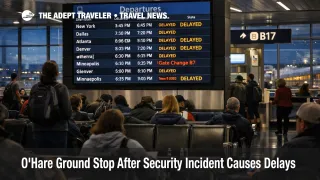
An FAA reported ground stop at Chicago O'Hare International Airport (ORD), tied to a security incident, briefly halted departures in the early evening on February 3, 2026. Travelers on outbound flights, plus anyone trying to connect through O'Hare during the late day banks, faced an elevated risk of delays, inbound holding, and missed connections as the airport worked through the backlog. If you are traveling through O'Hare the same night or early the next morning, you should add buffer, watch for aircraft swaps, and lock in backup options before remaining seats thin out.
The O'Hare ground stop security incident mattered because even a short departure pause can overload gates and ramp space, which then slows both arrivals and departures as the system restacks.
NBC Chicago, citing FAA National Airspace System information, reported the ground stop began at about 524 p.m. CT, was expected to run until 630 p.m. CT, and was lifted around 6:00 p.m. CT. Details about the underlying security incident were not immediately available in that report, so travelers should treat cause level specifics as unconfirmed unless later updates come from airport police, the Chicago Department of Aviation, or the FAA.
Who Is Affected
Travelers departing from O'Hare in the late afternoon and evening of February 3, 2026 are the most directly affected, especially on routes that rely on tight turn times and gate availability. Passengers connecting at O'Hare during the evening banks are also exposed because a brief ground stop can translate into late arriving inbound flights, shortened connection windows, and gate holds that prevent deplaning on schedule.
Knock on effects can extend beyond Chicago. When a hub pauses departures, aircraft can arrive late to their next stations, crews can run closer to duty limits, and airlines can cancel selected segments to protect the next day's schedule integrity. That is why travelers flying into regional airports on the last bank, or those with early morning onward connections on February 4, 2026, should watch for rolling impacts even after operations resume.
What Travelers Should Do
Start with immediate actions and buffers. Check your airline app for your specific flight status and any posted travel waivers, then recheck after you clear security and again at the gate, because departure times can move several times while the queue unwinds. If you are still at home or at a hotel, build extra time for curbside and security, and avoid arriving at the airport "just in time" for boarding, since gate changes and last minute holds are more common during irregular operations.
Use clear decision thresholds for rebooking versus waiting. If your connection at O'Hare is under about two hours, if your inbound leg is already delayed, or if you are on separate tickets, the rational move is to hold a backup itinerary early, even if you hope the original routing recovers. If you have multiple later same day options, or a long protected connection on one ticket, waiting can be reasonable, but only if you accept that late evening flights are often the first to be cut when the operation needs to reset for the morning.
Over the next 24 to 72 hours, monitor the signals that predict whether disruptions will persist. Watch whether your aircraft tail changes, whether your crew assignment appears to be shifting, and whether your airline begins offering flexible changes systemwide for Chicago area itineraries. For a broader read on how FAA flow measures and capacity drops propagate into gate holds and misconnects, see Flight Delays and Airport Impacts: February 4, 2026 and the hub recovery playbook in Charlotte Airport Recovery Delays Keep Misconnect Risk.
How It Works
A ground stop is a traffic management action that temporarily holds departures, either systemwide or for specific destinations, to keep demand from exceeding safe capacity. In this case, the reported trigger was a security incident, and the ground stop was short, but the operational mechanics are the same: departures queue, gates stay occupied longer, and arriving aircraft may be metered or held until ramp space and staffing normalize.
The first order effects at O'Hare are departure backlog, longer taxi out times, and gate congestion, because aircraft that would normally push back cannot, and inbound flights may not have gates available on arrival. The second order ripple spreads into connections, crew legality, and aircraft positioning across multiple layers of the network. A delayed inbound bank misses its outbound bank, crews approach duty time limits, and airlines may cancel later segments to prevent the disruption from breaking the next morning's schedule, which is why travelers often see impacts linger after the ground stop itself ends.
For travelers, the practical takeaway is that the hardest part is not the stop window, it is the recovery window. The system clears in waves, and the late evening bank is typically where slack is thinnest. If you want deeper context on why capacity shocks, staffing constraints, and resiliency investments keep surfacing as traveler problems, U.S. Air Traffic Control Privatization: Reality Check provides the structural backdrop.