

Rome Naples Italo Rail Works Change Trains Feb 5 to 16
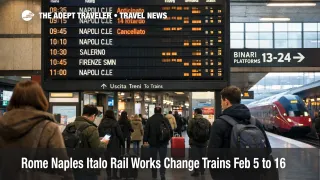
Infrastructure works on Italy's Rome, Italy to Naples, Italy high speed corridor are reshaping some Italo services from February 5, 2026, through February 16, 2026. Italo says the infrastructure manager has imposed traffic measures that lead to timetable changes, including some earlier departures, plus partial cancellations on certain trains. Travelers relying on an older screenshot, an email confirmation, or a remembered departure time are the most likely to get caught, because the "same train" can move earlier, skip a stop, or stop short of the segment you actually need.
Italo's corridor notice lists a wide set of affected train numbers. The trains Italo flags include 8111, 8134, 8158, 8902, 8903, 8904, 8907, 8908, 8910, 8913, 8915, 8918, 8919, 8920, 8922, 8923, 8925, 8929, 8954, 8956, 8968, 9903, 9907, 9908, 9912, 9916, 9919, 9920, 9924, 9927, 9931, 9932, 9935, 9940, 9946, 9947, 9948, 9950, 9951, 9954, 9955, 9958, 9959, 9962, 9967, 9968, 9970, 9971, 9974, 9975, 9976, 9977, 9980, 9981, 9982, 9987, 9989, 9991, 9992, 9994, 9995, 9996, and 9998. Italo also says sales channels are updated, and that customers who purchased before the measure should receive a communication, but the operational reality is that you should plan off the live itinerary in your booking channel close to departure.
Who Is Affected
The highest consequence travelers are the ones using Rome and Naples high speed rail as a positioning move for something that has a hard cutoff. That includes flights linked via Rome Fiumicino Leonardo da Vinci International Airport (FCO), flights linked via Naples International Airport (NAP), ferry departures out of Naples, Italy, and timed entry tours that do not tolerate late arrival.
Travelers chaining multiple rail segments are the second high risk group, because infrastructure works compress the network's spare capacity. When one departure shifts earlier, you can lose your planned platform change, and when one train is partially canceled, you may be forced into a last minute station pair swap or a different operator. The second order ripple is load shifting, more passengers concentrate onto fewer usable departures, which can tighten seat inventory, raise walk up fares, and turn a simple day trip into an overnight if the last service no longer lines up with your plan.
This Rome Naples window is also distinct from Genoa focused work programs that hit different corridors and different failure modes. If you are planning multi city Italy rail in early February, you can be exposed to more than one infrastructure constraint in the same week, which is why itinerary resilience matters more than normal. Related context, Genoa Works Cut Italo Trains Feb 6 to 9.
What Travelers Should Do
Start by validating what will actually run. Check your exact Italo train number and the updated departure time about 24 hours before travel, then check again the morning you leave for the station, because Italo warns that additional day specific measures can be applied for works on other points of the network. If your train has moved earlier, treat it as a new trip, re plan your hotel checkout, and re price your last mile transfer so you are not forced into surge taxis at the last minute.
Use a decision threshold for rebooking versus waiting. If arriving 60 to 90 minutes late would make you miss a flight, a ferry, or a paid pickup, move to an earlier departure, or swap operators now while seats still exist. If your plan is flexible, you can sometimes wait for the operator flow, but only if you have enough slack to accept the next available departure, and only if you are not stacking separate tickets where one missed segment collapses the rest.
Over the next 24 to 72 hours, monitor three things: the Italo corridor notice for this specific window, the live status of your exact train number, and seat inventory on nearby departures that still fit your day. If seats tighten, broaden your reroute search to include Trenitalia high speed options, or an Intercity plus regional split that uses higher frequency regional links for the final segment, even if it is slower, because slow and predictable can beat fast and fragile on a day with retimed paths.
How It Works
Planned infrastructure works disrupt high speed corridors because train paths are pre allocated and tightly timed. When the infrastructure manager takes track capacity out of service for maintenance, inspection, signaling work, or junction changes, operators lose some of the slots that make the published timetable possible, and the easiest operational choices are to retime departures, adjust stopping patterns, or truncate a train so rolling stock and crews still land where they must be for later rotations. That is the first order impact at the source, the specific corridor has fewer usable paths, so some trains move earlier or lose a segment.
The second order ripple travels outward across the travel system. When high speed arrivals bunch into narrower windows at Roma Termini and Napoli Centrale, station circulation, taxi supply, and pre booked transfers can become the new bottleneck, even if the trains themselves are running. If travelers miss planned flight and hotel check in timings, demand shifts into same day rebooking, last minute hotel nights near the station, and higher priced road backups, which is why a "small" timetable move can produce outsized cost and stress for anyone who built a tight day around a specific departure.
If you need additional context on how similar RFI work programs have already been clipping Rome Naples options into early February, see Italo Rail Works Rome Naples Cut Trains Into Feb.