

Berlin Airport Black Ice Shutdown Extends Feb 6
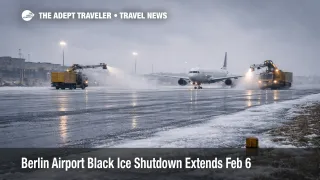
Berlin Brandenburg Airport (BER) saw operations suspended again as black ice and freezing rain left airfield surfaces too slick for safe takeoffs, landings, and ground movement on Friday, February 6, 2026. The airport's passenger guidance warned of significant delays and cancellations and urged travelers to check flight status before heading to the terminals, with conditions described as preventing normal operations. This extends the disruption beyond the February 5 departure pauses, and it pushes the reliability problem into a high demand weekend window when fewer empty seats exist for same day recovery.
The practical escalation is not only the hours the runway is unavailable, it is the network position shock. When aircraft cannot arrive, depart, taxi, or be turned on schedule, crews time out, gates clog, and airlines cancel later flights to protect the rest of their day. Even when a restart becomes possible, airlines often need multiple departure waves to pull aircraft and crews back into sequence, which is why you can see cancellations continue well after the first flights move again.
For earlier context on how the February 5 freezing rain started the disruption cycle, see BER Freezing Rain Halts Departures, Cancellations Grow.
Who Is Affected
Departing passengers are hit first, especially travelers on the morning and mid day banks where a single lost hour can erase the last workable same day option to smaller European cities. Inbound passengers are the next group at risk, because diversions and cancellations can strand you at an origin or alternate, and those alternates can be far enough away that ground transfer time and weather conditions turn into a second problem.
Connecting travelers carry the highest hidden exposure. Many itineraries into Berlin rely on a feeder flight into a hub, then a short leg into Berlin, or the reverse on departure day. When Berlin collapses into irregular operations, the hub side does not stay clean. Aircraft that were supposed to leave Berlin and return to a hub do not show up, crews are not where they were planned to be, and airline inventory gets consumed quickly by reaccommodations. That produces misconnect risk across multiple European hubs, even for passengers who are not traveling through Berlin but share the same aircraft rotations and crew pairings.
Passengers attempting rail substitution or repositioning are also exposed. Berlin's airport rail links and long distance trains can become the pressure valve when flights are unreliable, but winter weather can degrade trackside operations, station flows, and last mile transfers. If you plan to reroute by Deutsche Bahn to reach another airport, assume longer dwell times, crowded platforms, and higher odds that your connection time buffer gets eaten by small delays.
What Travelers Should Do
If your flight is cancelled or delayed into uncertainty, act as if your itinerary is broken until you hold a confirmed new booking in writing. Start with your airline's app or manage booking page, because self service options usually clear faster than phone queues and airport desks during weather events. If the app offers multiple reroute options, prioritize paths with higher frequency and more same day flights, because that is what gives you recovery elasticity if the first reroute fails.
Use a decision threshold for rebooking versus waiting. If you are within one missed connection of losing the day, or if the next available option lands after your last practical onward move, stop waiting and reroute. That typically means switching to a larger hub with more departures, or shifting your travel to the next day with an overnight, rather than chasing rolling delay updates that quietly burn the remaining inventory. If you are on separate tickets, treat the threshold as earlier, because a missed self connection can strand you without protection on the second booking.
Over the next 24 to 72 hours, monitor restart signals that matter more than headlines. Watch BER's flight status board for sustained sequences of departures and arrivals, not a single first flight, because a one off movement can happen before the system is truly stable. Also watch whether airlines continue to cancel blocks of flights even after movement resumes, because that indicates they are still shedding the schedule to reset crews and aircraft. If you need help framing refunds, rerouting options, and care obligations during weather disruption in Europe, see Berlin Airport Icing Delays, Rebooking and Refunds.
Background
Black ice events are operationally severe because the problem is not only runway friction for aircraft, it is the safety of every vehicle and worker movement across the airfield, from tug operations to fueling and emergency response positioning. Airports can treat surfaces and de ice operational areas, but when freezing rain continues or refreezes rapidly, treatments may not hold long enough to sustain continuous operations. That creates a stop start pattern where the safest choice is to suspend movement until conditions can support predictable, repeatable cycles.
The disruption then propagates outward in layers. First order effects show up at the airport as immediate cancellations, diversions, and long holds, along with reduced de icing throughput and gate congestion. Second order effects hit the network as aircraft and crews end up in the wrong cities, which forces downstream cancellations and tight reaccommodation supply at hubs that would normally absorb misconnects. Third order effects land on the traveler's ground plan, because airport rail links, taxis, and hotels become the fallback system, and those fallbacks can simultaneously degrade under the same weather conditions. The net result is that the effective disruption footprint can extend well beyond Berlin, with higher misconnect risk and higher out of pocket exposure across a traveler's full chain.
For broader ongoing coverage of irregular operations patterns and recovery mechanics, see Flight Delays - Travel News and Guides from The Adept Traveler.