

CocoCay Pier Docking Limits After Storm Damage
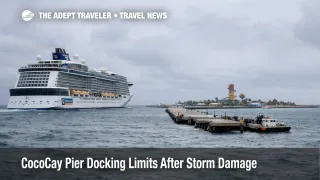
Operations have resumed at Royal Caribbean's private island destination Perfect Day at CocoCay in the Bahamas after a storm window that ran from January 30 to February 1 temporarily closed the destination. The company told TravelPulse that after assessments, the eastern side of the pier was unavailable for docking, and select itineraries were adjusted. For travelers, the key practical issue is not whether the island is "open" in a general sense, it is whether your ship can be accommodated on your scheduled day in a pier configuration that normally supports two calls.
The reopening language can be easy to misread as a full return to normal capacity. In this case, multiple reports describe a one berth constraint after storm damage on the eastern side, which creates a daily prioritization problem when two ships are scheduled. That is why some sailings have skipped the private island call entirely, while others have still been able to dock. Travelers should plan around the idea that "resumed operations" can still coexist with reduced docking flexibility.
This matters most on short Bahamas sailings where CocoCay is the main value anchor. When a private island day drops, the substitution options are often a sea day or a different Bahamas port, which can feel like a fundamental change to the trip's purpose even if the cruise still runs as scheduled.
Who Is Affected
The highest exposure is on Royal Caribbean International and Celebrity Cruises itineraries that include Perfect Day at CocoCay in early February 2026, especially on days when two ships were planned to call. Travel Weekly reported that catwalks on the east side fell into the water, leaving only the west side operational, and it cited recent examples of ships skipping calls during the disruption window. When the system is constrained to one docking position, the cruise line has to decide which vessel keeps the call, and which vessel gets reassigned to a sea day or an alternate port.
A second group affected is anyone who pre purchased CocoCay specific add ons, such as waterpark admission, beach club access, cabanas, and shore excursions. When the port is removed, cruise line sold items typically unwind more smoothly because they are tied to the ship call and can be cancelled centrally. Independent purchases, third party vendors, and tightly timed meetups are where money and documentation risk rises quickly.
A third group at risk is travelers whose cruise is stacked tightly against flights, hotels, and transfers. A CocoCay swap does not necessarily change embarkation or debarkation days, but it can reshape onboard demand and guest services, which can indirectly affect the stress level of execution on the last morning. When multiple ships converge on the same substitute port, excursion inventory and local transport can also tighten, which can change the real cost and convenience of the revised plan.
For closely related context on how this pattern behaves across Bahamas itineraries, see Bahamas Cruise Port Swaps Rise in High Winds and the specific capacity update in CocoCay Pier Capacity Limits Hit Bahamas Cruises. For a broader explainer on how ports drop, substitute, and refund mechanics usually work, see Cruise Itinerary Changes.
What Travelers Should Do
Start with immediate verification and buffers. Open the Royal Caribbean or Celebrity app, confirm the current itinerary, confirm the current port hours, and screenshot the details so you have a stable record if the plan changes again. If you booked independent shore plans that assume CocoCay, contact those suppliers now and document cancellation terms, because waiting until the night before often converts a solvable refund into a partial credit problem.
Use decision thresholds for rebooking versus waiting. If the private island day is the primary reason you booked, and your sailing is within the next week, treat a one berth constraint as a meaningful risk signal and evaluate whether a different sailing date, or an itinerary with additional sheltered ports, would preserve more of the trip's value if a call cancels. If you are already sailing, shift spend toward onboard options you control until you see the ship committed to approach and docking.
Over the next 24 to 72 hours, monitor two things, the cruise line's app updates for your specific sailing, and the pattern of whether multiple ships are scheduled for CocoCay on the same day. A one ship day has more margin, while a two ship day has less room for recovery if a berth remains unavailable. Also watch for last minute substitute ports, because those can create crowding, sold out excursions, and longer waits at guest services, which changes how you should pace your day and how conservatively you should plan return to ship timing.
How It Works
Private island calls are unusually sensitive to single points of failure because the guest experience depends on one interface, either a dock, a tender platform, or both. When one side of a two berth pier is unavailable, the first order effect is simple, the island can host fewer ships per day, and that forces itinerary triage. The second order ripple spreads through at least two other layers of the travel system.
First, the cruise operations layer takes the hit. A dropped private island day often becomes a sea day or a substitute port, which reshapes onboard demand for dining, spa, kids programming, and guest services at the same time that shore revenue shifts or disappears. Second, the ports and excursions layer gets stressed. When multiple ships reroute to the same fallback ports, local tour inventory and transport availability can tighten quickly, which raises costs and lowers flexibility for travelers who assumed a curated private island day. The third layer is traveler logistics. Even if the ship returns to its homeport on time, the cumulative disruption can increase friction for travelers managing tight post cruise flights, single night hotels, or time sensitive obligations.