

Transatlantic Bookings Down, US Europe Summer 2026
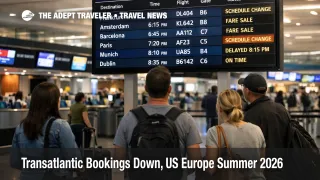
Advance booking signals for peak summer travel between the United States and Europe are trending lower in both directions. Cirium analysis of July 2026 travel, comparing bookings made from October 7, 2025 through January 31, 2026 versus the same booking window a year earlier, shows Europe to United States bookings down 14.22 percent, and United States to Europe bookings down 7.27 percent, based on a directional sample drawn from online travel agencies and the global distribution system used by airlines and travel advisors. Travelers are affected most when this softness turns into schedule trims, aircraft downgrades, or fare volatility that reshapes the best days and best routings.
The Summer 2026 transatlantic bookings shift matters because it is early, it is peak season, and it sits next to demand wildcards. The FIFA World Cup 2026 runs June 11, 2026 through July 19, 2026 across the United States, Canada, and Mexico, and America250 programming builds toward July 4, 2026, both of which can concentrate demand into specific cities even if the broader market is softer.
Cirium's city level directional results point to uneven movement rather than a single story everywhere. On the Europe to United States side, the deepest declines highlighted include Frankfurt down 36 percent, Amsterdam down 23 percent, Barcelona down 26 percent, and Paris down 21 percent, while London Heathrow is the outlier at plus 1 percent. In the opposite direction, the directional sample shows United States to Frankfurt down 29 percent, with declines also noted for Athens, Dublin, and Munich, while Barcelona is the only market listed with growth at plus 5 percent.
Who Is Affected
Travelers most exposed are those building summer 2026 itineraries that depend on specific nonstop schedules, tight hub connections, or premium cabin award space. When demand indicators weaken, airlines often protect their highest yielding segments first and adjust the edges, meaning some midweek frequencies, marginal nonstops, and certain aircraft types become more likely to change. If your plan relies on one daily departure, or a last flight of the day, you have less recovery margin if schedules shift.
The pattern Cirium describes is concentrated on large gateways, which matters because these cities feed connecting banks. Amsterdam Airport Schiphol (AMS), Frankfurt Airport (FRA), Barcelona El Prat Airport (BCN), Paris Charles de Gaulle Airport (CDG), Dublin Airport (DUB), Rome Fiumicino Airport (FCO), Athens International Airport (ATH), Munich Airport (MUC), Milan Malpensa Airport (MXP), and London Heathrow Airport (LHR) are not just origin destinations, they are connection distributors. When one hub sees demand soften, airlines can rebalance capacity through other hubs, which changes connection times, minimum connection viability, and the odds that a same day itinerary survives a disruption.
Travel advisors and frequent flyers are also affected because directional softness can create the illusion of broad bargains while still producing scarcity in the places travelers actually want to be. July 2026 can be cheaper in aggregate while still expensive, or capacity constrained, in match cities, coastal leisure markets, and high convenience departure times. That mismatch tends to produce late rebooking waves, which is when hotel inventory, airport area rooms, and short notice rail and car availability tighten.
What Travelers Should Do
Take immediate control of flexibility, and stop treating the first price you see as the true market. If you have not bought yet, start by tracking two or three acceptable departure airports and at least two date bands, then watch fares weekly rather than daily, because the first meaningful airline response to softer demand is often tactical pricing, not a headline schedule cut. If you already bought, put a calendar reminder on the airline's schedule change and fare drop policies, and keep screenshots of what you purchased, including baggage, seats, and change terms, because reissues get messy when inventory shifts, and fee transparency is not uniform across channels, especially after Fifth Circuit Ends Airline Fee Disclosure Rule.
Decide in advance when you will rebook versus when you will wait. A practical threshold is any schedule change that breaks your connection buffer, removes your only nonstop, or pushes arrival late enough to disrupt timed plans like cruises, tours, or onward rail. For price, set a specific number, for example, if the fare drops by $150.00 (USD) to $250.00 (USD) per person, you will attempt a reprice, and if the carrier does not offer it, you will consider cancel and rebook only if you can hold the replacement itinerary first. The goal is to avoid emotional rebooking during a sale that does not match your constraints.
Over the next 24 to 72 hours, monitor the signals that move fastest. First, watch schedule changes on your exact flight numbers, not just route headlines, because airlines often "quiet change" departure times and aircraft types before they cancel anything. Second, watch whether London routings become more attractive, because Heathrow is the only Europe to United States origin in Cirium's sample showing growth, and because UK entry workflow changes can add friction if your connection goes landside, so keep UK ETA Enforcement Blocks UK Travel Feb 25, 2026 in view if you are routing through London. Third, keep currency in your budget model, because even if airfare softens, on the ground costs can move the other way, and U.S. Dollar Outlook and Travel Impact for 2025 is a useful baseline for how purchasing power can change your all in trip cost.
How It Works
This data is an early warning system, not a final count. Cirium describes the figures as directional because the sample is built from third party distribution channels, chiefly online travel agencies and the GDS, rather than a complete view of airline direct bookings. In practice, that means the data can spot a real trend, but it can also miss late demand, loyalty redemptions, corporate contract flows, and airline site conversion that accelerates closer to departure.
If the directional softness holds, the first order impact typically shows up in airline revenue management and network planning. Airlines can stimulate demand with targeted fare sales, bundled offers, and premium cabin upgrade auctions, but they can also shrink supply by swapping to smaller aircraft, trimming frequencies, or shifting capacity to other long haul markets. Those actions do not stay isolated to a single route, they propagate through hub banks, aircraft rotations, and crew flows. When a transatlantic flight is removed or downgauged, the seats that would have fed onward domestic connections disappear too, which can make U.S. domestic legs more expensive, or less available, even for travelers not flying across the Atlantic.
Second order ripples often land in hotels, ground transport, and timed itinerary products. Softer transatlantic demand can reduce pressure in some gateway hotel markets, but it can also increase volatility, because travelers respond to sales by moving dates and concentrating around weekends, event weeks, and the most popular neighborhoods. With FIFA World Cup 2026 spanning June 11, 2026 through July 19, 2026, demand can still spike sharply on match city dates even if overall transatlantic volume is lower, and America250 programming leading into July 4, 2026 can create additional pockets of compression. The traveler outcome is a market where airfare may look friendlier at times, but the cost of mistakes, missed connections, wrong entry documentation, or last minute hotel additions can still be high.