

Bermuda Gale Winds Suspend Ferries, Causeway Risk
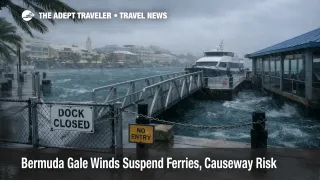
Gale force winds are disrupting transportation across Bermuda, prompting ferry service suspensions and raising the risk of intermittent Causeway restrictions. The most immediate impact is on travelers who rely on ferries to move between Hamilton, the Royal Naval Dockyard area, and St George's on a schedule that lines up with tours, dining, and cruise port or airport timing. If you are moving today, treat every cross island transfer as a weather dependent move, shift critical departures earlier when you can, and plan a land based backup route that does not assume ferries will restart on your timeline.
The Bermuda Weather Service forecast for Saturday, February 7, 2026, includes active marine warnings, including gale conditions, and a storm warning window later Saturday into Sunday morning. That matters because ferry operations typically pause before peak gusts and seas, then resume only after conditions stabilize long enough for safe docking, loading, and routing. Even when ferries restart, expect a phased return with limited capacity until crews can confirm consistent conditions on each corridor.
Who Is Affected
Cruise visitors are exposed because short port calls often depend on predictable waterfront connections, especially if your day plan spans multiple areas, such as Hamilton plus Dockyard, or St George's plus the central parishes. When ferries are suspended, that same itinerary compresses into road transfers, and the margin for error shrinks quickly if the island is also dealing with outages, flooding, or localized road hazards.
Air travelers are also exposed, particularly those arriving into L F Wade International Airport, and then planning to cross toward Hamilton or the Dockyard area on a tight schedule. A Causeway restriction can force reroutes, or in the worst case, pause direct passage between St George's and the main island, which can strand vehicles on the wrong side for hours. If you have a flight today, your goal is not speed, it is certainty, meaning earlier departures from your hotel, more slack for check in cutoffs, and fewer steps in the chain.
Hotel guests and anyone with timed reservations, including evening dining, fixed start tours, and prepaid excursions, should expect second order impacts once ferries are offline. The first order effect is obvious, fewer vehicles and longer waits. The second order effect is that staff and suppliers are also moving through the same constrained network, so tour start points can shift, pickup windows can slide, and cancellation decisions can come late if operators wait for weather confirmation.
If you want a comparable disruption pattern, see how wind driven marine constraints ripple into day of itinerary changes in Bahamas Cruise Port Swaps Rise in High Winds. For another example of ferry dependent corridors tightening under storm conditions, see Strait of Gibraltar Ferries Disrupted by Storm Leonardo.
What Travelers Should Do
If you must move cross island today, front load your critical transfers. Aim to be on the road well before the peak wind window you are tracking, and do not plan a sequence that depends on a ferry restart announcement arriving on time. If you are headed to the airport, prioritize arriving early enough that a Causeway warning or closure does not force you into a last minute, high stress reroute decision.
Set a clear decision threshold for rebooking versus waiting. If your plan includes a same day flight, a same day cruise embarkation, or a prepaid tour with a firm check in cutoff, do not gamble on a ferry restart that has no guaranteed time. Move to ground transport early, or shift the activity to a different day. If your plans are discretionary, such as shopping, a flexible beach window, or an open ended museum visit, waiting can be reasonable, but only if you have shelter, food, and a safe way to return without relying on late day services.
Over the next 24 to 72 hours, monitor three things consistently. First, the Bermuda Weather Service warnings and forecast updates for the timing of gale easing and sea state improvement. Second, ferry service advisories from Marine and Ports for when routes resume, and whether the restart is partial. Third, any official notices related to the Causeway, because a closure can change your feasible route map even when the rest of the road network is open.
How It Works
Bermuda's ferry network is a high leverage mobility layer because it moves people quickly across water corridors that would otherwise require longer road transfers. When winds and seas reach gale thresholds, the operational risk rises fast, including docking safety, passenger handling at terminals, and route viability in exposed waters, so suspensions are a standard safety response. Once that water capacity disappears, demand shifts to taxis, minibuses, and public buses, which can create queues, uneven availability by parish, and longer travel times even for short distances.
The Causeway is a separate, but tightly coupled system constraint. It is a critical link between St George's and the main island, and when wind thresholds trigger safety restrictions, the island effectively loses a primary artery that many airport transfers depend on. That can cascade into staffing and service delays at the airport, at cruise related pickup points, and at hotels, because drivers and workers are subject to the same bottleneck. The practical traveler takeaway is that ferry suspensions plus Causeway risk is not just a transport inconvenience, it is a network capacity shock, and the safest move is to reduce dependencies, simplify itineraries, and add buffer until conditions stabilize.