

Germany Transit Strike Risk For Cities Ahead Of Feb 9
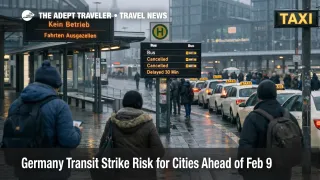
Germany transit strike risk is rising again for city travelers as negotiations resume on February 9, 2026, following a major ver.di led warning strike that disrupted municipal buses and trams across most of the country earlier this month. The travelers most exposed are those relying on city transit to reach airports, main stations, hotels, and meeting points, because the failure mode is often not a flight cancellation, it is that the path to the terminal breaks. If you are traveling around February 9, build a backup transfer plan now, and use clear thresholds for switching modes or moving departure times earlier.
The February 2, 2026 action affected roughly 150 municipal transport companies in 15 of Germany's 16 federal states, a scale that matters for visitors because it can hit multiple cities on the same day, shrinking alternatives everywhere at once. ver.di has framed the dispute around working conditions, such as shift length, rest breaks, and premiums for night and weekend work, while employer groups have pointed to municipal budget constraints.
For travelers, the most important operational detail is that disruptions often concentrate in the urban layer, buses, trams, and some metro services, while national and long distance rail can remain more intact. That split creates a trap: your intercity train or flight can still operate, but you cannot reliably get to the station or the airport, and arriving passengers can struggle to reach hotels when local distribution collapses.
Who Is Affected
Travelers starting from or connecting through major German cities are the first group at risk, especially anyone using municipal transit as the primary airport access plan. That includes passengers flying from Berlin Brandenburg Airport (BER), Frankfurt Airport (FRA), Munich Airport (MUC), Hamburg Airport (HAM), Düsseldorf Airport (DUS), Cologne Bonn Airport (CGN), and Stuttgart Airport (STR), where a normal day often depends on a smooth feeder leg from hotel or meeting point into an S Bahn, U Bahn, tram, or bus corridor.
Rail first itineraries are also exposed, even when Deutsche Bahn long distance service is not the primary target of this dispute, because strikes push commuters and visitors into fewer workable paths at the same time. Station forecourts and entry flows get more congested, taxis and rideshares tighten, and earlier arrival behavior increases crowding in station halls and airport terminals, which can lengthen bag drop, security, and customer service lines.
Business travelers and event travelers with fixed start times, as well as cruise passengers transiting by rail and then taxi, tend to feel the second order effects hardest. The first order hit is a canceled bus or tram line, and the ripple is missed check in cutoffs, missed connection windows, and forced overnight stays when same day alternatives sell out after a surge of disrupted travelers rebook into the same remaining inventory.
What Travelers Should Do
Start with immediate actions and buffers. If your trip touches Germany around February 9, 2026, rebuild your airport and station transfers as if local transit will not show up, then add resilience back in. For most travelers, that means pricing and preplanning a taxi, rideshare, or private transfer option, identifying pickup points that still work during disruption, and setting an earlier hotel departure time that protects you if curbside traffic is slow.
Use decision thresholds for rebooking versus waiting. If missing a municipal transit leg would cause you to miss an international flight, a long distance train, or a cruise embarkation, treat any renewed strike announcement as a reason to shift to an earlier departure, or to move the trip to a different day, rather than trying to thread the needle. If the consequence is only a later arrival and you have real slack plus multiple workable modes, you can wait for operator forecasts, but only if you are prepared to switch modes the night before.
Over the next 24 to 72 hours, monitor the right signals. Watch ver.di updates and the relevant local operator pages for your city, because strike scope is often communicated at the operator or region level, and details can land close to the action window. Also monitor your airline or rail operator for knock on changes, but do not treat an unchanged flight status as proof that your airport access plan is safe.
Background
Germany's municipal transit systems are run by a patchwork of city and regional operators, and labor actions in this layer can be both broad and uneven, with some cities seeing near total bus and tram stoppages while others run reduced or modified service. In the February 2026 dispute, the public framing has focused on working conditions and scheduling burdens, which is relevant to travelers because even partial service can become functionally unusable when headways stretch, vehicles bunch, or depots run short staffed.
The disruption propagates through the travel system in predictable layers. The first order effect is the local feeder leg failing, hotel to station, hotel to airport express, or station to terminal, which forces travelers onto taxis, rideshares, and walking detours in winter conditions. The second order ripple is timing compression at hubs, because when many travelers shift to earlier departures or arrive in uneven surges, queues at bag drop, security, and service desks build, and late arrivals miss the banked waves that airports and rail hubs rely on. That pushes demand into later departures and overnight lodging, which can sell out quickly in big cities even when the underlying flight and rail schedules are technically running.
If your itinerary includes multiple European strike sensitive segments, treat Germany as part of a broader pattern of last mile fragility this month, and plan buffers the same way across borders. Two related Adept Traveler pieces that cover this system failure mode are Western Europe Strike Spillover Risk For Airport Transfers and Belgium National Strike Disrupts Transport Feb 5.