

Germany Transit Strike Risk for City Travel Feb 9
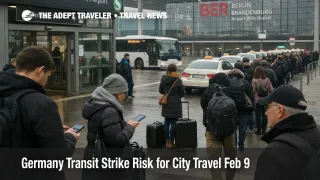
Germany city travel is facing renewed disruption risk because Verdi has signaled that additional public transport strike action remains possible if negotiations scheduled for February 9, 2026 do not progress. The earlier warning strike wave shut down or heavily reduced buses and trams across most states, and it forced travelers to rebuild airport and station transfers in freezing conditions, often with limited notice. If a fresh strike call lands around the February 9 talks, the practical problem is not whether your flight exists, it is whether you can reliably reach the terminal or the correct rail platform on time.
This dispute sits in the municipal transport layer, which means the knock on effects travel outward. First order impacts hit city networks, buses, trams, and many U Bahn lines, leading to gaps in service and overloaded alternatives. Second order ripples show up at airports and main stations when travelers pile into the modes that still operate, particularly S Bahn and regional rail, and when taxis and rideshares surge, queues lengthen, and road times become less predictable. The result is a higher risk of missed flight check in cutoffs, missed long distance trains, and forced overnight stays when same day inventory disappears.
Who Is Affected
Travelers in major German metro areas are the highest exposure group, especially anyone depending on municipal transit for the last segment into an airport, a main station, or a meeting point with a fixed time. The earlier action hit about 150 municipal operators across all but one German state, with large cities including Berlin, Germany, Hamburg, Germany, and Bremen, Germany among those affected, and full stoppages reported in parts of Baden Württemberg such as Stuttgart, Germany, Karlsruhe, Germany, and Freiburg, Germany.
Airport travelers are affected in a specific way. Even when airlines keep schedules intact and even when Deutsche Bahn long distance trains and many S Bahn lines continue running, the feeder layer can fail. That means a workable airport rail link is only useful if you can reach the correct station to board it. This is why urban travelers connecting through Berlin Brandenburg Airport Willy Brandt (BER), Frankfurt Airport (FRA), Munich Airport (MUC), and other major gateways should treat the city segment as the fragile segment.
There are also meaningful regional exceptions that can confuse travelers. Lower Saxony has been highlighted as outside the earlier strike footprint in this round, tied to different timing and a peace obligation, so service expectations can vary sharply by state and by operator. Do not assume that what is true in one city will hold in another, even on the same day.
What Travelers Should Do
Start with immediate actions and buffers. If your trip touches Germany around the February 9, 2026 negotiation date, check your local operator status the night before and again early the morning of travel, then rebuild your plan around modes that are most likely to run, and make the final approach to the terminal or station as walkable as you can. If you must use a taxi or rideshare, request it earlier than normal and pick a pickup point on a main road where vehicles can reach you even if side streets are congested.
Use decision thresholds for rebooking versus waiting. If your itinerary depends on one specific departure, such as a long haul flight, an intercity train, or a cruise or tour check in time, treat any announced municipal transit strike as a reason to shift to a more robust transfer plan, not as a reason to hope it works out. A practical threshold is simple, if losing the connection forces an overnight stay or breaks a non refundable segment, move yourself closer to the airport or main station the night before, or switch to a car transfer with a large buffer, rather than waiting for partial service to appear.
Monitor the right signals over the next 24 to 72 hours. The key updates are whether Verdi escalates beyond the earlier warning strike pattern, whether employer side statements indicate movement, and whether your specific city operator publishes an emergency timetable or a full stoppage notice. Also watch for secondary strain indicators, long taxi queues at stations, crowding on S Bahn platforms, and limited hotel inventory near airports and Hauptbahnhof areas, because those are the channels where the disruption propagates even if your flight or train is technically operating. For broader planning context on how a transit strike breaks the travel chain, see Germany Transit Strike Disrupts Berlin Transfers, NE Rail, and for cross border timing risk see Western Europe Strike Spillover Risk For Airport Transfers. For traveler rights and rerouting logic when strikes reach airports, see Europe Airport Strikes: Compensation and Re-Routing Guide.
Background
Germany's municipal public transport is largely operated by city or regional companies under state level frameworks, so labor negotiations and strike calls often land unevenly by state and by operator, even when the union message is national. In this dispute, Verdi has pushed for working condition improvements such as shorter shifts, longer rest breaks, and better compensation for night and weekend work. Employers have pushed back under budget constraints, which is why Verdi has framed additional action as possible if the February 9, 2026 talks do not produce meaningful movement.
For travelers, the operational lesson is that city transit strikes usually do not cancel flights directly, they break access to the system. When buses, trams, and U Bahn service thin out or stop, demand shifts into taxis, rideshares, walking, S Bahn, and regional rail. That surge can overload the remaining modes, expand station dwell times, and compress airport processing windows because more people arrive in uneven bursts rather than a steady flow. This is why a disruption that begins in the city network can still produce missed flights, missed trains, and unexpected hotel nights across the travel stack.