

PortMiami Carnival Horizon IT Crash Delays Boarding
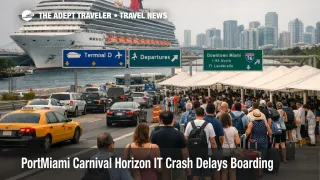
A computer systems outage disrupted Carnival Horizon's turnaround at PortMiami, Florida, delaying the offload of arriving guests and slowing boarding for the next sailing. The immediate impact hit two groups at once, passengers trying to get off the ship and make flights home, and embarking guests whose terminal arrival appointments were pushed back as the queue grew. If you are traveling through PortMiami after this disruption, treat the day as a high friction travel day, add time for port road access, and build buffers on both ends of your trip.
The PortMiami Carnival Horizon IT crash matters because cruise turnarounds depend on fast, sequential steps, debarkation, terminal processing, baggage flow, cabin reset, then embarkation. When the technology layer fails, each step becomes slower, and delays compound quickly into missed flights, later sail away times, and longer waits in heat and traffic.
Carnival has not detailed the precise technical fault behind the PortMiami disruption in local coverage, but the cruise line did acknowledge broader IT issues tied to planned maintenance that delayed debarkation and embarkation operations, while stating that navigation and safety systems remained operational.
Who Is Affected
The first affected group is anyone disembarking Carnival Horizon at PortMiami who planned tight, same day air travel. When debarkation slows and terminal processing shifts to manual work, guests can lose the margin they counted on for airport transfers, bag drop cutoffs, and security lines. Local reporting included passenger accounts of missed flights and long delays getting both through the port area and off the ship.
The second affected group is embarking guests whose terminal arrival windows were pushed back. Passenger accounts described check in appointments moving from mid day into later afternoon, alongside long port road delays. For the sailing itself, Carnival's own itinerary listing for Carnival Horizon shows a Miami departure time of 3:30 p.m. and a Western Caribbean route that includes Ocho Rios, Jamaica, Grand Cayman, and Cozumel, Mexico, which is why late boarding creates immediate anxiety about whether the ship will still depart on schedule.
A third affected group is anyone connecting this cruise with separate ticket travel, prepaid transfers, or fixed check in times at hotels. When a port day slips by a couple of hours, the ripple is not limited to the pier, it becomes a citywide ground transport problem, rideshare surge pricing, longer taxi lines, and slower traffic near the causeways into the port, which in turn raises the odds of missed dinner reservations, tour meetups, and early evening departures.
What Travelers Should Do
If you are disembarking, protect your flight home first. Rebook to a later departure from Miami International or Fort Lauderdale Hollywood if your schedule is still changeable, and prioritize nonstop options over tight connections. If you cannot change flights, move immediately to the most direct ground option available, and be ready to pivot to a same day hotel night if you fall behind airline cutoff times.
If you are embarking, do not treat your original terminal appointment as fixed during a disruption day. Follow Carnival's push updates, email, texts, and calls, and time your arrival to reduce standing in outdoor lines. Bring water, sun protection, and portable phone power, because extended curbside waits are common when a terminal shifts to manual processing.
Over the next 24 to 72 hours, watch for signs that the same failure mode is affecting multiple ships or ports, not only one terminal. Carnival has described the issue as an IT disruption related to planned maintenance, and that type of event can create rolling delays as systems recover and backlogs clear. If your sailing is within a few days, consider arriving in Miami, Florida the night before, and treat post cruise flights as next day departures when the total trip cost makes that buffer rational.
For travelers who want a reference point for how onboard and terminal processes can amplify travel friction when operations slow, see Seven Seas Mariner Illness Outbreak CDC Probe, and for a deeper explainer on why seemingly small technology failures can cascade in complex travel systems, see Cosmic Rays, Bit Flips, and the Airbus A320 "Icarus" Recall.
How It Works
Cruise turnaround days run on a tight choreography, the ship arrives, guests disembark in managed waves, luggage is routed off, cabins and public spaces reset, then embarking guests are processed through check in, identity verification, and boarding. Carnival, like other major lines, increasingly relies on app supported workflows to streamline debarkation and reduce crowding, which is efficient when systems are up, and brittle when they are not.
When a terminal or shipboard operations stack goes down, the first order impact is slower identity and boarding verification, longer lines, and manual exception handling. The second order ripple spreads into the city transport layer, port road congestion, rideshare availability, and airport transfer timing, which then pushes stress onto airline rebooking desks and hotel inventory when people miss flights. A third layer appears when multiple ships share the same arrival and departure window, because delays on one ship can block curb space, staff attention, and baggage throughput for others, making the disruption feel larger than the original IT fault.