

Spain Rail Strike Called Off, Feb 9 to 11 Train Plans
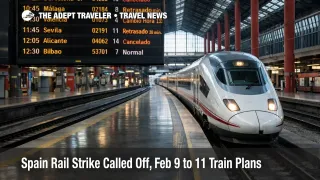
Spain's planned rail strike window for February 9 to 11, 2026 shifted midstream after major unions reported a last minute agreement with the government focused on safety and infrastructure maintenance. Travelers are affected because many operators had already published altered timetables and cancellations, and station operations were already running under strike day procedures. The practical move now is verification, confirm whether your exact train number is operating, then decide whether to keep the booking, switch departures, or pivot modes if your day includes a hard deadline.
The key nuance is timing. Multiple reports describe a cancellation of further strike action after negotiations, which points to disruption on February 9, 2026, followed by an attempted return toward normal service for February 10 and February 11, 2026. That sequencing matters because it means some trains were removed from sale, reassigned, or reissued before the stand down, and those changes do not always unwind instantly in apps, ticketing, and staffing. SEMAF, the train drivers union that called the action, also posted that it was calling off the strike after achieving its demands, framing the deal as a structural change in system safety.
For travelers who have been following the earlier risk picture, this update also creates a new failure mode, uncertainty. Even when a strike is called off, smaller unions can maintain separate calls, and different work groups touch different layers of the system, from driving to onboard service, infrastructure dispatch, and station operations. Several outlets reported that major unions were standing down while some smaller unions did not join the agreement, which is exactly why the traveler action item is train level confirmation rather than headline level reassurance.
If you want the earlier corridor and buffer logic that was built for the original February 9 to 11 window, compare this update with Spain Rail Strike Feb 9 to 11, Renfe AVE Tips and, for Barcelona area feeder risk, Barcelona Rodalies Rail Disruption Before Feb 11 Strike.
Who Is Affected
Long distance travelers on AVE, Avlo, Alvia, Euromed, and other reserved seat services are the first group that feels the whiplash. When a strike threat is active, operators pre cancel selected departures to meet minimum service rules and to avoid last minute stranded trains, then they may restore service only partially as rosters and rolling stock reposition. That means two passengers on the same city pair can have opposite realities, one train runs close to normal, another remains canceled, and the station is crowded because demand compresses into fewer departures.
Private operator passengers, especially on the Madrid, Barcelona, Valencia, Seville, Malaga, and Zaragoza corridors, are also exposed because seat inventory on Iryo and Ouigo can tighten quickly when travelers who rebooked flights or cars decide to shift back to rail. Even if the strike is largely stood down, the capacity that was removed earlier can leave gaps in the day that fill fast, pushing last minute fares higher and making it harder to keep the exact departure time you planned.
Commuter and regional riders sit in the second risk layer, but they often trigger the most expensive misses. A traveler can have a valid long distance reservation and still fail to reach the station on time if the local feeder pattern is uneven, if platforms change, or if crowding makes entry and boarding slower than normal. This is especially relevant in Barcelona where Rodalies has already been running under constraints, and where a nominal return to normal still leaves real world variance in headways and travel time.
Finally, travelers with rail to air, rail to cruise, or rail to tour connections are the highest stakes group, because those endpoints punish late arrivals with hard cutoffs. A late breaking labor update can reduce cancellation risk while still leaving enough operational noise to break a tight check in window, especially when customer service queues and station crowding spike on the first normalization day.
What Travelers Should Do
If you travel on February 9, February 10, or February 11, 2026, treat verification as the task, not reading headlines. Open your operator app, locate your booking, and confirm the train number and departure time are still active, then cross check that information against live station boards when you arrive. If your operator shows a cancellation or a forced change, act early while the best alternates still exist, because the rebound effect from other travelers shifting back into rail can tighten seats quickly.
Use a decision threshold based on consequences, not convenience. If losing your planned train would cause a missed flight on a separate ticket, a missed cruise embarkation, or a forfeited timed tour pickup, switch to an earlier departure or change the travel day as soon as you see instability, even if the operator says service is resuming. If the consequence is only arriving later and you have flexible hotel policies, it can be rational to wait for the operator's reissue flow, but only if you are not chaining multiple legs where one break collapses the day.
Over the next 24 to 72 hours, monitor signals that change outcomes. Watch for operator notices that explicitly state service has returned to normal by corridor, watch for push notifications tied to your booking, and watch for crowding, staffing, and platform churn at major stations, because that is where a paper resolution can still behave like disruption. Many outlets framed the stand down as linked to a safety and maintenance agreement, which suggests a negotiated end, but operational normalization still takes time, and smaller labor actions can still create localized gaps.
Background
Rail strikes propagate through the travel system in layers, and a late reversal does not instantly unwind those layers. The first order effect is at the source, rosters, dispatch, and minimum service compliance change the timetable, which removes capacity and forces passengers into fewer departures. When the strike is called off, the system then has to rebuild the planned pattern while trains and crews are out of position, and while customer service channels are overloaded by reissues and refunds.
The second order ripple hits connections and transfers. When long distance departures are thinned out, passengers arrive in pulses, stations crowd, platforms change, and missed connections climb, even if the underlying infrastructure is intact. That crowding then pushes demand into taxis, rideshares, buses, and short haul flights, raising prices and making last mile timing less predictable. When the strike threat lifts, those flows reverse, but they rarely reverse smoothly, and that is why travelers can see a day where the railway is officially recovering but practically still fragile.
A third ripple, often ignored, is fare and inventory whiplash. Travelers who moved to air or road alternatives may try to shift back to rail once the risk appears lower, while other travelers are still trying to rebook into the remaining seats created by earlier cancellations. That combination can raise last minute prices, tighten seat availability on specific corridors, and create a customer service bottleneck at exactly the moment travelers expect relief.
Sources
- Spanish Train Drivers Call Off Strike After Safety Deal
- Conseguimos TODAS las reivindicaciones, desconvocamos la huelga
- Los sindicatos mayoritarios desconvocan la huelga del ferrocarril desde este martes
- Train strike in Spain cancelled thanks to deal
- El acuerdo de desconvocatoria de la huelga ferroviaria incluye refuerzos de personal y un aumento del gasto en mantenimiento del 77% para 2030