

Barcelona Rodalies Rail Disruption Before Feb 11 Strike
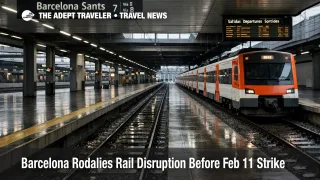
Commuter rail reliability around Barcelona, Spain is still degraded as the Rodalies network operates under layered constraints, including extraordinary inspections, temporary speed restrictions, and bus replacements on multiple corridors. Travelers are affected because these constraints do not behave like a clean cancellation, they create uneven headways, longer trip times, and last minute platform and routing changes that can break airport, cruise, and day trip timing. With a strike called for February 9 to 11, 2026, the practical move is to treat Rodalies as a high variance segment, add buffer, and pre plan a backup transfer mode for any timed departure.
The current failure mode is layered. Inspections and speed restrictions slow trains and reduce how many runs a crew and a set can complete in a shift, which then forces short turns, late starts, and knock on delays into the next cycle. That is why even lines that are technically running can feel unreliable in practice, especially when a bus substitution or a shuttle transfer is part of the chain.
Who Is Affected
Visitors using Rodalies for airport access, day trips, and cross city hotel moves are the highest exposure group, because small timing slips can snowball into missed bag drop cutoffs, missed timed tickets, or missed check in windows. The most sensitive traveler patterns are rail to air connections at Josep Tarradellas Barcelona El Prat Airport (BCN), rail to long distance departures through Barcelona Sants, and rail to embarkation at the Port of Barcelona cruise terminals, because each of those endpoints punishes late arrivals with hard deadlines.
Line level impacts remain broad. As of early February, multiple lines have been operating partially with bus alternatives, including R1, RG1, R3, R4, RL4, R7, R8, R13, R14, R15, and RT1, while some corridors have been reported as fully running by train, including R2 North, R2 South, R11, R16, and R17. Even where trains run, temporary speed restrictions and ongoing infrastructure work can extend journey times and create unpredictable gaps.
The R4 corridor remains a particular pinch point because it has been central to the post accident recovery pattern, with segments shifting between train, bus, and shuttle operations, and with additional short notice disruption reported around Sant Feliu de Llobregat and the L'Hospitalet to Martorell area. The R3 corridor is also structurally fragile due to longer running works, which increases the odds that you will be routed to a road alternative rather than a through train.
Strike dynamics compound the problem. Rodalies staff have called a strike for February 9 to 11, 2026, and Catalonia's published minimum services are 66% at peak times and 33% during the rest of the day, with peak windows defined as 600 a.m. to 930 a.m. and 500 p.m. to 830 p.m. local time. Minimum service rules do not mean your specific train will run, they mean the network will attempt to operate a reduced pattern, which often produces long gaps, heavier loads, and more frequent last minute changes at stations.
What Travelers Should Do
If you have a flight, a cruise embarkation, or a long distance departure during February 9 to 11, 2026, plan transfers as if Rodalies will be late and crowded, then layer resilience back in. Build an earlier departure time than you would normally use, and identify a backup mode that does not depend on Rodalies, such as metro, FGC, or a prebooked taxi, so a single service gap does not collapse the day.
Use a clear decision threshold for rebooking versus waiting. If missing the transfer would cause a same day misconnect on separate tickets, a missed cruise check in window, or a forfeited timed tour, treat that as a reason to move the critical segment earlier, shift hotels closer to your departure node, or switch to a private transfer. If the consequence is only a later arrival and you have slack plus multiple workable options, it can be rational to monitor operator updates and keep the original plan.
Over the next 24 to 72 hours, monitor the system signals that actually change outcomes, not just your airline or cruise line app. Watch for strike day service plans, station specific guidance, and alerts tied to speed restrictions or bus substitution segments, because those are the mechanisms that create long headway gaps and missed meetups. If you see repeated reports of 30 minute plus delays or frequent service pattern changes, assume the evening peak will be harder to protect, because crowds, taxi demand, and customer service queues tend to concentrate into fewer workable windows.
Background
Rodalies is a commuter and regional rail network that acts as a feeder layer for Barcelona's travel system, connecting suburbs, coastal towns, and regional stations into the city's rail hubs. When that feeder layer slows down, the disruption propagates outward in predictable ways.
The first order effect is operational throughput. Temporary speed restrictions extend run times, which means fewer trains can complete their planned cycles, and crews and rolling stock end up out of position for later runs. Operators then compensate with short turns, skipped stops, and bus bridges, which looks like service is running but behaves like an unreliable network for a traveler with a timed deadline.
The second order ripple hits at least two other layers. Connections suffer because Barcelona Sants, and other junction stations, operate on timed waves, and when commuters and visitors arrive in uneven pulses, platforms and concourses crowd, and missed connections climb. Ground transport absorbs the overflow, so metro trains, taxis, and rideshares tighten, and curbside travel time becomes less predictable, especially near major stations and the cruise port. For visitors, that is how a rail issue becomes a hotel and tour issue, late check ins, missed group departures, and last minute rebooking costs when the day's inventory is already gone.
Strike action adds another layer because reduced staffing and reduced planned service compress the timetable at the same time the network is already operating under constraints. The result is not just fewer trains, it is a higher probability that the line you need is the one that gets gapped, swapped to buses, or retimed after you have already committed to a meeting point.
For related Europe strike spill risk and transfer buffering logic, see Western Europe Strike Spillover Risk For Airport Transfers and Belgium National Strike Disrupts Transport Feb 5.
Sources
- Free Rodalies travel until network fully restored
- Rodalies trains still not back to normal as 11 lines continue operating with bus alternatives
- Rodalies rail services to resume progressively after agreement on safety conditions
- Rodalies manté "la mateixa oferta ferroviària" aquest dimarts
- Transportes anuncia que la "normalidad" de Rodalies no llegará hasta abril
- RENFE to cancel 955 trains as three-day strike in February looks set to go ahead