

Spain Rail Strike Feb 9 to 11, Renfe AVE Tips
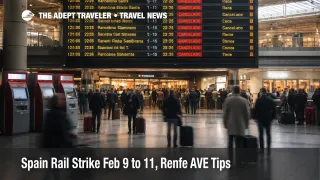
A nationwide rail strike in Spain is scheduled for Monday to Wednesday, February 9 to 11, 2026, with full day stoppages that can disrupt Renfe passenger trains and also pressure private operators on the same high demand corridors. Travelers are most exposed on AVE and other long distance routes that tourists use as flight alternatives, plus on commuter services that function as the feeder layer into major stations. The practical next step is to plan around the trains that will actually run under minimum service orders, and to treat any tight rail, flight, cruise, or tour connection during the window as high risk.
Minimum services do not mean your trip is safe. They mean a percentage of the timetable must operate, but the cancellations can cluster in ways that create long gaps on specific city pairs, and they can change your best backup option from rail to air or road within hours. If you want broader context on why multi day labor actions tend to fail at the connection level first, compare this update with Spain Rail Strike Feb 9 to 11 Hits Trains Nationwide and Western Europe Strike Spillover Risk For Airport Transfers.
Who Is Affected
Intercity travelers are the first group at risk, especially on the Madrid, Barcelona, Valencia, Seville, and Malaga corridors where most itineraries assume frequency will cover small timing mistakes. Under strike conditions, frequency becomes uneven, remaining trains fill faster, and a single cancellation can eliminate the buffer you expected to recover with the next departure.
Commuter and regional riders, including visitors, are the second group at risk because commuter rail is the quiet dependency behind many itineraries. When services drop to reduced levels, the failure mode is often not arriving late, it is failing to reach the correct station in time for a long distance departure. That is how travelers with an otherwise solid AVE plan can miss a paid seat reservation without ever having a problem on the high speed network itself.
Air travelers are also exposed, even if flights operate normally, because rail is a common access mode to airports in Spain's biggest cities. If you planned airport access on a specific commuter departure, reduced service increases missed flight risk at Adolfo Suárez Madrid Barajas Airport (MAD) and Josep Tarradellas Barcelona El Prat Airport (BCN), and it increases curbside congestion as more travelers switch to taxis, rideshares, and private transfers at the same time.
What Travelers Should Do
If your itinerary touches Spain rail on February 9, February 10, or February 11, build slack now while alternatives are still available. When you can, move rail travel outside the strike dates, and when you cannot, take an earlier train than you normally would, and add a buffer night near your departure city or station so a cancellation does not cascade into missed check ins, tours, or flights.
Use a clear decision threshold for rebooking versus waiting. If losing your planned train would cause you to miss the last practical connection of the day, miss cruise embarkation, miss a timed tour pickup, or miss an international flight on a separate ticket, switch modes or shift the day as soon as your operator shows your train is not running. If you can tolerate an overnight and you have flexible hotel cancellation terms, waiting for the operator's rebooking flow can be reasonable, but only if you are not chaining multiple rail legs where one break collapses the entire day.
Over the next 24 to 72 hours, monitor three things in parallel, your operator's strike update page, your booking specific notifications, and the minimum service lists that identify which trains will operate. For Renfe, that includes checking whether your exact train number remains scheduled under the minimum service plan, and using the no cost change or cancellation option if you prefer not to travel. For Ouigo, it includes confirming whether your specific departure is labeled as minimum service or canceled, because the published list can differ by day, route, and departure time.
Background
Rail disruption during a multi day strike propagates through the travel system in layers. The first order effect is direct capacity loss, fewer staffed departures, tighter dispatch windows, and fewer crew rosters that can be legally operated, which is why cancellations often concentrate on the busiest corridors rather than distributing evenly across the network. Spain's high speed and long distance services also run through shared infrastructure constraints, so operational headroom can tighten across multiple brands at the same time, even when the traveler experiences it as a single operator issue.
The second order ripple is substitution pressure. Passengers push onto the trains that remain, those trains become more fragile to small delays, and then overflow moves into parallel short haul flights, long distance buses, and one way rental cars. That reprices inventory quickly, and it tends to compress hotels near major stations as stranded travelers add unplanned nights close to where rebooking is easiest. The end state is that even when minimum services keep a large percentage of trains running, the trip can still fail for travelers who planned with narrow buffers, because the entire chain loses slack, and alternatives are consumed by others reacting to the same disruption.
Sources
- Sindicatos mantienen la huelga de trenes tras una tercera reunión con Transportes sin acuerdo (RTVE)
- Transportes fija servicios mínimos en la alta velocidad y Cercanías para los días de huelga de maquinistas (RTVE)
- Resolución de servicios mínimos Renfe 9, 10 y 11 de febrero de 2026 (Ministerio de Transportes y Movilidad Sostenible)
- Servicios mínimos para la huelga del 9, 10 y 11 de febrero (Renfe)
- Servicios mínimos huelga del sector ferroviario (Ouigo)
- Los sindicatos mantienen el paro ferroviario del 9 al 11 de febrero tras su tercera reunión con Puente (El País)