

American Airlines No Confidence Vote Raises Flight Risk
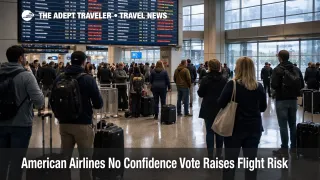
American Airlines' main flight attendants union says it has issued a unanimous vote of no confidence in CEO Robert Isom, escalating a widening labor pressure campaign that is now spilling into traveler planning. The Association of Professional Flight Attendants, APFA, said the move reflects frustration with operational performance and recovery execution following Winter Storm Fern. Travelers with American flights in the next several weeks should not assume an immediate schedule change from the vote itself, but should plan for tighter buffers and faster decision making the next time weather or system strain hits a major hub.
The American Airlines no confidence vote matters to travel because it is a signal that the carrier's recovery mechanics, staffing resilience, and customer support processes are under intensified internal scrutiny, right when winter disruption risk remains high.
Who Is Affected
The highest exposure group is anyone whose itinerary depends on a connection through an American hub, especially if the trip is built on minimum connection times, late day departures, or separate tickets. In irregular operations, hub banks break first, and that failure mode propagates outward: inbound flights are held for metered arrivals, aircraft miss turns, crews hit duty time limits, and downstream legs cancel in cities far from the original disruption.
Travelers with hard arrival windows face the most practical risk. Cruise embarkations, prepaid tours, weddings, medical appointments, conferences, and any trip where "arrive tomorrow" functionally means "miss the point of the trip" should treat this moment as a prompt to reduce single point failures. The union campaign is not a strike notice, but it raises the odds that the next disruption becomes a high visibility stress test for hotel sourcing, crew repositioning, call center capacity, and app based self rebooking, all at once.
For closely related context on how this leadership dispute is already intersecting with operational reliability concerns, see American Airlines Pilot Union Talks Raise Delay Risk.
What Travelers Should Do
Take immediate steps that reduce exposure to a late day spiral. If you have flexibility, shift onto earlier departures, choose longer connections than the published minimums, and avoid building a trip on the last flight of the night to a smaller destination where same day recovery seats may not exist. If you must connect, prioritize routings with multiple later fallback options, and keep essentials in a personal item in case an overnight becomes unavoidable.
Use a decision threshold for rebooking versus waiting that is based on arrival certainty, not optimism. If your first delay erases the buffer you built, or if your connection has no same day alternate, move early while inventory still exists. Waiting can be rational only when later flights are plentiful, you can tolerate a later arrival, and you are watching the hub wide picture, not just a single gate screen.
Over the next 24 to 72 hours before departure, monitor three layers: American's travel alerts and waiver rules, rolling hub level cancellations, and whether delays are clustering late day, which often indicates crews and aircraft are still out of position. Save screenshots, keep receipts, and write down a short timeline of what happened and when you sought help, because those details often determine whether you can recover costs through travel insurance, employer policy, or a carrier reimbursement request. For storm recovery mechanics that explain why "weather is over" can still mean "schedule is fragile," see Winter Storm Fern US Airline Recovery Risk at Hubs.
How It Works
A no confidence vote does not cancel flights, change aircraft assignments, or rewrite crew schedules on its own. What it does change is the context in which the next disruption is managed. Airlines run on tight coupling between aircraft positioning, crew legality rules, gate availability, and hotel capacity near hubs. When a large event such as Winter Storm Fern knocks that system off its planned rotation, the recovery phase becomes a logistics problem that depends on spare crews, available aircraft, and, critically, the ability to house and move crews so they can legally return to duty.
That is the first order layer: reduced airport throughput during the event, followed by scattered aircraft and crews that no longer match the published schedule. The second order ripple is where travelers feel the cost. Once cancellations spike, reaccommodation inventory collapses, hotel rooms around hubs compress, and even travelers far from the storm footprint get dragged in because their aircraft or crew was supposed to arrive from an affected node. In that environment, any weakness in customer support staffing, technology, or local station execution shows up quickly as long lines, inconsistent messaging, and missed connections that turn into forced overnights.
APFA's statement frames the vote as a response to a broader pattern, including the carrier's storm recovery, profitability comparisons, and strategic missteps that unions argue left less margin for error. Separately, American's pilots union has also escalated criticism and sought direct engagement with the board, reinforcing that multiple labor groups are now publicly questioning leadership and operational direction.