

CocoCay Pier Damage Limits Royal Caribbean Calls
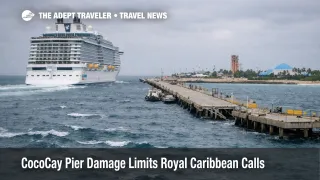
Storm damage at Royal Caribbean's Perfect Day at CocoCay in the Bahamas is still restricting docking to one ship at a time, a constraint that can force diversions when two ships are scheduled for the same day. Royal Caribbean told TravelPulse that adverse weather over January 30 to February 1 temporarily closed the destination, and that after assessments the eastern side of the pier was unavailable for docking, prompting itinerary adjustments even as operations resumed.
For travelers, the practical difference is capacity. Perfect Day at CocoCay is designed to handle high volumes quickly when both berths are usable. With one side out of service, the cruise line has to triage which ship keeps the private island call on double ship days, and the other ship may get an added sea day or a replacement port. Trade reporting has described catwalks on the east side falling into the water, leaving only the west berth operational, and it has cited recent examples of ships skipping scheduled calls during the disruption window.
Royal Caribbean has not published a firm date for when two berth operations will be restored, and public reporting has described the constraint as tied to clearing underwater hazards and completing safety work. That means the most useful mindset for this week is conditional planning: treat CocoCay as possible, not guaranteed, especially when multiple ships are slated to call.
Related: CocoCay Pier Docking Limits After Storm Damage and Related: CocoCay Pier Capacity Limits Hit Bahamas Cruises
Who Is Affected
The primary group is Royal Caribbean International and Celebrity Cruises guests on Bahamas and short Caribbean itineraries that include Perfect Day at CocoCay, particularly sailings where the private island is the trip's main value anchor. Travel Weekly specifically noted both Royal Caribbean and Celebrity impacts, including ships that skipped calls during the first week of February after the pier damage.
The next group is anyone sailing on a day when two ships are scheduled to be at CocoCay. Third party port schedule listings for February show multiple dates where two large Royal Caribbean ships appear on the same day, which is exactly the scenario where a one berth constraint can force a last minute decision. Even when your ship keeps the call, port hours can change, and the flow ashore can be managed more tightly than a normal day.
A third group is travelers with prepaid, CocoCay specific add ons such as waterpark admission, beach club access, cabanas, and excursions, plus anyone who booked independent plans that assume a specific dock time. When the port drops, cruise line sold items generally unwind more cleanly because the charge lives inside the cruise line system, while third party purchases often require you to document the cancellation and request a refund under that vendor's terms.
What Travelers Should Do
Take immediate actions that preserve options. Check the Royal Caribbean or Celebrity app in the morning and again in the evening for itinerary updates, then screenshot the itinerary page and any notices so you have a stable record if plans change again. If you booked independent excursions, beach services, or meetups that hinge on CocoCay, contact those vendors now, and ask what they require to process a refund if your ship is diverted, because many companies want notice before the day of service.
Use decision thresholds that match why you booked. If the private island day is the main reason you chose the sailing, and you have not departed yet, treat a one berth week as a meaningful risk signal, and price out rebooking to a sailing date with more buffer ports, or a longer itinerary where one dropped call hurts less. If you are already onboard, shift discretionary spend toward onboard experiences you control until your ship is clearly committed to the approach, since late changes are most painful when you have stacked nonrefundable third party plans on top of a port day.
Monitor a short list of signals over the next 24 to 72 hours. First, watch for any clear indication that CocoCay is back to two ship operations, because that is the switch that materially reduces triage risk. Second, watch whether your sailing day is a one ship or two ship day, because a one ship day has more margin even with a compromised pier. Third, keep an eye on weather and sea conditions around the northern Bahamas, since even a usable berth can become operationally unattractive in strong winds and swell, and weather driven conservatism often compounds infrastructure constraints.
If your stop is removed and you had cruise line purchased shore excursions, Royal Caribbean's policy is that canceled shore excursions are refunded to the onboard account. For travel protection claims, keep the screenshots, your updated invoice, and any written notice of the port change, because documentation quality often decides whether you get cash reimbursement versus a denial for insufficient proof.
How It Works
A private island call is unusually sensitive to single points of failure because so much depends on one interface, the pier. When one side of a two berth pier is unavailable, the first order effect is simple: the island can host fewer ships per day, and that forces the line to choose which ship keeps the call when schedules collide.
The second order ripple spreads across at least two other layers of the travel system. One layer is shore side capacity. When ships get pushed into substitute ports like Nassau or Freeport at short notice, tours, beach clubs, taxis, and simple walk up plans can sell out faster, and the day can feel more crowded and more expensive than the private island day you planned. Another layer is onboard behavior. A swapped sea day concentrates demand onto dining, pools, kids clubs, spa reservations, and guest services at the same time, and that compression can change the lived experience of the sailing even if the ship still returns to its homeport on schedule.
The most forward looking takeaway is that infrastructure constraints behave differently than a single bad weather day. A weather closure is often binary and short lived, but pier damage can create a rolling capacity problem that shows up repeatedly on two ship days until repairs are complete and the restricted side is reopened.