

Germany Strikes Hit Local Transport Feb 10 11
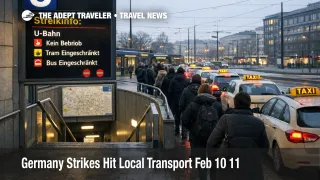
Strike actions across Germany widened into February 10 and 11, 2026, increasing the odds of localized gaps in city transport and public facing services. Travelers are most affected in large metro areas where the last mile to airports, main stations, and appointments depends on municipal systems that can be curtailed quickly. Even when flights and long distance rail remain broadly available, weakened feeder networks can turn a normal departure into a missed bag drop cutoff or a missed platform change, especially during the morning and late afternoon commute peaks.
The most practical change for travelers is that disruption is no longer confined to one service layer. This week's actions include public sector walkouts that can slow or close offices, schools, and some healthcare sites, alongside city transport strikes that can reduce U Bahn, tram, and bus availability in specific regions. That combination matters because it removes the easy fallbacks travelers use when one option fails, for example, taking a different tram line, handling a document errand at a different district office, or shifting an appointment to an earlier window on the same day.
For broader planning context on how transit strikes break airport and station transfers, see Germany Transit Strike Risk for City Travel Feb 9. For how multi country actions can stack and compress backup capacity, see Western Europe Strike Spillover Risk For Airport Transfers. If strike impacts spill into airport handling or flight operations later this month, traveler rights and rerouting logic are covered in Europe Airport Strikes: Compensation and Re-Routing Guide.
Who Is Affected
Travelers in North Rhine Westphalia are among the most exposed on February 10, because reporting indicates strike activity affecting schools, universities, government offices, and multiple university hospitals, including in cities that also serve as major rail and air gateways. This matters for visitors because it can disrupt both the mobility layer, getting across the city, and the problem solving layer, replacing documents, getting stamps, handling local registrations, or resolving time sensitive issues that are easy to underestimate until they block onward travel.
Berlin visitors face a different version of the problem on February 11, when public sector warning strikes can translate into restrictions or closures at daycare centers, schools, and district offices. For travelers, district office disruption is often the hidden risk, because it can affect appointments, administrative errands, and some services relied on by long stay visitors and relocating travelers. Even short stay travelers can be affected indirectly when hotel and venue staffing is thinner, or when local mobility demand spikes because parents and commuters shift routines.
Munich travelers should plan for a more classic transit strike failure mode on February 11, with Munich's transport operator MVG warning that U Bahn, tram, and bus services will be affected by strike action. MVG has also noted that S Bahn and regional buses are not expected to be affected, which can preserve some airport and regional connectivity, but it also concentrates demand onto fewer functioning corridors and can lengthen access times to the stations that still run.
Visitors moving between cities should also keep a mental firewall between municipal transport strikes and Deutsche Bahn's long distance network. Earlier in February, a large ver.di led public transport action disrupted buses and trams across many cities, while Deutsche Bahn's S Bahn and long distance services were described as continuing normally, a pattern that can mislead travelers into thinking the whole trip is safe when the first leg to reach the correct station is the part that fails.
What Travelers Should Do
Start by treating February 10 and 11 as transfer risk days, not just "strike news." If you must reach an airport or Hauptbahnhof by a specific time, build a buffer that can absorb an unexpected gap in local service, then add a second path that uses a different mode. A good structure is one rail based option plus one road based option, because two transit options can fail for the same reason, and two road options can fail if everyone pivots to taxis at once.
Use clear decision thresholds for rebooking versus waiting. If missing your departure would force an overnight stay, break a separate ticket connection, or cause you to lose a timed tour or cruise check in, do not gamble on partial service. Move the fragile segment earlier in the day, shift to a hotel closer to the airport or main station the night before, or pre arrange a car transfer with a pickup point on a main road that remains reachable even if local streets clog.
Monitor the right signals over the next 24 to 72 hours, and ignore the noise. The useful signals are your city operator's strike page, emergency timetable notices, and station service updates, plus any changes in the scope of actions tied to negotiations. The less useful signals are generic social posts that do not name the operator, the date window, and the affected modes. On the day of travel, check again early morning, then commit to your backup before the commute peak, because once queues build, switching modes becomes slower and more expensive.
Background
Germany's strike disruptions often propagate through the travel system in layers. The first order effect is reduced service or closures at the source, municipal transit, district offices, schools, hospitals, or other public services. The second order ripple shows up where travelers concentrate onto what still runs, typically S Bahn corridors, regional trains, and taxis, which drives platform crowding, longer curbside queues, and less predictable road travel times. That congestion then spills into missed rail to air connections, last minute hotel nights near airports and central stations, and tour disruptions when guides and staff cannot reposition.
This week's pattern is especially tricky because it is mixed mode. A traveler can see that flights are operating, or that a mainline rail timetable looks normal, then still lose the trip because the local access layer fails. That is why strike planning in Germany is less about one perfect route, and more about building redundancy into the approach to the terminal, the station, and any appointment you cannot easily reschedule.
Sources
- Which German public services are impacted by strikes this week?
- Warnstreik: Kliniken, Schulen, Nahverkehr - hier drohen Ausfälle
- Warning strikes in daycare centers, schools and government offices on Wednesday
- MVG to be affected by strike on Wednesday
- Tens of thousands of transport workers walk off job in Germany