

Kenya Airport Strike Notice Risks Nairobi Flights Feb 16
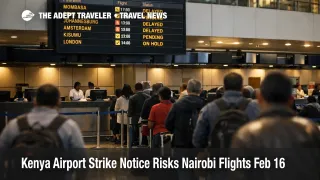
A formal strike clock is now running in Kenya's aviation system after the Kenya Aviation Workers Union delivered a seven day strike notice to the Kenya Civil Aviation Authority, warning of nationwide disruption if talks fail. The travelers most exposed are anyone transiting Nairobi, Kenya for safaris, regional hops across East Africa, or long haul routings that rely on Jomo Kenyatta International Airport (NBO) banks. The practical move is to treat next week as a planning window, add connection buffer, and lock in reroute options before seats tighten.
The Kenya airport strike notice matters because it turns a labor dispute into an actionable travel risk that can change schedules, break connections, and force overnight stays around Nairobi.
Who Is Affected
Travelers connecting through Jomo Kenyatta International Airport (NBO) are the most exposed, because Nairobi's banks are the hinge point for Kenya Airways and many regional carriers feeding safari gateways and neighboring capitals. If even one layer, such as air navigation services, technical operations support, or other KCAA staffed functions, slows down, the impact can show up as longer departure spacing, longer turn times, and missed departure slots that ripple across the day.
The earliest start date implied by the notice, and cited in local reporting, is Monday, February 16, 2026. Reuters reports the union's letter is dated February 9, 2026, and says unionisable KCAA employees would strike after the seven day period expires, while Kenyan outlets quoting KCAA and KAWU point to February 16 as the target date.
Participation levels are still the big unknown. Reuters notes it was not immediately clear how many workers would participate, and KCAA has said it is engaging the union, and that operations were not disrupted as of February 10, 2026. Travelers should plan around uncertainty rather than assume "no disruption" statements guarantee a normal day once the notice window ends.
If the strike goes live, the first order impact tends to be uneven airport processing and irregular flight operations, not a clean, predictable schedule reduction. When departures slip in Nairobi, the second order ripple often hits two layers fast: regional connections into smaller East Africa airports that have fewer daily frequencies, and hotel inventory in Nairobi when misconnects force overnight stays. A third layer can follow within 24 to 48 hours, aircraft and crews out of position, which can create cancellations on routes that were not initially the problem.
What Travelers Should Do
Start with immediate actions and buffers. If you have a tight connection through Nairobi next week, especially on February 16, build a larger margin than you normally would, and carry essentials for a forced overnight, including medication, chargers, and one change of clothes. If you are using separate tickets, treat them as unprotected, and consider rebooking into a single itinerary on one ticket, even if it costs more, because misconnect recovery is usually the worst when many passengers are rebooked at the same time.
Use a decision threshold for rebooking versus waiting. If missing your connection would break a safari start, a cruise, a wedding, a permit, or any fixed date event, rebook off Monday, February 16, 2026, now while there is still inventory, and prioritize routings with fewer moving parts. If your plans are flexible and you can absorb a one night slip, waiting can be rational, but only if you have a clear Plan B, such as an alternate hub connection or a confirmed Nairobi hotel hold you can cancel.
Over the next 24 to 72 hours, monitor three signals. First, whether KCAA and KAWU announce a settlement, a deferral, or a narrowed scope, because the difference between "threatened" and "confirmed" action changes airline waiver behavior. Second, whether airlines publish no fee change policies, because that is usually the cleanest way to move away from the riskiest day without buying a new ticket. Third, whether your carrier starts padding schedules or retiming flights through Nairobi, because that often appears before mass cancellations, and it is a practical hint that the operation expects friction.
For travelers comparing strike playbooks across regions, the mechanics are similar to other national aviation actions, even when the legal frameworks differ, see Italy Aviation Strike to Disrupt Flights Feb 16, 2026. For how multi sector action can turn airport access into a misconnect problem even when flights operate, see Belgium Strike Days Hit Brussels Airport Transfers Feb 10.
How It Works
A strike notice is not the same thing as a strike, but it changes traveler risk because airlines, airports, and controllers plan staffing, slot usage, and contingency rotations around the possibility of reduced service. When the threatened workgroups touch operational layers, even indirectly, the system can slow in ways that passengers feel as queues, longer taxi out waits, longer turnaround times, and missed connection windows.
This is how disruption propagates through the travel system. The first order effect is at the source, Nairobi processing and flight flow become less predictable, which can compress departure banks and cause late aircraft to arrive for their next leg. The second order ripple spreads into connections and downstream capacity, because a delayed inbound can break protected connections, and because fewer operating seats concentrate demand into the remaining flights. A third ripple often lands in ground logistics, hotel nights in Nairobi, transfer rescheduling, and tighter inventory on alternates via Addis Ababa and Gulf hubs once rebooking surges.